Georgia (Country) – History, Culture, Sports and Fascinating Facts
Discover Georgia (country), its rich history, unique culture, famous sports, traditions, geography, economy and interesting facts in this informative overview.
Georgia
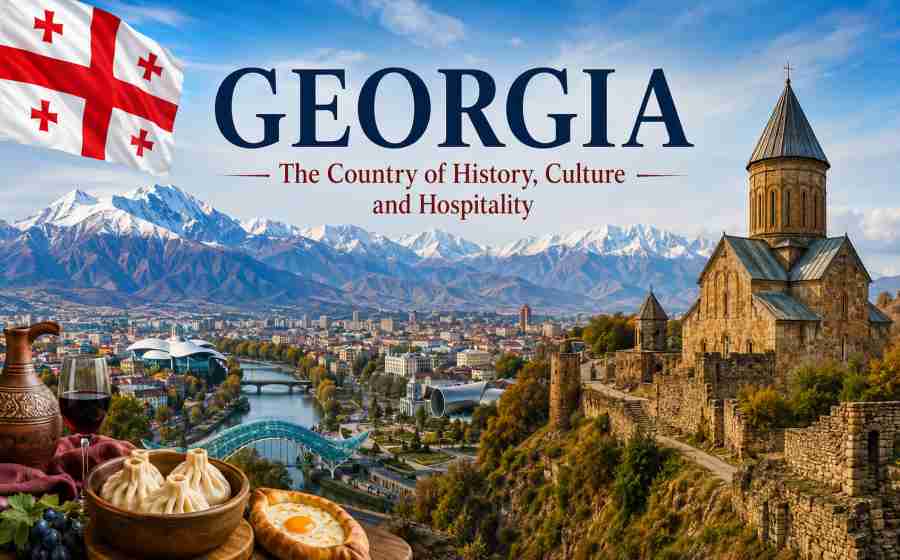
Georgia is a beautiful country located at the crossroads of Eastern Europe and Western Asia in the Caucasus region. Despite its relatively small size, Georgia has a rich history spanning thousands of years. The country is famous for its breathtaking mountains, ancient churches, traditional music, delicious cuisine, and warm hospitality. Georgia has played an important role in connecting Europe and Asia through trade, culture, and diplomacy.
Today, Georgia is an independent democratic nation known for its growing tourism industry, unique traditions, and cultural heritage. Its capital city, Tbilisi, is one of the oldest continuously inhabited cities in the world and serves as the country’s political, economic, and cultural center.
Table of Contents
Location and Geography
Georgia shares borders with Russia to the north, Turkey and Armenia to the south, Azerbaijan to the southeast, and the Black Sea to the west. The country’s strategic location has made it a meeting point for different civilizations throughout history.
The landscape of Georgia is remarkably diverse. The Greater Caucasus Mountains dominate the northern part of the country, while fertile valleys, forests, rivers, and coastal plains cover other regions. The highest mountain in Georgia is Mount Shkhara, standing at approximately 5,193 meters (17,037 feet).
Georgia experiences a variety of climates, from humid subtropical weather near the Black Sea to alpine conditions in the mountain regions.
Capital and Major Cities
- Capital: Tbilisi
- Major Cities:
- Batumi
- Kutaisi
- Rustavi
- Gori
- Zugdidi
Tbilisi is famous for its colorful architecture, historic churches, sulfur baths, and lively cultural atmosphere.
Brief History
Georgia has one of the world’s oldest civilizations. Archaeological discoveries suggest human settlement dating back thousands of years.
Ancient Kingdoms
The ancient kingdoms of Colchis and Iberia were established in the region. Colchis became famous in Greek mythology as the destination of Jason and the Argonauts in search of the Golden Fleece.
Christianity
Georgia became one of the earliest countries to officially adopt Christianity as its state religion around AD 337, making it one of the oldest Christian nations in the world.
Medieval Golden Age
The country’s greatest period came during the reign of Queen Tamar in the 12th and 13th centuries. Under her leadership, Georgia expanded its territory and became a powerful cultural and political center.
Foreign Rule
Over the centuries, Georgia experienced invasions by Persians, Mongols, Ottomans, and Russians. In the early 19th century, much of Georgia became part of the Russian Empire.
Soviet Era
Following the Russian Revolution, Georgia briefly gained independence in 1918 before becoming part of the Soviet Union in 1921.
Modern Independence
Georgia regained independence on 9 April 1991 after the collapse of the Soviet Union. Since then, it has worked to strengthen democracy, modernize its economy, and build closer ties with Europe and the international community.
Government
Georgia is a unitary parliamentary republic.
- Capital: Tbilisi
- Official Language: Georgian
- Currency: Georgian Lari (GEL)
- National Flag: Five-cross flag
- National Day: Independence Day (26 May)
Population
Georgia has a population of approximately 3.7 million people.
Most people belong to the Georgian ethnic group, while Armenians, Azerbaijanis, Russians, and several smaller communities also live in the country.
Language
The official language is Georgian, one of the oldest living languages in the world.
The Georgian language uses its own unique writing system called the Georgian script, which is considered one of the world’s most distinctive alphabets.
Religion
The majority of Georgians belong to the Georgian Orthodox Church, which has played an important role in preserving the country’s culture and traditions.
There are also Muslim, Armenian Apostolic, Catholic, and Jewish communities.
Economy
Georgia has transformed its economy significantly since independence.
Major sectors include:
- Tourism
- Agriculture
- Wine production
- Hydropower
- Trade
- Mining
- Information technology
Georgia is recognized for its business-friendly environment and improving infrastructure.
Agriculture
Agriculture remains important to Georgia’s economy.
Major agricultural products include:
- Grapes
- Hazelnuts
- Citrus fruits
- Tea
- Wheat
- Corn
- Vegetables
Georgia is widely considered one of the birthplaces of wine, with a winemaking tradition dating back over 8,000 years.
Culture
Georgia has one of the richest cultural traditions in the Caucasus.
Important cultural features include:
- Traditional polyphonic singing
- Folk dances
- Colorful festivals
- Ancient churches
- Hospitality
- Handmade crafts
Georgian hospitality is famous worldwide, and guests are traditionally treated with great respect.
Traditional Food
Georgian cuisine is flavorful and unique.
Popular dishes include:
- Khachapuri (cheese-filled bread)
- Khinkali (dumplings)
- Lobio (bean stew)
- Mtsvadi (barbecue)
- Churchkhela (traditional sweet)
- Pkhali (vegetable dish)
Traditional feasts known as Supras are an important part of Georgian culture.
Music and Dance
Georgian folk music is internationally admired for its polyphonic singing, recognized by UNESCO as an important cultural tradition.
Traditional dances feature energetic jumps, graceful movements, and elaborate costumes.
Tourism
Georgia has become one of Europe’s fastest-growing tourist destinations.
Popular attractions include:
- Tbilisi Old Town
- Kazbegi National Park
- Batumi Black Sea Coast
- Uplistsikhe Cave Town
- Gelati Monastery
- Svaneti mountain villages
Visitors enjoy hiking, skiing, historical monuments, wine tours, and cultural festivals.
Sports
Sports play an important role in Georgian society.
Popular sports include:
- Rugby Union
- Football
- Wrestling
- Judo
- Weightlifting
- Basketball
- Chess
Georgia is internationally respected for producing world-class wrestlers and judokas.
The national rugby team is among Europe’s strongest outside the traditional Six Nations countries.
Education
Georgia has a high literacy rate.
Its universities attract students from many countries, particularly in medicine and engineering.
The government continues investing in education, digital learning, and scientific research.
Wildlife
Georgia’s varied geography supports diverse wildlife.
Animals found in Georgia include:
- Brown bears
- Wolves
- Lynx
- Wild goats
- Eagles
- Falcons
Protected national parks help conserve biodiversity.
Interesting Facts About Georgia
- Georgia is among the oldest wine-producing countries in the world.
- The Georgian alphabet is unique and unlike any other writing system.
- Tbilisi is over 1,500 years old.
- Queen Tamar is remembered as one of Georgia’s greatest rulers.
- The Caucasus Mountains contain some of Europe’s highest peaks.
- Georgian hospitality is a central part of national identity.
- Polyphonic singing is recognized by UNESCO.
- The country has numerous medieval monasteries and churches.
- Georgia connects Europe and Asia through trade and transportation.
- Tourism has become one of the country’s fastest-growing industries.
Summary
Georgia is a nation where ancient traditions blend harmoniously with modern development. Its remarkable history, spectacular mountain landscapes, rich cultural heritage, unique language, and centuries-old winemaking traditions make it one of the world’s most fascinating countries. From the historic streets of Tbilisi to the snow-covered Caucasus Mountains and the Black Sea coast, Georgia offers a unique combination of natural beauty and cultural richness. As the country continues to grow economically while preserving its heritage, Georgia remains an important bridge between Europe and Asia and an attractive destination for travelers, historians, and students of world cultures.
Also Check: General Knowledge