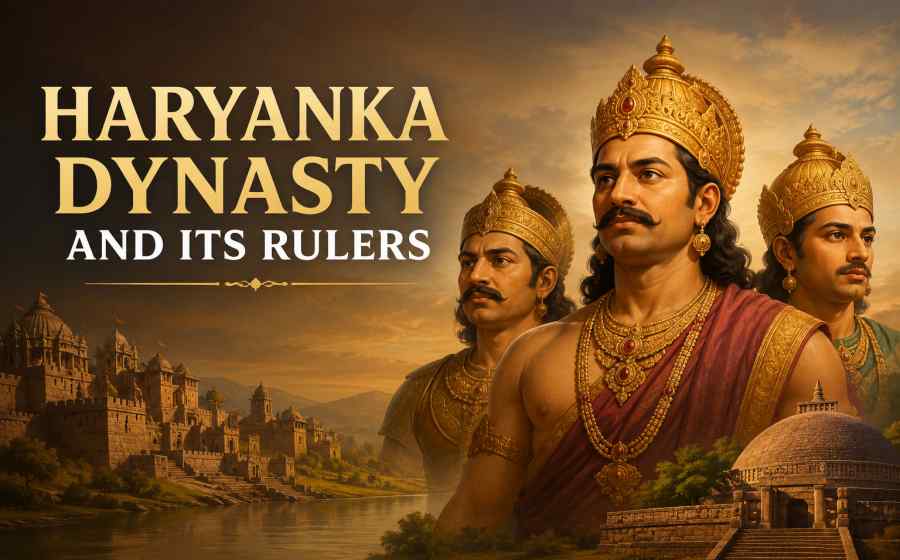
Haryanka Dynasty and Its Rulers – The Foundation of Magadha’s Rise to Power
Explore the Haryanka Dynasty and its rulers, including Bimbisara and Udayin. Learn about their achievements, expansion of Magadha and historical significance.
Haryanka Dynasty and Its Rulers
The Haryanka Dynasty was the first major imperial dynasty of the ancient kingdom of Magadha, located in present-day Bihar, India. It played a crucial role in transforming Magadha into one of the most powerful kingdoms of ancient India. The dynasty laid the political, military, and administrative foundations that later enabled the rise of the Nanda and Maurya Empires. The Haryanka rulers expanded their territory through diplomacy, warfare, and efficient governance, making Magadha the center of political power in northern India.
The Haryanka Dynasty ruled during the 6th and 5th centuries BCE, a period marked by the emergence of sixteen powerful states known as the Mahajanapadas. During this time, important religious movements such as Buddhism and Jainism also flourished. The rulers of this dynasty maintained close connections with these religions and supported spiritual leaders like Gautama Buddha and Mahavira.
Table of Contents
Origin of the Haryanka Dynasty
The Haryanka Dynasty is considered the earliest historically significant ruling family of Magadha. Before its rise, Magadha was one of the sixteen Mahajanapadas but was not the dominant kingdom in northern India. Through strong leadership and military expansion, the Haryanka rulers gradually established Magadha as the leading political power.
Although historians differ on the exact origin of the dynasty, it is generally believed that it began around 544 BCE with the accession of King Bimbisara.
Major Rulers of the Haryanka Dynasty
1. Bimbisara (c. 544–492 BCE)
Bimbisara was the founder and greatest early ruler of the Haryanka Dynasty. He ascended the throne at a young age and ruled for nearly five decades. His reign marked the beginning of Magadha’s transformation into a powerful kingdom.
Major Achievements
- Expanded Magadha by conquering the kingdom of Anga, whose capital was Champa.
- Strengthened diplomatic ties through strategic marriages with royal families of Kosala, Lichchhavi, and Madra.
- Developed an efficient administrative system for governing the expanding kingdom.
- Established Rajagriha (Rajgir) as the capital and strengthened its fortifications.
- Encouraged trade and economic development by improving communication routes.
- Maintained peaceful relations with neighboring kingdoms whenever possible.
Religious Contributions
Bimbisara was a contemporary of both Gautama Buddha and Mahavira. According to Buddhist traditions, he became an important patron of Buddhism and donated the famous Veluvana Monastery to Buddha and his followers. He also respected Jain teachings and supported religious tolerance.
2. Ajatashatru (c. 492–460 BCE)
Ajatashatru was the son of Bimbisara and succeeded him after a controversial struggle for the throne. Despite the tragic circumstances of his accession, he proved to be one of the strongest military rulers of ancient India.
Major Achievements
- Defeated the powerful Lichchhavi Confederacy after a prolonged war.
- Expanded Magadha’s territory significantly.
- Strengthened the kingdom’s military with advanced weapons such as the Rathamusala (chariot with maces) and Mahashilakantaka (stone-throwing war machine).
- Fortified Pataligrama, which later developed into the famous city of Pataliputra.
- Continued administrative reforms and increased the kingdom’s military strength.
Religious Contributions
Ajatashatru later became a supporter of Buddhism and participated in the First Buddhist Council, held shortly after Buddha’s death at Rajagriha. He also respected Jain monks and religious scholars.
3. Udayin (c. 460–440 BCE)
Udayin, also known as Udayabhadra, succeeded Ajatashatru and is remembered primarily for shifting the capital.
Major Achievements
- Founded Pataliputra at the strategic confluence of the Ganga and Son rivers.
- Shifted the capital from Rajagriha to Pataliputra.
- Improved the administrative efficiency of Magadha.
- Enhanced the kingdom’s trade due to the new capital’s favorable geographical location.
The establishment of Pataliputra proved to be one of the most important political decisions in Indian history. It later became the capital of the Nanda, Maurya, Gupta, and several other powerful empires.
Later Haryanka Rulers
After Udayin, several rulers governed Magadha for relatively short periods.
Anuruddha
Very little reliable historical information is available regarding his reign. It is generally believed that he continued the existing administration without major territorial expansion.
Munda
Munda ruled for a brief period and maintained the stability of the kingdom, though no major military achievements are associated with his reign.
Nagadasaka
Nagadasaka was the last ruler of the Haryanka Dynasty. His rule became unpopular due to weak administration and dissatisfaction among the people and nobles. Eventually, he was overthrown by his minister Shishunaga, who founded the Shishunaga Dynasty around 413 BCE.
Administration of the Haryanka Dynasty
The Haryanka rulers established a well-organized administrative system that strengthened Magadha.
Key administrative features included:
- Strong centralized monarchy.
- Efficient collection of taxes.
- Appointment of ministers and provincial officials.
- Maintenance of a disciplined standing army.
- Development of roads and trade routes.
- Construction of forts and defensive structures.
- Promotion of agriculture and commerce.
This administrative framework became the model for later Magadhan empires.
Military Strength
The Haryanka Dynasty significantly expanded its military capabilities.
Important features included:
- Large infantry force.
- Powerful cavalry.
- War elephants.
- Chariots equipped with advanced weapons.
- Fortified cities and defensive walls.
- Innovative siege warfare techniques.
These military improvements enabled Magadha to defeat rival Mahajanapadas and emerge as the dominant regional power.
Economic Development
Economic prosperity was one of the greatest strengths of the Haryanka Dynasty.
Major economic factors included:
- Fertile plains along the Ganga River.
- Rich iron ore deposits in nearby regions.
- Flourishing agriculture.
- Growth of internal and external trade.
- Strategic location connecting eastern and northern India.
- Development of important commercial centers such as Rajagriha and Pataliputra.
These advantages greatly increased the wealth of Magadha.
Religious Importance
The Haryanka period coincided with the rise of two major religions:
- Buddhism
- Jainism
Both religions received encouragement from various Haryanka rulers. Their support helped spread these faiths across northern India. Religious discussions, monasteries, and councils became prominent during this era.
Decline of the Haryanka Dynasty
Several factors contributed to the decline of the dynasty:
- Weak leadership after Udayin.
- Frequent succession disputes.
- Internal political instability.
- Growing dissatisfaction among nobles and ministers.
- Reduced military effectiveness.
These weaknesses allowed Shishunaga to overthrow the last Haryanka ruler and establish a new dynasty.
Legacy of the Haryanka Dynasty
The Haryanka Dynasty occupies a significant place in Indian history because it transformed Magadha from a regional kingdom into a major political power. The administrative systems, military organization, diplomatic strategies, and urban development initiated by its rulers paved the way for later empires.
The foundation of Pataliputra, expansion of Magadha, support for Buddhism and Jainism, and efficient governance remain the dynasty’s greatest contributions. Without the achievements of rulers such as Bimbisara, Ajatashatru, and Udayin, the later rise of the Nanda and Maurya Empires might not have been possible.
Summary
The Haryanka Dynasty marked the beginning of Magadha’s journey toward becoming the greatest empire of ancient India. Through visionary rulers like Bimbisara, Ajatashatru, and Udayin, the dynasty expanded its territory, strengthened administration, promoted trade, and supported religious movements that shaped Indian civilization. Although the dynasty eventually declined, its political innovations and enduring legacy continued to influence Indian history for centuries, making it one of the most important dynasties in ancient India.
Also Check: Bihar GK