
Hungary – History, Culture, Sports, Tourism and Fascinating Facts
Discover Hungary’s rich history, vibrant culture, famous sports, beautiful cities, traditional cuisine, economy, geography and fascinating key facts.
Hungary
Hungary is a beautiful landlocked country located in Central Europe. It is known for its rich history, magnificent architecture, thermal baths, classical music, delicious cuisine, and world-famous athletes. Although Hungary is not one of Europe’s largest countries, it has made significant contributions to science, literature, sports, and culture. The capital city, Budapest, is often called the “Pearl of the Danube” because of its stunning beauty and historical landmarks.
Today, Hungary is a modern European nation and a member of the European Union. It attracts millions of tourists every year with its castles, historic towns, natural landscapes, and unique traditions.
Table of Contents
Location and Geography
Hungary is situated in Central Europe and shares borders with Austria, Slovakia, Ukraine, Romania, Serbia, Croatia, and Slovenia. It covers an area of approximately 93,030 square kilometers.
The country has mostly flat plains, especially the Great Hungarian Plain, while hills and low mountains are found in the northern region. The Danube River, one of Europe’s longest rivers, flows through Hungary and divides Budapest into two parts, Buda and Pest. Hungary experiences a continental climate with warm summers and cold winters.
Capital and Major Cities
- Capital: Budapest
- Other Major Cities: Debrecen, Szeged, Miskolc, Pécs, Győr, and Kecskemét
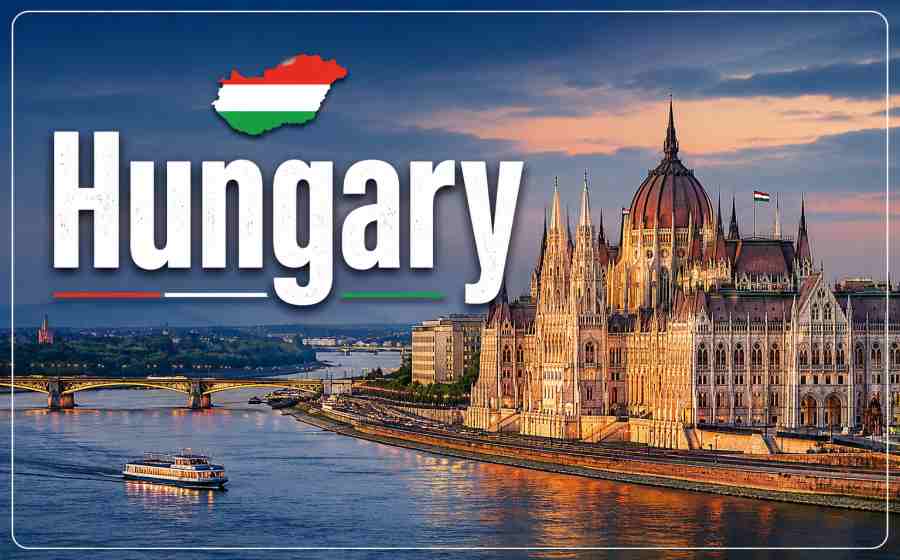
Budapest is the country’s political, cultural, and economic center. It is famous for its Parliament Building, Chain Bridge, Buda Castle, thermal baths, and scenic Danube riverfront.
Brief History
Hungary’s history dates back over a thousand years. The Magyar tribes settled in the Carpathian Basin around 895 AD, laying the foundation for the Hungarian state. In 1000 AD, Stephen I became Hungary’s first king and established Christianity as the nation’s official religion.
During the Middle Ages, Hungary became one of Europe’s strongest kingdoms. However, the country later faced invasions by the Mongols and the Ottoman Turks. For nearly 150 years, much of Hungary remained under Ottoman rule.
In the late 17th century, Hungary became part of the Habsburg Empire. Later, in 1867, the Austro-Hungarian Empire was established, making Hungary one of Europe’s major powers.
After World War I, Hungary lost a significant portion of its territory through the Treaty of Trianon. Following World War II, Hungary became a communist state under Soviet influence. In 1989, Hungary peacefully transitioned to democracy, and in 2004, it joined the European Union.
Government and Political System
Hungary is a parliamentary republic.
- Capital: Budapest
- President: Head of State
- Prime Minister: Head of Government
- Legislature: National Assembly
The country follows a democratic system with regular elections.
Population and Language
Hungary has a population of around 9.5 million people. The official language is Hungarian (Magyar), which belongs to the Finno-Ugric language family and is quite different from most European languages.
English and German are commonly spoken in tourist areas and among younger generations.
Culture and Traditions
Hungarian culture is a fascinating blend of Eastern and Western influences. Traditional folk music, colorful embroidery, dance festivals, and handcrafted pottery remain important parts of Hungarian life. Family values, hospitality, and respect for traditions are deeply rooted in society.
Hungarians celebrate several national festivals throughout the year, including:
- National Day (15 March)
- State Foundation Day (20 August)
- Revolution Memorial Day (23 October)
- Christmas and Easter
Traditional folk costumes are still worn during cultural festivals and village celebrations.
Hungarian Cuisine
Hungarian cuisine is famous for its rich flavors and generous use of paprika. Popular dishes include:
- Goulash
- Chicken Paprikash
- Fisherman’s Soup
- Stuffed Cabbage
- Lángos
- Chimney Cake (Kürtőskalács)
Hungary is also well known for its wines, particularly those produced in the Tokaj wine region.
Religion
Christianity is the dominant religion in Hungary.
Major religious communities include:
- Roman Catholic
- Protestant (Calvinist and Lutheran)
- Greek Catholic
- Jewish community
- Other minority religions
Religious freedom is protected by law.
Economy
Hungary has a diversified and export-oriented economy.
Major industries include:
- Automobile manufacturing
- Electronics
- Pharmaceuticals
- Food processing
- Tourism
- Agriculture
- Information technology
Important agricultural products include wheat, corn, sunflower, grapes, and livestock. Tourism plays a vital role in the economy, especially in Budapest and around Lake Balaton.
Education
Hungary has a well-developed education system. School education is compulsory for children, and the country is home to several prestigious universities, including:
- Eötvös Loránd University
- University of Debrecen
- University of Szeged
- Budapest University of Technology and Economics
Hungarian universities attract many international students every year.
Sports in Hungary
Sports have always been an important part of Hungarian society. Hungary has achieved remarkable success in Olympic competitions, particularly in:
- Swimming
- Canoeing
- Water Polo
- Fencing
- Wrestling
- Athletics
Football remains the most popular sport among fans. Hungary has also produced several world-class swimmers and Olympic champions. The country regularly hosts international sporting events and continues to invest in sports infrastructure.
Tourism
Hungary offers many attractions for visitors. Popular tourist destinations include:
- Budapest Parliament Building
- Buda Castle
- Fisherman’s Bastion
- Chain Bridge
- Lake Balaton
- Hortobágy National Park
- Thermal Baths
- Tokaj Wine Region
Hungary is famous for having hundreds of natural thermal springs, making it one of Europe’s leading spa destinations.
Science and Innovation
Hungary has produced many internationally recognized scientists and inventors. Hungarian researchers have contributed to mathematics, physics, medicine, chemistry, and computer science. Several Nobel Prize winners have Hungarian roots, reflecting the country’s strong academic tradition.
Wildlife and Nature
Hungary has numerous protected national parks, wetlands, forests, and grasslands. Common wildlife includes:
- Red deer
- Wild boar
- Foxes
- Eagles
- Storks
- Otters
The Hortobágy National Park is a UNESCO World Heritage Site and is famous for its vast grasslands and unique biodiversity.
Interesting Facts About Hungary
- Hungary’s Parliament Building is one of Europe’s largest parliamentary buildings.
- Budapest is famous for its historic thermal baths.
- The Rubik’s Cube was invented by Hungarian architect Ernő Rubik.
- Hungary has won more Olympic medals per capita than many larger nations.
- Lake Balaton is the largest freshwater lake in Central Europe.
- Hungarian is one of the most unique languages in Europe.
- The Danube River divides Budapest into Buda and Pest.
- Hungary has more than a thousand natural thermal springs.
- Tokaj is one of the world’s oldest officially recognized wine regions.
- Hungary is renowned for its classical music and folk traditions.
Summary
Hungary is a nation where ancient traditions blend harmoniously with modern development. From the founding of the Hungarian Kingdom over a thousand years ago to its role as a modern member of the European Union, the country has built a remarkable legacy. Its impressive architecture, vibrant cultural heritage, delicious cuisine, sporting excellence, scientific achievements, and breathtaking landscapes make Hungary one of Central Europe’s most fascinating destinations. Whether exploring the historic streets of Budapest, relaxing in its famous thermal baths, or learning about its unique language and traditions, Hungary offers a rich and memorable experience for students, travelers, and anyone interested in world geography and general knowledge.
Also Check: General Knowledge