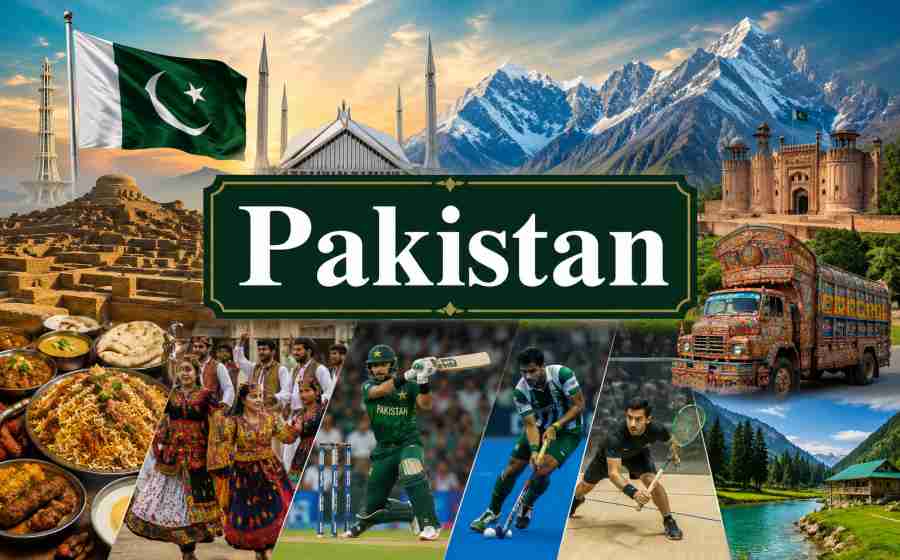
Pakistan – History, Culture, Sports, Nation’s Heritage and Key Facts
Explore Pakistan’s history, culture, sports, geography and key facts while discovering the rich heritage and unique identity of the nation.
Pakistan
Pakistan is a South Asian country known for its rich history, diverse culture, breathtaking landscapes, and passionate love for sports. Since gaining independence in 1947, Pakistan has played an important role in regional politics, literature, science, and international sports. From the ancient civilization of the Indus Valley to modern-day achievements, the country possesses a unique blend of tradition and progress.
Table of Contents
History of Pakistan
The region that now forms Pakistan has been home to some of the world’s oldest civilizations. The Indus Valley Civilization, which flourished around 2500 BCE in cities such as Mohenjo-daro and Harappa, is considered one of the earliest urban societies in human history. Over the centuries, the area witnessed the rise and fall of numerous empires, including the Persian Empire, the Mauryan Empire, the Delhi Sultanate, and the Mughal Empire.
These dynasties significantly influenced the region’s architecture, language, administration, and culture. The modern state of Pakistan came into existence on 14 August 1947, following the partition of British India. The movement for a separate homeland for Muslims of the Indian subcontinent was led by Muhammad Ali Jinnah, who is honored as the founder of Pakistan and is often referred to as “Quaid-e-Azam,” meaning “Great Leader.”
Since independence, Pakistan has experienced political transitions, economic challenges, and periods of military and civilian governance while continuing to shape its national identity.
Geography and Natural Features
Pakistan occupies a strategic location in South Asia. It shares borders with India, Afghanistan, Iran, and China, while its southern edge meets the Arabian Sea.
The country’s geography is remarkably diverse and includes:
- Fertile plains of Punjab.
- The deserts of Sindh and Balochistan.
- Mountain ranges such as the Himalayas, Karakoram, and Hindu Kush.
- Coastal areas along the Arabian Sea.
Pakistan is home to K2, the second-highest mountain in the world, making it a popular destination for mountaineers and adventure enthusiasts.
The Indus River, one of Asia’s longest rivers, serves as a lifeline for agriculture and supports millions of people across the country.
Culture of Pakistan
Pakistan’s culture reflects influences from Central Asia, South Asia, and the Middle East. Despite regional diversity, strong family values and hospitality remain central to Pakistani society.
Languages
Urdu is the national language, while English is widely used in education, government, and business. Several regional languages are also spoken, including:
- Punjabi
- Sindhi
- Pashto
- Balochi
- Saraiki
Traditional Dress
The shalwar kameez is the national dress and is worn by both men and women throughout the country. Regional embroidery styles and fabrics add distinct cultural identities.
Festivals and Celebrations
Major celebrations include:
- Eid-ul-Fitr
- Eid-ul-Adha
- Independence Day (14 August)
- Cultural festivals showcasing local music, crafts, and traditions
Music and Arts
Pakistan has a vibrant artistic tradition. Classical music, folk performances, qawwali, and contemporary pop music continue to attract audiences both domestically and internationally.
Handicrafts such as pottery, truck art, embroidery, and carpet weaving also represent the country’s creative heritage.
Pakistani Cuisine
Pakistani food is famous for its rich flavors and aromatic spices. Meals often emphasize hospitality and communal dining.
Popular dishes include:
- Biryani
- Nihari
- Haleem
- Karahi
- Seekh kebabs
- Chapli kebabs
- Saag with makki ki roti
Traditional desserts such as gulab jamun, kheer, and jalebi are also widely enjoyed.
Tea, locally known as “chai,” holds a special place in everyday social interactions.
Sports in Pakistan
Sports occupy an important position in Pakistani society and unite people across different regions.
Cricket
Cricket is by far the most popular sport in Pakistan. The national team has achieved significant milestones, including:
- Winning the 1992 Cricket World Cup.
- Winning the 2009 ICC T20 World Cup.
- Winning the 2017 ICC Champions Trophy.
Legendary players such as Imran Khan, Wasim Akram, Waqar Younis, Javed Miandad, and many modern stars have contributed to Pakistan’s cricketing legacy.
Hockey
Field hockey is Pakistan’s national sport. The country has a proud history in the game, having won multiple Olympic medals and Hockey World Cup titles.
Other Popular Sports
Other sports gaining popularity include:
- Football
- Squash
- Badminton
- Wrestling
- Kabaddi
Pakistan has produced world-class squash champions who dominated international competitions for many years.
Economy and Major Industries
Pakistan’s economy is supported by agriculture, manufacturing, and services.
Major industries include:
- Textile production
- Agriculture
- Information technology
- Pharmaceuticals
- Sports goods manufacturing
- Leather products
The country is among the leading producers of cotton and rice, while its sports equipment industry has earned international recognition.
Education and Scientific Contributions
Pakistan has made notable contributions in education and science. Universities across the country continue to expand opportunities for higher learning and research.
Pakistani scientists, engineers, and medical professionals have contributed significantly in various fields, enhancing the country’s presence on the global stage. Efforts to improve literacy and educational access remain important national priorities.
Key Facts About Pakistan
- Official Name: Islamic Republic of Pakistan
- Capital: Islamabad
- Largest City: Karachi
- Independence Day: 14 August 1947
- National Language: Urdu
- Official Languages: Urdu and English
- Currency: Pakistani Rupee (PKR)
- National Sport: Field Hockey
- National Animal: Markhor
- National Flower: Jasmine
- Time Zone: Pakistan Standard Time (PST)
Summary
Pakistan is a nation shaped by ancient civilizations, cultural diversity, and enduring resilience. Its historical heritage, flavorful cuisine, artistic traditions, and sporting achievements contribute to its distinct identity. From the towering peaks of K2 to the bustling streets of Karachi, Pakistan offers a fascinating blend of history and modernity. Understanding its people, traditions, and accomplishments provides valuable insight into one of South Asia’s most dynamic countries.
Also Check: General Knowledge