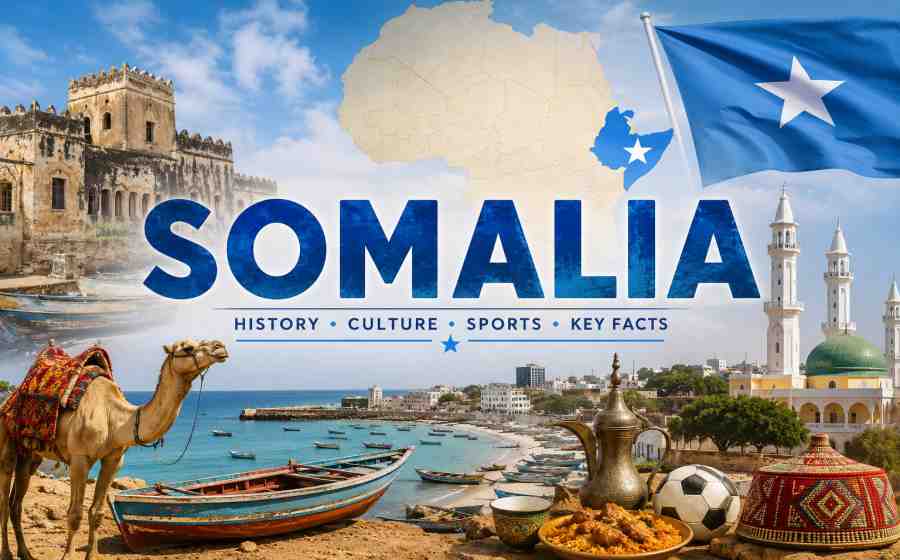
Somalia – History, Culture, Sports and Fascinating Facts About the Horn of Africa
Explore Somalia’s history, culture, sports, geography, economy and key facts. Learn about this unique Horn of Africa nation and its rich heritage.
Somalia
Somalia is a country located in the Horn of Africa on the eastern coast of the African continent. Known for its long coastline, rich cultural traditions, and strategic location along important maritime routes, Somalia has a fascinating history that stretches back thousands of years. Despite facing political and economic challenges over the decades, the country remains proud of its heritage, traditions, and resilient people.
Table of Contents
Geography of Somalia
Somalia is situated in East Africa and shares borders with Ethiopia, Kenya, and Djibouti. It also has the longest coastline on mainland Africa, stretching along the Indian Ocean and the Gulf of Aden.
- Capital: Mogadishu
- Largest City: Mogadishu
- Official Languages: Somali and Arabic
- Currency: Somali Shilling (SOS)
- Area: Approximately 637,657 square kilometers
- Population: Around 19 million (estimated)
The country’s landscape consists of plateaus, plains, semi-arid regions, and coastal areas. Due to its climate, Somalia experiences hot temperatures throughout most of the year, with limited rainfall in many regions.
History of Somalia
Somalia has a rich and ancient history. The region was an important center of trade connecting Africa, the Middle East, and Asia. Ancient Somali merchants traded valuable goods such as incense, spices, gold, and livestock with civilizations including Egypt, Persia, India, and Rome.
During the medieval period, several powerful Somali kingdoms and sultanates emerged. These included the Ajuran Sultanate and the Adal Sultanate, which played significant roles in regional politics and commerce.
In the late 19th century, European colonial powers divided Somalia. Britain controlled the northern region, while Italy ruled much of the south. After decades of colonial administration, Somalia gained independence in 1960 when British Somaliland and Italian Somaliland united to form the Somali Republic.
Following independence, Somalia experienced periods of political instability, military rule, and civil conflict. In recent years, efforts have been made to strengthen governance, improve security, and rebuild national institutions.
Somali Culture and Traditions
Somalia possesses a vibrant and deeply rooted culture influenced by African, Arab, and Islamic traditions. Family, hospitality, and community values remain central to Somali society.
Language and Literature
The Somali language is one of the most important aspects of national identity. Somalia has a rich oral tradition that includes poetry, storytelling, proverbs, and songs. Somali poetry is highly respected and often used to express social, political, and cultural ideas.
Religion
Islam is the dominant religion in Somalia, and the vast majority of the population follows Sunni Islam. Religious practices and values play a major role in everyday life, influencing customs, celebrations, and social norms.
Traditional Clothing
Somali clothing reflects both cultural heritage and practical adaptation to the climate.
Common traditional attire includes:
- Men: Macawiis (a sarong-like garment) and light shirts.
- Women: Dirac, colorful dresses, and hijabs.
Traditional clothing is often worn during festivals, weddings, and cultural events.
Somali Cuisine
Somali food combines African, Middle Eastern, and Indian influences.
Popular dishes include:
- Bariis (spiced rice)
- Canjeero (Somali flatbread)
- Suqaar (stir-fried meat)
- Sambusas
- Camel meat dishes
- Fresh seafood along coastal regions
Tea flavored with spices is a popular beverage enjoyed throughout the country.
Economy of Somalia
Agriculture and livestock are major pillars of Somalia’s economy. Many Somali families depend on pastoralism, raising camels, goats, sheep, and cattle.
Key economic sectors include:
- Livestock exports
- Agriculture
- Fishing
- Telecommunications
- Trade and transportation
Somalia’s location along major shipping routes gives it significant economic potential. The country’s long coastline also provides opportunities for fishing and maritime trade.
Education in Somalia
Education has been an important focus of reconstruction efforts in Somalia. Schools, colleges, and universities have expanded in many parts of the country over recent decades.
Educational institutions offer programs in science, medicine, engineering, business, and social sciences. Increasing access to education is considered vital for the nation’s future development.
Sports in Somalia
Sports play an important role in promoting unity and national pride among Somalis.
Football
Football is the most popular sport in Somalia. Local leagues and national competitions attract enthusiastic supporters. The Somalia national football team represents the country in regional and international tournaments.
Athletics
Track and field events are also popular, particularly among young athletes. Somali runners have participated in various international competitions and continue to inspire future generations.
Basketball
Basketball enjoys growing popularity, especially in urban areas. Schools and community organizations often promote the sport among youth.
Traditional Sports
Traditional games and camel-related competitions remain part of Somali cultural life in some regions.
Festivals and Celebrations
Somalia celebrates several religious and cultural occasions throughout the year.
Important celebrations include:
- Eid al-Fitr
- Eid al-Adha
- Islamic New Year
- Independence Day (July 1)
These events bring families and communities together through prayers, meals, and social gatherings.
Wildlife and Natural Attractions
Somalia is home to diverse wildlife adapted to arid and semi-arid environments.
Animals found in Somalia include:
- Gazelles
- Antelopes
- Hyenas
- Leopards
- Various bird species
Natural attractions include beautiful beaches, coastal landscapes, and unique desert scenery. Somalia’s coastline is among the longest and most scenic in Africa.
Interesting Facts About Somalia
- Somalia has the longest coastline on mainland Africa.
- Mogadishu is one of the oldest cities in East Africa.
- Camel farming is an important part of Somali culture and economy.
- Somalia has a rich tradition of poetry and oral storytelling.
- The country sits along important global shipping routes.
- Somali cuisine reflects African, Arab, and Indian influences.
- Livestock exports contribute significantly to the economy.
- Football is the most popular sport in the country.
- Somali merchants traded with ancient civilizations for centuries.
- Somalia’s strategic location has made it important throughout history.
Summary
Somalia is a nation with a remarkable history, rich cultural traditions, and significant geographic importance. From ancient trade networks and powerful historical sultanates to vibrant poetry, traditional cuisine, and passionate sporting communities, Somalia offers a unique blend of heritage and resilience. As the country continues its journey of development and reconstruction, its people remain committed to preserving their cultural identity while building a brighter future for generations to come.
Also Check: General Knowledge