Philippines – History, Culture, Tourist Attractions, Sports, Geography and Fascinating Key Facts
Discover the Philippines through its rich history, vibrant culture, popular sports, geography, traditions, economy and fascinating key facts.
Philippines
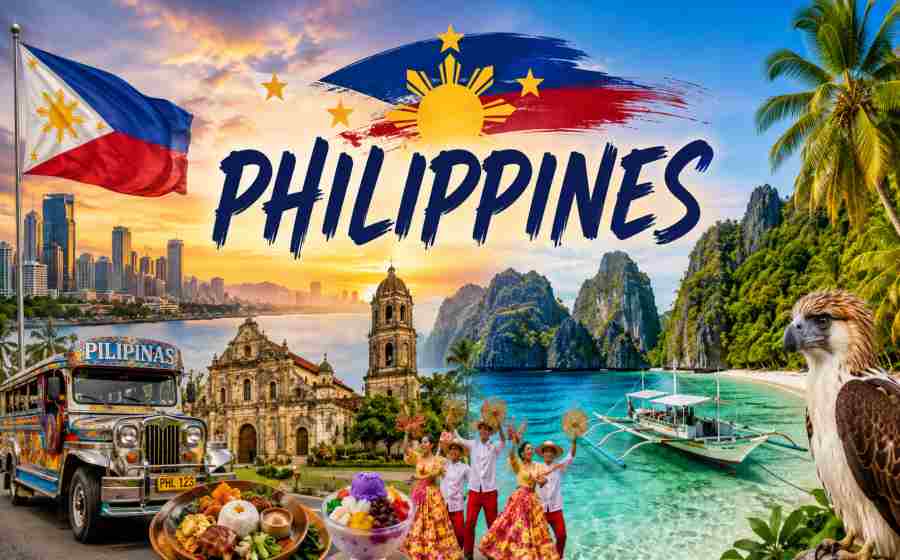
The Philippines is a beautiful island nation located in Southeast Asia. Known for its breathtaking beaches, rich cultural heritage, friendly people, and diverse traditions, the Philippines is one of the most fascinating countries in the world. It consists of more than 7,600 islands, making it one of the largest archipelagos on Earth. The country is famous for its tropical climate, colorful festivals, unique cuisine, and strong family values.
From ancient kingdoms to Spanish and American rule, the Philippines has a remarkable history that shaped its modern identity. Today, it is a democratic nation with a growing economy and a vibrant culture influenced by Asian, Spanish, and American traditions.
Table of Contents
Location and Geography
The Philippines lies in the western Pacific Ocean between the South China Sea and the Philippine Sea. It is surrounded by countries such as Taiwan to the north, Vietnam to the west, and Indonesia and Malaysia to the south.
Some important geographical facts include:
- Capital: Manila
- Largest City: Quezon City
- Total Area: Around 300,000 square kilometers
- Number of Islands: More than 7,600
- Highest Mountain: Mount Apo (2,954 meters)
- Longest River: Cagayan River
- Climate: Tropical with wet and dry seasons
The country is divided into three main island groups:
- Luzon
- Visayas
- Mindanao
Its coastline, mountains, forests, and volcanoes make the Philippines one of the world’s most biologically diverse countries.
A Brief History of the Philippines
The early inhabitants of the Philippines were believed to have arrived thousands of years ago. Before European colonization, local communities traded with China, India, and neighboring Southeast Asian kingdoms.
Spanish Rule
In 1521, Portuguese explorer Ferdinand Magellan reached the islands while sailing for Spain. Although Magellan was killed during his expedition, Spain later established control over the islands in 1565. The country was named after King Philip II of Spain.
Spanish rule lasted for more than 300 years, introducing Christianity, Western education, and new architectural styles.
American Rule
Following the Spanish-American War in 1898, Spain handed over the Philippines to the United States. During American rule, English education expanded, and infrastructure improved.
Independence
After Japanese occupation during World War II, the Philippines gained full independence on July 4, 1946. Since then, it has developed into a democratic republic.
Government and Economy
The Philippines is a democratic republic where citizens elect their leaders through regular elections.
Major sectors of the economy include:
- Agriculture
- Manufacturing
- Tourism
- Information Technology (IT)
- Business Process Outsourcing (BPO)
- Overseas Filipino workers (OFWs)
The country exports electronics, coconut products, bananas, pineapples, seafood, and garments.
Tourism is also a significant source of income because millions of visitors come every year to enjoy the country’s beaches, islands, diving spots, and cultural attractions.
Culture of the Philippines
Filipino culture is a unique blend of indigenous traditions and foreign influences, especially from Spain, America, China, and neighboring Asian countries.
Family Values
Family is the foundation of Filipino society. Respect for parents and elders is deeply valued, and relatives often live close together or support one another financially and emotionally.
Hospitality
Filipinos are known worldwide for their warm hospitality. Guests are treated with kindness and generosity, making visitors feel welcome.
Festivals
The Philippines celebrates numerous colorful festivals throughout the year. Some famous ones include:
- Sinulog Festival
- Ati-Atihan Festival
- Pahiyas Festival
- Panagbenga Flower Festival
- MassKara Festival
These festivals feature traditional dances, music, costumes, street parades, and religious celebrations.
Language and Religion
The official languages are:
- Filipino
- English
English is widely spoken in schools, businesses, and government offices, making the Philippines one of the largest English-speaking nations in Asia.
Besides these, more than 170 regional languages and dialects are spoken across the islands.
Religion
The Philippines is the largest predominantly Christian country in Asia.
Religious composition includes:
- Roman Catholic Christianity
- Protestant Christianity
- Islam
- Indigenous beliefs
- Other religions
Religious festivals and traditions play an important role in everyday life.
Famous Food
Filipino cuisine combines Asian and Spanish influences.
Popular dishes include:
- Adobo
- Sinigang
- Lechon
- Pancit
- Kare-Kare
- Halo-Halo
- Lumpia
Rice is the staple food and is served with almost every meal.
Sports in the Philippines
Sports are an important part of Filipino culture.
Basketball
Basketball is by far the most popular sport in the country. Courts can be found in nearly every town and neighborhood.
Boxing
The Philippines has produced several world-class boxers, making boxing one of the nation’s favorite sports.
Volleyball
Volleyball enjoys immense popularity, especially among young people and college students.
Other Popular Sports
- Football (Soccer)
- Badminton
- Billiards
- Athletics
- Esports
The country has won medals in international competitions, including the Olympic Games.
Education
Education is highly valued in Filipino society.
The education system generally includes:
- Elementary School
- Junior High School
- Senior High School
- College and University
Many universities offer internationally recognized programs, and English is commonly used as the medium of instruction.
Tourist Attractions
The Philippines offers countless natural and historical attractions.
Some famous destinations include:
- Boracay Island
- Palawan
- Chocolate Hills
- Banaue Rice Terraces
- Mayon Volcano
- Cebu
- Siargao
- Taal Volcano
Visitors enjoy activities such as island hopping, snorkeling, scuba diving, surfing, hiking, and exploring historical landmarks.
Wildlife and Nature
The Philippines is one of the world’s biodiversity hotspots.
Unique wildlife includes:
- Philippine Eagle
- Tamaraw
- Tarsier
- Whale Sharks
- Dugongs
Its coral reefs are among the richest marine ecosystems in the world.
Interesting Facts About the Philippines
- The Philippines has more than 7,600 islands.
- It is one of the world’s largest producers of coconuts.
- Jeepneys are one of the country’s most iconic forms of public transportation.
- Manila is one of the most densely populated cities in the world.
- The Philippines is among the world’s largest producers of bananas and pineapples.
- Filipinos are known for their musical talent and love of singing.
- The country experiences around 20 tropical cyclones each year.
- Christmas celebrations in the Philippines are among the longest in the world, beginning as early as September.
- English is widely spoken, making communication easy for international visitors.
- The Philippines is one of the world’s top destinations for scuba diving due to its vibrant coral reefs and marine biodiversity.
Summary
The Philippines is a nation of incredible natural beauty, rich history, vibrant culture, and resilient people. From its thousands of islands and breathtaking beaches to its colorful festivals, delicious cuisine, and love for sports, the country offers something unique for everyone. Its blend of Asian, Spanish, and American influences has created a diverse society that continues to grow while preserving its traditions. Whether studying world geography, history, or culture, learning about the Philippines provides valuable insight into one of Southeast Asia’s most fascinating countries.
Also Check: General Knowledge