
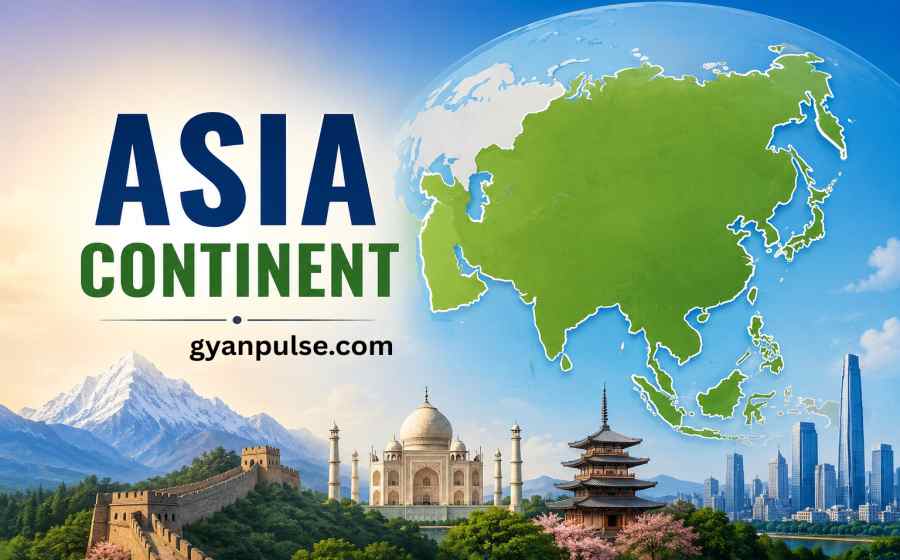
Asia Continent – Area, Population, Top Countries, Culture, Languages and Important Facts
Discover the Asia Continent, its geography, population, countries, climate, culture, languages, economy, sports and fascinating facts in one place.
Asia Continent
Asia is the largest and most diverse continent in the world, both in terms of land area and culture. It is known for its vast land area, huge population, ancient civilizations, rich cultures, and modern technological growth. Asia plays a major role in global history, economy, religion, and culture. From the icy lands of Siberia to the tropical islands of Southeast Asia, the continent shows extraordinary geographical and cultural diversity.
Table of Contents
Location and Boundaries of Asia
Asia is mainly located in the Northern and Eastern Hemispheres.
It is bordered by:
- Europe to the west
- Africa to the southwest
- Arctic Ocean to the north
- Indian Ocean to the south
- Pacific Ocean to the east
Asia is connected to Europe, and together they form a large landmass known as Eurasia.
Area of Asia Continent
Asia is the largest continent on Earth.
- Total Area: Approximately 44.5 million square kilometers
- Percentage of Earth’s land surface: About 30%
- Percentage of world’s total land area: Nearly 60%
Top 5 Largest Countries in Asia by Area
- Russia – 17.1 million sq km (partly in Europe, mostly in Asia)
- China – 9.6 million sq km
- India – 3.28 million sq km
- Kazakhstan – 2.7 million sq km
- Saudi Arabia – 2.15 million sq km
These countries cover a major portion of Asia’s total land area.
Population of Asia Continent
Asia is the most populous continent in the world, with more than half of the Earth’s population living here.
- Total Population: Over 4.7 billion people
- Percentage of world population: Around 60%
Asia’s population includes people from thousands of ethnic groups, tribes, and communities.
Top 5 Most Populated Countries in Asia
- India – Over 1.4 billion
- China – Over 1.4 billion
- Indonesia – Around 280 million
- Pakistan – Around 240 million
- Bangladesh – Around 170 million
India and China alone account for more than one-third of the world’s population.
Total Number of Countries in Asia
- Total Countries: 49 (as commonly accepted)
- UN-recognized Asian countries: 49
- Includes large nations, island countries, and landlocked states
Some well-known Asian countries include India, China, Japan, South Korea, Thailand, Nepal, Sri Lanka, Iran, Iraq, Israel, UAE, and Philippines.
Geographical Features of Asia
Asia has some of the world’s most extreme geographical features:
- Highest mountain: Mount Everest (Nepal–China border)
- Largest plateau: Tibetan Plateau
- Longest river: Yangtze River
- Largest desert: Gobi Desert
- Deepest lake: Lake Baikal (Russia)
- Lowest land point: Dead Sea (Israel–Jordan)
These features make Asia geographically unique and diverse.
Climate of Asia
Asia experiences almost every type of climate:
- Arctic cold in Siberia
- Tropical climate in Southeast Asia
- Desert climate in West Asia
- Monsoon climate in South Asia
- Mediterranean climate in parts of the Middle East
The monsoon system plays a vital role in the lives and agriculture of many Asian countries.
Culture of Asia
Asia is the birthplace of major world civilizations and cultures.
Key Cultural Features
- Strong family values
- Respect for elders
- Traditional clothing and festivals
- Ancient art, architecture, and literature
- Spiritual and philosophical traditions
Major religions like Hinduism, Buddhism, Jainism, Confucianism, Taoism, Islam, and Christianity originated or spread widely across Asia.
Languages Spoken in Asia
Asia is the most linguistically diverse continent.
- Over 2,300 languages are spoken
- Major language families include:
- Indo-European
- Sino-Tibetan
- Dravidian
- Altaic
- Austronesian
Most Spoken Languages in Asia
- Mandarin Chinese
- Hindi
- Bengali
- Arabic
- Japanese
- Korean
- Urdu
Many Asian countries have multiple official and regional languages.
Sports in Asia
Sports play an important role in Asian society. Popular Sports Across Asia
- Cricket – India, Pakistan, Sri Lanka, Bangladesh
- Football (Soccer) – West Asia, East Asia
- Badminton – China, Indonesia, Malaysia, India
- Table Tennis – China, Japan
- Martial Arts – Karate, Taekwondo, Kung Fu, Judo
- Kabaddi – South Asia
Asia also hosts major sporting events like the Asian Games and has produced world-class athletes.
Economy and Development
Asia includes:
- Developed nations – Japan, South Korea, Singapore
- Developing economies – India, Indonesia, Vietnam
- Resource-rich countries – Saudi Arabia, Qatar, UAE
Asia is a global leader in:
- Technology
- Manufacturing
- Oil and gas production
- Agriculture
- Trade and commerce
Important Facts About Asia
- Asia is home to the world’s oldest civilizations
- It has the highest and lowest points on Earth
- Asia has the largest population diversity
- It includes both richest and poorest countries
- Asia contributes significantly to global culture, science, and economy
Importance of Asia in Global Development
Asia holds a central position in the modern world due to its influence on global trade, innovation, education, and cultural heritage. The continent is home to some of the fastest-growing economies, leading technology hubs, and ancient historical landmarks. With its vast natural resources, skilled workforce, and rapidly developing infrastructure, Asia continues to shape international politics, business, and scientific progress. Learning about Asia helps students and competitive exam aspirants gain a better understanding of world geography, economics, and global affairs.
Summary
Asia is a continent of great contrasts and incredible diversity. It is the largest in area, highest in population, richest in cultures, and most varied in geography. From ancient traditions to modern innovation, Asia continues to shape the world in countless ways. Understanding Asia is essential for anyone interested in general knowledge, history, geography, and global affairs.
Also Check: General Knowledge