
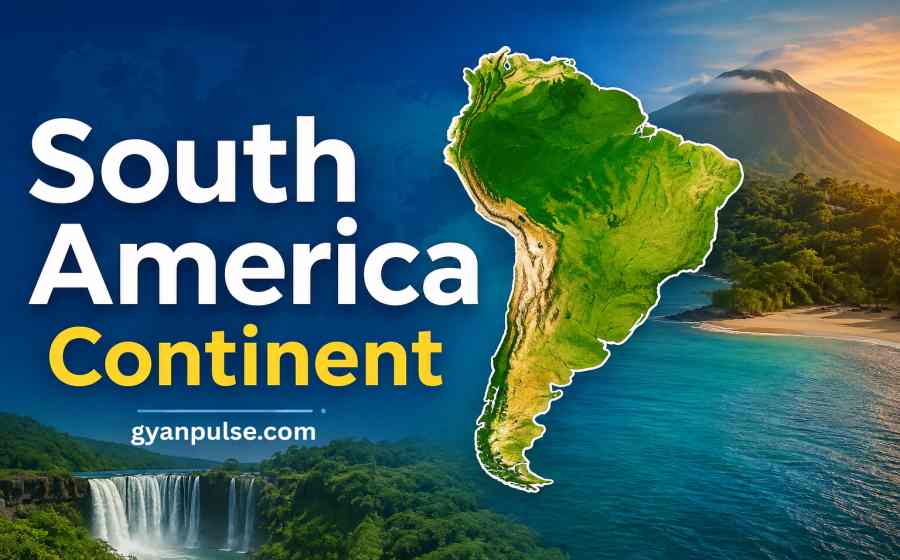
South America Continent – Geography, Population, Countries, Culture and Important Facts
Explore the South America Continent with key facts on countries, area, population, geography, culture, languages, economy, sports and natural wonders.
South America Continent
South America is one of the most diverse and resource-rich continents in the world. Known for its vast rainforests, mighty rivers, ancient civilizations, and vibrant cultures, the continent plays an important role in global geography, biodiversity, and history. From the Amazon Rainforest to the Andes Mountains, South America offers a unique blend of natural beauty and human heritage.
The continent is located mainly in the Southern Hemisphere, bordered by North America to the northwest, the Atlantic Ocean to the east, and the Pacific Ocean to the west.
Table of Contents
Total Area of South America
South America covers a total area of approximately 17.84 million square kilometers, making it the fourth-largest continent in the world by land area.
Despite having fewer countries than other continents, South America has vast stretches of forests, mountains, plains, and coastlines.
Top 5 Largest Countries by Area
- Brazil – ~8.51 million sq km
- Argentina – ~2.78 million sq km
- Peru – ~1.28 million sq km
- Colombia – ~1.14 million sq km
- Bolivia – ~1.10 million sq km
Brazil alone occupies nearly half of South America’s total land area, making it the dominant geographical presence on the continent.
Important Cities of South America
Some of the major cities of South America include São Paulo in Brazil, Buenos Aires in Argentina, Rio de Janeiro in Brazil, Lima in Peru, and Bogotá in Colombia. These cities serve as important hubs of trade, culture, education, and economic activity, playing a key role in the development and global connection of the South American continent.
Population of South America
South America has a population of over 430 million people. The population is unevenly distributed, with dense urban centers along the coasts and sparse populations in rainforests and mountainous regions.
Top 5 Most Populated Countries
- Brazil – 215 million
- Colombia – 52 million
- Argentina – 46 million
- Peru – 34 million
- Venezuela – 29 million
Large cities like São Paulo, Buenos Aires, and Lima are major population hubs.
Total Number of Countries in South America
South America consists of 12 independent countries and 1 overseas territory.
List of South American Countries
South America consists of twelve independent countries, namely Argentina, Bolivia, Brazil, Chile, Colombia, Ecuador, Guyana, Paraguay, Peru, Suriname, Uruguay, and Venezuela. In addition to these sovereign nations, French Guiana is located on the northeastern coast of the continent, but it is not an independent country. Instead, it is an overseas department of France and is considered part of the European Union, even though it lies geographically in South America.
Physical Geography and Natural Features
South America is famous for its dramatic and highly varied landscapes, which make the continent one of the most ecologically significant regions in the world. It is home to the Amazon River, the longest river by volume on Earth, and the Amazon Rainforest, the largest tropical rainforest, known for its unmatched biodiversity.
The continent is also dominated by the Andes Mountains, the longest mountain range in the world, stretching along its western edge and influencing climate and culture. In contrast, the Atacama Desert stands as one of the driest places on the planet, while the southern region of Patagonia is renowned for its massive glaciers, rugged terrain, and windswept plains. Together, these natural features highlight South America’s extraordinary environmental diversity and underline its global ecological importance.
Climate of South America
South America experiences a wide range of climates due to its size and geography.
- Equatorial climate in the Amazon Basin
- Tropical climate in northern regions
- Temperate climate in southern areas like Argentina and Chile
- Cold alpine climate in the Andes Mountains
This climate diversity supports rich biodiversity and varied agricultural production.
Languages Spoken in South America
South America is linguistically diverse, but most countries share common colonial languages.
Major Languages
- Spanish – Spoken in most countries
- Portuguese – Official language of Brazil
- English – Guyana
- Dutch – Suriname
- French – French Guiana
Indigenous Languages
- Quechua
- Aymara
- Guarani
Many indigenous languages are officially recognized and still widely spoken.
Culture and Traditions
South American culture is a blend of indigenous, European, African, and Asian influences.
- Colorful festivals like Carnival
- Traditional music such as Samba, Tango, and Andean folk music
- Strong family values and community life
- Rich traditions in dance, art, and storytelling
Each country has its own unique cultural identity, yet they share common continental traits.
Sports Popular in South America
Sports are a major part of South American life and culture.
- Football (Soccer) is the most popular sport
- Countries like Brazil, Argentina, and Uruguay have produced legendary players
- Other popular sports include:
- Volleyball
- Basketball
- Rugby
- Athletics
South America has won multiple FIFA World Cups, especially Brazil and Argentina.
Political Importance, Economy, and Natural Resources of South America
South America holds growing importance in international politics and the global economy due to its strategic regional cooperation and abundant natural resources. The continent actively participates in international affairs through regional organizations such as MERCOSUR and UNASUR, which promote economic integration, political cooperation, and regional stability among member nations. South American countries also play an active role in global forums like the United Nations and the G20, contributing to discussions on international development, trade, and environmental issues.
Economically, South America has a mixed economy that includes both developing and emerging markets. Agriculture remains a backbone of the continent’s economy, with major products such as coffee, soybeans, and sugarcane supporting domestic livelihoods and global exports. The continent is also rich in mineral resources, with Chile leading in copper production, Brazil and Argentina producing iron ore and soybeans, and Venezuela possessing some of the world’s largest oil reserves. In addition to minerals and energy resources, South America has vast forests and freshwater systems, making it one of the most resource-rich regions on Earth.
Manufacturing and service sectors are expanding steadily across the continent, especially in urban and industrial centers. Brazil and Argentina are the largest economies in South America, driven by diversified industries, agriculture, and services, while countries like Chile and Peru are internationally recognized for their strong mining exports. Overall, South America plays a vital role in the global supply of food, energy, and raw materials, strengthening its economic and political significance on the world stage.
Important Facts about South America
- Home to the world’s largest rainforest
- Contains more biodiversity than any other continent
- The Andes Mountains stretch over 7,000 km
- Brazil is the only Portuguese-speaking country in the Americas
- The Amazon produces a significant portion of the Earth’s oxygen
Tourism and World Heritage of South America
South America is one of the world’s most fascinating travel destinations, attracting millions of visitors each year with its remarkable natural wonders and historical landmarks. The continent is home to famous attractions such as Machu Picchu in Peru, Christ the Redeemer in Brazil, Iguazu Falls on the Brazil–Argentina border, the Galápagos Islands of Ecuador, and the stunning landscapes of Patagonia.
Several UNESCO World Heritage Sites preserve South America’s rich cultural and natural heritage, making tourism an important contributor to the economies of many countries. The continent’s combination of breathtaking scenery, ancient civilizations, diverse wildlife, and vibrant traditions makes it a globally significant destination for education, exploration, and adventure.
Summary
South America is a continent of contrasts, combining ancient traditions with modern development. Its vast natural resources, cultural richness, and strategic importance make it a key region in global geography and GK studies. Understanding South America helps build strong knowledge of world geography, culture, economy, and environmental importance.
Also Check: General Knowledge