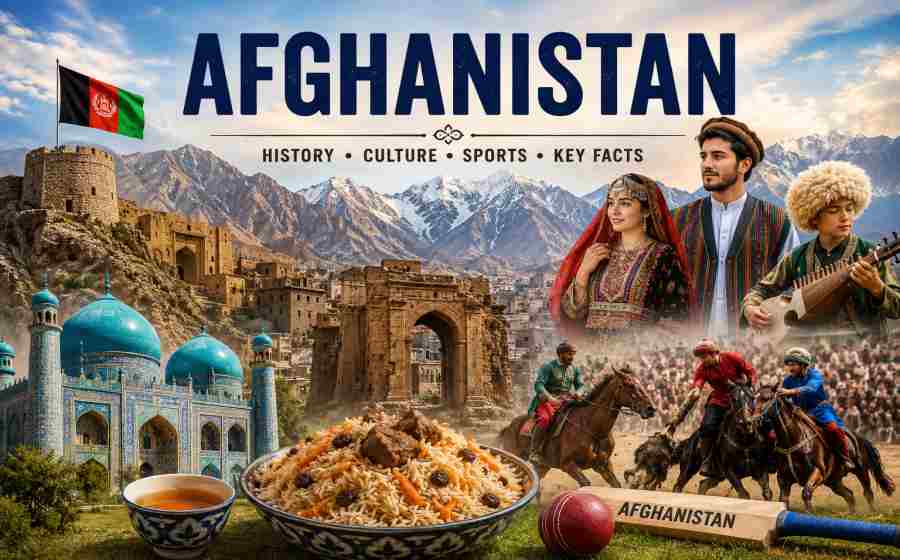
Afghanistan – A Land of Ancient History, Rich Culture, Sports and Fascinating Facts
Discover Afghanistan’s history, culture, sports, geography and key facts. Explore the traditions and unique identity of this remarkable nation.
Afghanistan
Afghanistan is a country with a history that stretches back thousands of years. Located at the crossroads of Central and South Asia, it has long been an important center of trade, culture, and civilization. Despite facing numerous challenges throughout its history, Afghanistan remains a land of remarkable resilience, diverse traditions, and deep cultural heritage.
From ancient empires and famous trade routes to traditional music and exciting sports, Afghanistan offers countless interesting facts that make it an important topic in general knowledge studies.
Table of Contents
Geography of Afghanistan
Afghanistan is a landlocked country situated in Asia. It shares borders with Pakistan, Iran, Turkmenistan, Uzbekistan, Tajikistan, and China.
Some key geographical facts include:
- Capital: Kabul
- Official Languages: Pashto and Dari
- Currency: Afghan Afghani (AFN)
- Government: Islamic Emirate (current administration)
- Population: More than 40 million people
- Major Mountain Range: Hindu Kush
- Highest Peak: Noshaq (7,492 meters)
The country’s mountainous terrain has played a significant role in shaping its history, defense, and lifestyle.
Historical Background of Afghanistan
Afghanistan possesses one of the world’s oldest civilizations. Archaeological discoveries suggest that humans have lived in this region for thousands of years.
Ancient Afghanistan
The region was once part of major ancient empires, including:
- The Achaemenid Persian Empire
- Alexander the Great’s Empire
- The Mauryan Empire
- The Kushan Empire
Its strategic location made it a major center along the famous Silk Road, connecting Asia, Europe, and the Middle East.
Medieval Period
During the medieval era, Afghanistan became an important center for Islamic learning, literature, and trade. Several dynasties ruled the region, contributing to architecture, education, and governance.
Modern Afghanistan
Modern Afghanistan emerged during the eighteenth century under the leadership of Ahmad Shah Durrani, often regarded as the founder of the modern Afghan state.
The country later experienced conflicts involving foreign powers and internal struggles. Despite these hardships, the Afghan people have preserved their cultural identity and traditions.
Culture of Afghanistan
Afghanistan’s culture reflects influences from Central Asia, Persia, South Asia, and the Middle East. Ethnic diversity has enriched the country’s traditions over centuries.
Ethnic Diversity
Major ethnic groups include:
- Pashtuns
- Tajiks
- Hazaras
- Uzbeks
- Turkmens
- Baluch communities
Each group contributes unique customs, clothing styles, languages, and celebrations.
Traditional Clothing
Afghan traditional attire is known for both elegance and practicality.
Men often wear:
- Perahan tunban
- Waistcoats
- Traditional caps or turbans
Women traditionally wear colorful dresses featuring intricate embroidery, although styles vary by region and community.
Music and Dance
Music occupies an important place in Afghan society. Traditional instruments include:
- Rubab
- Tabla
- Dhol
The rubab is often considered Afghanistan’s national instrument.
The Attan, a traditional dance originally associated with Pashtun communities, is now performed across the country during celebrations and cultural events.
Hospitality
Afghan society highly values hospitality. Guests are treated with great respect and are often offered tea, fruits, and traditional dishes as symbols of friendship and honor.
Traditional Cuisine of Afghanistan
Afghan cuisine combines flavors from neighboring regions while maintaining its own distinctive identity.
Popular dishes include:
Kabuli Pulao
Considered the national dish, Kabuli Pulao consists of rice cooked with raisins, carrots, and meat.
Mantu
These are steamed dumplings filled with seasoned meat and onions, often served with yogurt-based sauces.
Ashak
A favorite traditional dish made from dumplings stuffed with leeks or chives.
Bolani
A stuffed flatbread commonly filled with potatoes, lentils, pumpkin, or vegetables.
Tea remains an essential part of daily life and social gatherings.
Sports in Afghanistan
Sports have always played an important role in bringing communities together.
Cricket
Cricket has become the most popular modern sport in Afghanistan. The Afghan national cricket team has achieved remarkable success in international competitions. The team’s rise has inspired young athletes throughout the country.
Football
Football also enjoys widespread popularity, particularly among urban youth. Local leagues and national competitions continue to attract enthusiastic supporters.
Buzkashi
Buzkashi is Afghanistan’s traditional national sport. In this exciting horseback game, riders compete to carry a goat carcass to a designated goal area. It requires exceptional strength, horsemanship, and strategy.
Buzkashi remains an important symbol of Afghan heritage and is often featured during festivals and special events.
Education and Literature
Afghanistan has a long literary tradition influenced by Persian and Islamic scholarship. Classical poetry remains highly respected among Afghans.
Famous themes in Afghan literature include:
- Love
- Spirituality
- Heroism
- Wisdom
- Patriotism
Educational institutions have historically served as centers for intellectual development, although access to education has varied across different periods.
Economy of Afghanistan
Agriculture forms a major part of Afghanistan’s economy.
Important agricultural products include:
- Wheat
- Fruits
- Nuts
- Grapes
- Pomegranates
- Saffron
The country is also rich in natural resources such as copper, iron ore, lithium, and precious stones, offering significant economic potential. Trade and small businesses continue to support the livelihoods of many Afghan families.
Key Facts About Afghanistan
- Kabul is one of the oldest continuously inhabited cities in the world.
- Afghanistan is often called the “Heart of Asia” because of its strategic location.
- The Hindu Kush mountains cover much of the country.
- The national dish is Kabuli Pulao.
- Buzkashi is the traditional national sport.
- The rubab is considered the national musical instrument.
- Afghanistan was an important part of the ancient Silk Road trade network.
- Ahmad Shah Durrani is widely regarded as the founder of modern Afghanistan.
Summary
Afghanistan is far more than the conflicts often highlighted in international headlines. It is a nation shaped by ancient civilizations, vibrant cultural traditions, resilient people, and enduring values. Its contributions to trade, literature, music and sports continue to reflect a rich historical legacy.
Also Check: General Knowledge