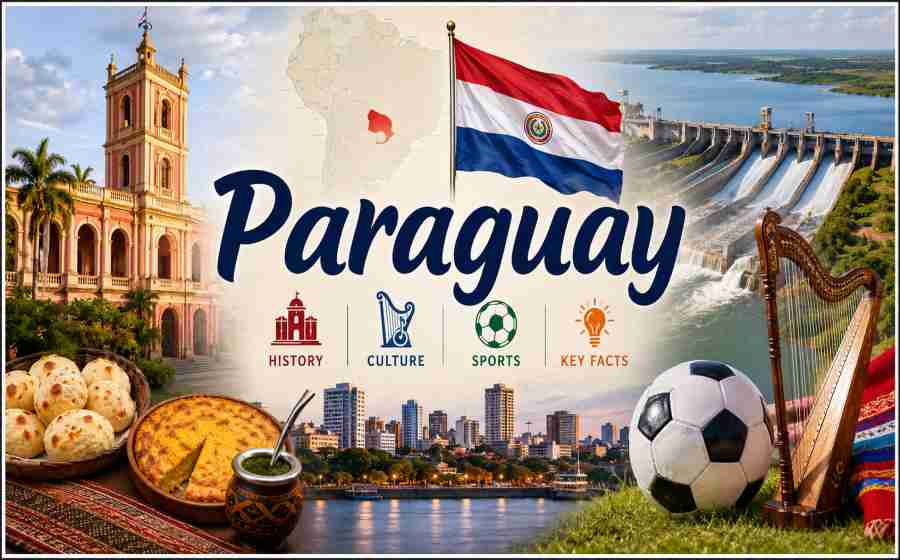
Paraguay – History, Culture, Sports and Fascinating Facts About the Heart of South America
Explore Paraguay’s rich history, unique culture, popular sports, geography, economy and key facts. Learn everything about this South American nation.
Paraguay
Paraguay is a landlocked country located in the heart of South America. Though often overshadowed by its larger neighbors, Paraguay possesses a rich history, vibrant culture, unique traditions, and a strong national identity. Known for its bilingual society, beautiful landscapes, and passionate love for football, Paraguay offers a fascinating blend of indigenous and European influences.
Table of Contents
Introduction to Paraguay
Paraguay is situated between Brazil, Argentina, and Bolivia. Despite having no coastline, the country benefits from extensive river systems that play a crucial role in transportation and trade.
Basic Facts About Paraguay
- Official Name: Republic of Paraguay
- Capital City: Asunción
- Continent: South America
- Official Languages: Spanish and Guaraní
- Currency: Paraguayan Guaraní (PYG)
- Population: Approximately 7 million
- Independence Day: May 14–15, 1811
- National Animal: Pampas Fox
- Major Rivers: Paraguay River and Paraná River
Paraguay is one of the few countries in the world where an indigenous language, Guaraní, is widely spoken by most citizens alongside Spanish.
History of Paraguay
Early Indigenous Civilization
Before European arrival, the region was inhabited primarily by the Guaraní people. These indigenous communities developed rich traditions, agricultural practices, and social structures that continue to influence Paraguayan society today.
Spanish Colonization
Spanish explorers arrived in the 16th century and established settlements throughout the region. The city of Asunción became one of the earliest colonial centers in South America and played a significant role in Spanish expansion.
Independence
Paraguay gained independence from Spain in 1811. Unlike many other Latin American countries, Paraguay achieved independence with relatively little bloodshed.
The War of the Triple Alliance
One of the most significant events in Paraguayan history was the War of the Triple Alliance (1864–1870). Paraguay fought against Argentina, Brazil, and Uruguay. The conflict devastated the nation, resulting in massive population losses and economic destruction.
Modern Paraguay
Throughout the 20th century, Paraguay experienced periods of political instability and authoritarian rule. Since the late 20th century, the country has developed democratic institutions and strengthened its economy.
Geography and Climate
Paraguay covers an area of approximately 406,752 square kilometers and is divided into two major regions:
Eastern Region
This area contains most of the population and agricultural activity. It features fertile plains, forests, and rolling hills.
Western Region (Chaco)
The Chaco region occupies more than half of Paraguay’s territory. It is characterized by dry forests, grasslands, and diverse wildlife.
Climate
Paraguay experiences a subtropical climate with:
- Hot summers
- Mild winters
- Seasonal rainfall
- Occasional droughts
The country’s rivers are essential for transportation, irrigation, and hydroelectric power generation.
Culture of Paraguay
Paraguayan culture is a unique combination of indigenous Guaraní traditions and Spanish heritage.
Language
Paraguay is famous for being one of the most bilingual nations in the world. Most citizens speak both Spanish and Guaraní in daily life.
Music and Dance
Traditional Paraguayan music often features:
- Harps
- Guitars
- Folk singing
The Paraguayan harp is considered one of the country’s most iconic musical instruments.
Traditional Clothing
During festivals and cultural celebrations, people wear colorful traditional attire reflecting centuries-old customs.
Festivals
Paraguay celebrates numerous cultural and religious festivals throughout the year, showcasing local music, dance, food, and craftsmanship.
Paraguayan Cuisine
Food is an important part of national identity.
Popular dishes include:
Chipa
A traditional cheese bread made from cassava starch, eggs, and cheese.
Sopa Paraguaya
Despite its name, it is not a soup but a delicious cornbread-like dish.
Mbejú
A starch-based pancake made from cassava flour and cheese.
Asado
Grilled meat remains a favorite meal across the country. These foods reflect both indigenous ingredients and Spanish culinary traditions.
Sports in Paraguay
Sports play a major role in Paraguayan society.
Football (Soccer)
Football is by far the most popular sport in Paraguay. Children and adults alike play the game passionately across cities and rural communities.
The national football team has participated in multiple FIFA World Cup tournaments and has produced many talented players.
Notable footballers include:
- José Luis Chilavert
- Roque Santa Cruz
Other Popular Sports
Besides football, Paraguayans also enjoy:
- Basketball
- Volleyball
- Tennis
- Athletics
- Rugby
International sporting events often attract enthusiastic support from the Paraguayan public.
Economy of Paraguay
Paraguay has one of South America’s fastest-growing economies in several recent decades.
Major sectors include:
Agriculture
Agriculture is a key pillar of the economy.
Main products include:
- Soybeans
- Corn
- Wheat
- Sugarcane
- Beef
Hydroelectric Power
Paraguay is a global leader in renewable energy production. The country generates enormous amounts of electricity from hydroelectric dams. The famous Itaipu Dam is one of the world’s largest hydroelectric facilities.
Trade and Industry
Paraguay exports agricultural products, meat, and electricity to neighboring countries and international markets.
Wildlife and Natural Attractions
Paraguay is home to diverse ecosystems and wildlife.
Common animals include:
- Jaguars
- Capybaras
- Giant anteaters
- Toucans
- Armadillos
Nature enthusiasts visit national parks and protected areas to observe these species in their natural habitats.
Popular attractions include:
- Itaipu Dam
- Ybycuí National Park
- Cerro Corá National Park
Interesting Facts About Paraguay
- Paraguay is one of only two landlocked countries in South America.
- Guaraní is spoken by a majority of the population.
- The country produces more hydroelectric power than it consumes.
- Paraguay’s flag has different designs on its front and back sides.
- Asunción is among the oldest cities in South America.
- Paraguay is a major exporter of soybeans.
- Traditional harp music remains an important cultural symbol.
- The Chaco region covers more than half of the nation’s territory.
- Paraguay has abundant freshwater resources.
- The country celebrates both indigenous and European cultural traditions.
Summary
Paraguay is a remarkable South American nation with a rich historical legacy, vibrant cultural traditions, diverse natural landscapes, and a deep passion for sports. From its bilingual society and indigenous heritage to its powerful hydroelectric resources and growing economy, Paraguay stands out as a unique and fascinating country. Understanding Paraguay’s history, culture, sports, and key facts offers valuable insight into one of South America’s most distinctive and resilient nations.
Also Check: General Knowledge