
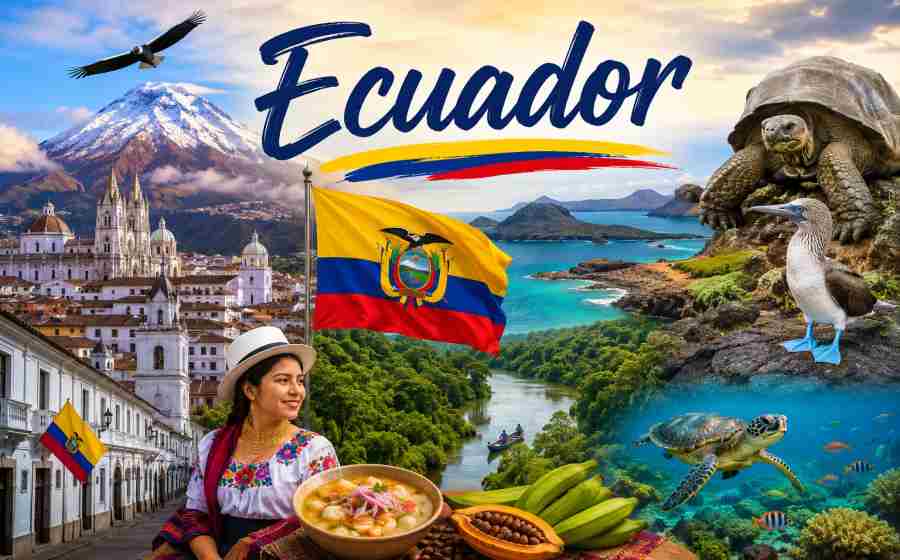
Ecuador – History, Culture, Sports, Tourism and Fascinating Facts
Discover Ecuador through its rich history, vibrant culture, famous sports, breathtaking geography, unique wildlife and important facts.
Ecuador
Ecuador is one of South America’s most fascinating countries, known for its breathtaking landscapes, rich cultural heritage, diverse wildlife, and historical significance. Despite being one of the continent’s smaller nations, Ecuador offers an incredible variety of natural wonders, from the towering Andes Mountains to the lush Amazon Rainforest and the world-famous Galápagos Islands. The country’s name comes from the Equator, which passes directly through its northern region, making Ecuador one of the few countries situated on both sides of the Earth’s equator.
Today, Ecuador is recognized for its biodiversity, colorful traditions, delicious cuisine, and growing presence in international sports. It is also famous for preserving indigenous cultures while embracing modern development.
Table of Contents
History of Ecuador
The history of Ecuador dates back thousands of years. Long before European explorers arrived, the region was home to several indigenous civilizations such as the Valdivia, Quitu, Cañari, and Caras peoples. These communities developed agriculture, pottery, and organized societies.
During the 15th century, the powerful Inca Empire expanded northward and incorporated much of present-day Ecuador into its territory. The city of Quito became an important administrative center of the empire.
In 1532, Spanish conquistadors led by Francisco Pizarro conquered the Inca Empire. Ecuador remained under Spanish colonial rule for nearly 300 years. During this period, churches, colonial architecture, and European customs spread across the region.
The struggle for independence gained momentum in the early 19th century. On May 24, 1822, the Battle of Pichincha secured Ecuador’s freedom from Spanish rule. Initially, Ecuador became part of Gran Colombia before becoming an independent republic in 1830.
Since then, Ecuador has experienced political changes, economic reforms, and democratic development while preserving its rich cultural identity.
Geography of Ecuador
Ecuador covers approximately 283,561 square kilometers and is bordered by Colombia to the north, Peru to the east and south, and the Pacific Ocean to the west.
The country is divided into four major geographical regions:
- Coastal Region (Costa): Known for beautiful beaches, agriculture, and major ports.
- Andean Highlands (Sierra): Home to volcanoes, mountains, and historic cities.
- Amazon Basin (Oriente): Covered by dense tropical rainforest with exceptional biodiversity.
- Galápagos Islands: A volcanic archipelago famous for its unique wildlife and scientific importance.
The country’s highest mountain is Chimborazo, whose summit is the point on Earth’s surface farthest from the planet’s center due to the Earth’s equatorial bulge.
Culture of Ecuador
Ecuadorian culture is a colorful blend of indigenous traditions and Spanish colonial influence. Music and dance play an important role during festivals and celebrations. Traditional instruments include pan flutes, drums, and guitars. Folk dances vary by region and often celebrate harvests, religious events, or historical occasions.
The country hosts many vibrant festivals throughout the year, featuring traditional costumes, parades, music, and local cuisine.
Handicrafts are another important part of Ecuadorian culture. Indigenous communities produce beautifully woven textiles, pottery, wood carvings, and jewelry that reflect centuries of craftsmanship.
Spanish is the official language, but many indigenous languages, including Kichwa and Shuar, are also spoken.
Traditional Food of Ecuador
Ecuadorian cuisine varies across its regions due to differences in climate and geography.
Some popular dishes include:
- Ceviche
- Locro de Papa (potato soup)
- Hornado (roast pork)
- Llapingachos (potato patties)
- Encebollado (fish stew)
- Empanadas
- Humitas
- Bolón de Verde
Fresh tropical fruits such as bananas, mangoes, papayas, passion fruit, and guavas are widely available throughout the country.
Wildlife and Biodiversity
Ecuador is considered one of the world’s most biodiverse countries despite its relatively small size.
Its ecosystems support thousands of plant and animal species, including:
- Giant tortoises
- Blue-footed boobies
- Marine iguanas
- Jaguars
- Spectacled bears
- Pink river dolphins
- Hummingbirds
- Andean condors
The Galápagos Islands inspired Charles Darwin’s theory of evolution through natural selection after his famous visit in 1835. Protected national parks and conservation programs help preserve Ecuador’s remarkable wildlife.
Economy of Ecuador
Ecuador’s economy depends on several important industries:
- Petroleum production
- Agriculture
- Tourism
- Fishing
- Manufacturing
- Mining
Major agricultural exports include bananas, cocoa, coffee, flowers, shrimp, and palm oil. Ecuador is one of the world’s largest exporters of bananas, supplying markets across Europe, North America, and Asia.
Tourism also contributes significantly to the economy, attracting visitors to Quito, Cuenca, the Amazon rainforest, and the Galápagos Islands.
Sports in Ecuador
Football (soccer) is by far the most popular sport in Ecuador. The national football team has qualified for multiple FIFA World Cups and continues to perform competitively in South American tournaments.
Many Ecuadorian footballers have achieved international recognition by playing for clubs in Europe and other major football leagues.
Cycling has also gained popularity, with Ecuador producing internationally successful cyclists in recent years. Athletics, volleyball, basketball, tennis, and boxing are also enjoyed throughout the country.
Adventure sports such as mountain climbing, hiking, rafting, surfing, and paragliding are popular due to Ecuador’s varied landscapes.
Tourism in Ecuador
Ecuador offers a wide variety of travel destinations.
Popular attractions include:
- Quito’s historic colonial center
- The Galápagos Islands
- Cotopaxi National Park
- Chimborazo Volcano
- Cuenca
- Amazon Rainforest
- Otavalo Market
- Baños
- Pacific Coast beaches
Visitors enjoy wildlife watching, volcano trekking, rainforest exploration, cultural experiences, and marine adventures.
Education and Language
Education has steadily improved in Ecuador through government investment in schools and universities. Spanish is spoken by the majority of the population, while indigenous communities continue to preserve their native languages.
Higher education institutions offer programs in engineering, medicine, business, environmental sciences, and technology.
Government and Currency
Ecuador is a democratic republic with an elected president serving as both head of state and government. Unlike many South American countries, Ecuador uses the United States Dollar (USD) as its official currency, a system adopted in 2000 to stabilize the economy.
Interesting Facts About Ecuador
- Ecuador is named after the Equator.
- The Equator passes directly through the country.
- The Galápagos Islands are a UNESCO World Heritage Site.
- Quito is one of the highest capital cities in the world.
- Chimborazo’s summit is the point on Earth farthest from the planet’s center.
- Ecuador is among the world’s most biodiverse nations.
- The country is one of the largest banana exporters globally.
- More than 1,600 bird species have been recorded in Ecuador.
- The Galápagos Islands helped inspire Charles Darwin’s theory of evolution.
- Ecuador uses the US Dollar instead of its former national currency.
Summary
Ecuador is a remarkable country where ancient history, stunning natural beauty, and vibrant cultural traditions come together. From the snow-capped Andes and the Amazon rainforest to the extraordinary Galápagos Islands, Ecuador offers an unmatched diversity of landscapes and wildlife. Its rich indigenous heritage, colonial history, flavorful cuisine, passion for football, and commitment to conservation make it an important nation in South America. Whether explored for education, travel, or general knowledge, Ecuador stands out as a country full of fascinating stories, natural wonders, and cultural treasures.
Also Check: General Knowledge