
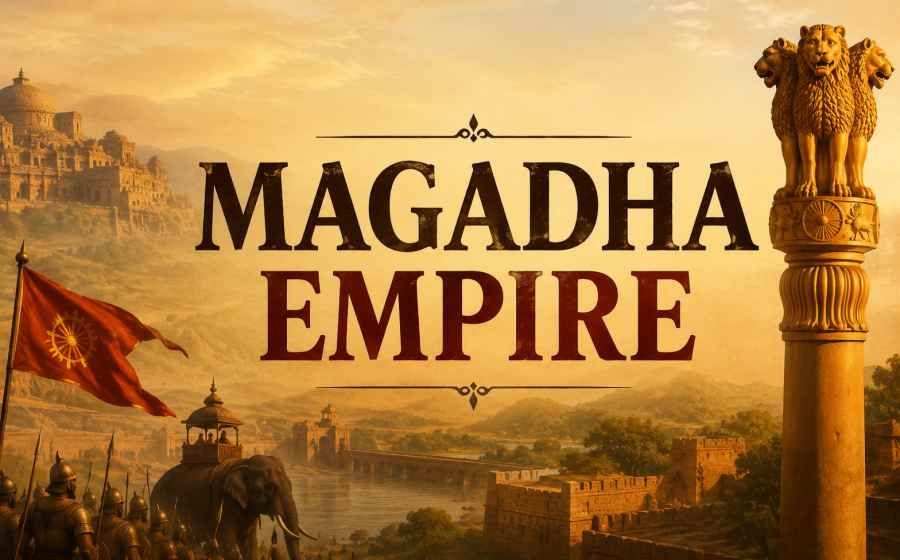
Magadha Empire – Rise, Expansion and Lasting Contributions to Indian Civilization
Discover the rise of the Magadha Empire, its powerful rulers, expansion, administration and lasting contributions to Indian civilization.
Magadha Empire
The Magadha Empire was one of the most powerful and influential kingdoms in ancient India. Located in the fertile plains of present-day southern Bihar, Magadha laid the foundation for some of India’s greatest empires, including the Maurya and Gupta Empires. Its strategic location, capable rulers, strong military, and efficient administration enabled it to emerge as the dominant political power in northern India during ancient times.
The history of Magadha is not only significant for Bihar but also for the entire Indian subcontinent. Many important historical events, including the rise of Buddhism and Jainism, the establishment of India’s first large empire and remarkable developments in administration and governance, are closely connected with Magadha.
Table of Contents
Geographical Location of Magadha
Magadha was situated in the southern part of present-day Bihar, mainly covering the districts around modern-day Patna, Gaya, Nalanda, Jehanabad, and Nawada. It was bounded by the Ganga River in the north, the Son River in the west, and hills and forests in the south.
Its fertile land supported agriculture, while rivers facilitated trade and transportation. The region also possessed rich deposits of iron ore, which helped in manufacturing weapons and agricultural tools. These geographical advantages greatly contributed to the rise of Magadha as a powerful kingdom.
Early History of Magadha
Magadha was one of the Sixteen Mahajanapadas (large kingdoms) that flourished around the 6th century BCE. Although it existed earlier, its real rise began under the rule of the Haryanka Dynasty.
The earliest known capital of Magadha was Rajagriha (Rajgir), surrounded by hills that provided natural protection against enemies. Later, the capital was shifted to Pataliputra (modern Patna), which became one of the greatest cities of ancient India.
Rise of the Magadha Empire
Several factors contributed to Magadha’s rapid rise.
1. Strategic Location
Magadha enjoyed fertile agricultural land due to the Ganga basin. The abundance of food ensured economic prosperity and supported a large population.
2. Rich Natural Resources
The nearby Chotanagpur Plateau provided iron ore, which strengthened agriculture and military capabilities.
3. Strong Military
The rulers of Magadha maintained a well-trained army equipped with iron weapons. They also used elephants extensively in warfare, giving them an advantage over rival kingdoms.
4. Efficient Administration
Magadha developed an organized administrative system with capable ministers, tax collection, and local governance, ensuring stability and economic growth.
Important Dynasties of Magadha
Haryanka Dynasty
The Haryanka Dynasty marked the beginning of Magadha’s expansion. Bimbisara (c. 543–492 BCE) is regarded as one of Magadha’s greatest early rulers. He strengthened the kingdom through military conquests, diplomatic marriages, and efficient administration. He annexed the neighboring kingdom of Anga and established friendly relations with several powerful states.
His son Ajatashatru further expanded the empire by defeating the Licchavis and strengthening the kingdom’s military. During his reign, new military technologies and fortified cities were introduced.
Shishunaga Dynasty
After the Haryankas, the Shishunaga Dynasty ruled Magadha. They expanded the kingdom further by defeating Avanti, one of Magadha’s major rivals, making Magadha the strongest kingdom in northern India.
Nanda Dynasty
The Nanda rulers transformed Magadha into a vast and wealthy empire. Mahapadma Nanda, the founder of the dynasty, conquered many neighboring kingdoms and greatly increased the empire’s territory.
The Nandas maintained one of the largest standing armies in ancient India, reportedly consisting of thousands of infantry, cavalry, chariots, and war elephants. Their immense wealth made Magadha one of the richest kingdoms of its time.
Maurya Dynasty
The Maurya Dynasty emerged after Chandragupta Maurya, with the guidance of Chanakya, overthrew the last Nanda ruler around 322 BCE.
Under Chandragupta, Magadha became the center of the Maurya Empire, the first empire to unite most of the Indian subcontinent. His grandson Ashoka the Great further expanded the empire and later embraced Buddhism after the Kalinga War, spreading the religion across Asia.
Capital Cities
Rajagriha (Rajgir)
Rajagriha served as the first capital of Magadha. Its natural hill fortifications made it highly secure against invasions.
Pataliputra (Patna)
Pataliputra became the new capital due to its strategic location near the confluence of major rivers. It developed into one of the world’s largest and most prosperous cities during ancient times and served as the political center of several great empires.
Contributions of the Magadha Empire
Political Unity
Magadha played a vital role in bringing political unity to northern India. It laid the groundwork for the creation of India’s first large centralized empire under the Mauryas.
Administrative Reforms
The rulers of Magadha established an organized system of governance involving ministers, provincial administration, tax collection, law enforcement, and public works. These systems influenced later Indian kingdoms.
Economic Development
Agriculture flourished due to fertile land and irrigation. Trade expanded through river routes connecting different regions of India. The empire encouraged commerce, resulting in increased prosperity.
Military Innovation
Magadha built one of the strongest armies in ancient India. The extensive use of iron weapons and war elephants revolutionized warfare during that period.
Growth of Cities
Cities such as Rajagriha and Pataliputra became major centers of trade, administration, education, and culture. Urban development accelerated under Magadha’s rule.
Promotion of Buddhism and Jainism
Magadha became the center for the spread of Buddhism and Jainism. Both Gautama Buddha and Mahavira spent considerable time in Magadha, where they delivered teachings and gained followers.
After embracing Buddhism, Emperor Ashoka sent missionaries to Sri Lanka, Central Asia, and Southeast Asia, helping Buddhism become a global religion.
Educational Development
The Magadha region later became home to world-famous educational institutions such as Nalanda University, attracting scholars from across Asia and contributing immensely to learning and research.
Cultural Influence
The empire encouraged architecture, sculpture, literature, and art. Pillars, stupas, monasteries, and inscriptions from the Mauryan period remain important symbols of India’s cultural heritage.
Reasons Behind Magadha’s Success
Several reasons explain why Magadha emerged stronger than other Mahajanapadas:
- Fertile agricultural land
- Rich iron ore resources
- Strategic geographical location
- Strong and visionary rulers
- Efficient administration
- Powerful standing army
- Flourishing trade and commerce
- Well-planned capital cities
- Diplomatic alliances and military expansion
These combined factors enabled Magadha to dominate northern India for centuries.
Legacy of the Magadha Empire
The legacy of the Magadha Empire extends far beyond its political achievements. It established the foundation of centralized governance in ancient India and shaped the country’s administrative traditions. It also played a central role in the spread of Buddhism and Jainism, influencing the religious and cultural landscape of Asia. Cities such as Patna, Rajgir, and Nalanda continue to preserve the rich heritage of this remarkable civilization. Even today, Magadha remains a symbol of Bihar’s glorious historical past and India’s ancient greatness.
Summary
The Magadha Empire stands as one of the most remarkable chapters in Indian history. From its humble beginnings as a Mahajanapada to becoming the center of the Maurya Empire, Magadha transformed the political, economic, cultural, and religious landscape of ancient India. Its visionary rulers, efficient governance, military strength, and support for learning and religion left an enduring legacy that continues to inspire historians and students alike. Understanding the rise and contributions of the Magadha Empire provides valuable insight into the origins of India’s ancient civilization and highlights Bihar’s pivotal role in shaping the nation’s history.
Also Check: Bihar GK