Ireland – History, Culture, Sports, Tourist Places and Amazing Key Facts
Discover Ireland through its rich history, vibrant culture, famous sports, stunning landscapes, traditions, economy and fascinating key facts in one overview.
Ireland
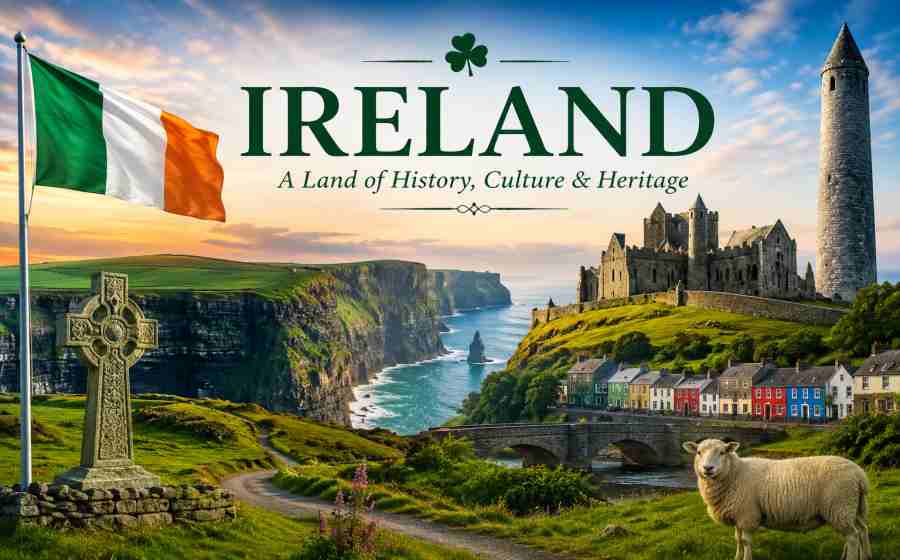
Ireland is one of Europe’s most beautiful and historically significant countries. Known as the Emerald Isle because of its lush green landscapes, Ireland is famous for its ancient castles, Celtic traditions, friendly people, literary heritage, and breathtaking natural scenery. Located in northwestern Europe, the country occupies most of the island of Ireland, while Northern Ireland is part of the United Kingdom.
From prehistoric monuments to medieval monasteries and modern cities, Ireland has a remarkable story that has shaped its identity. Today, it is recognized for its high quality of life, strong economy, vibrant culture, and achievements in literature, sports, science, and technology.
Table of Contents
Geography of Ireland
Ireland is situated in the North Atlantic Ocean, west of Great Britain. The island covers approximately 84,421 square kilometers, making it the third-largest island in Europe.
Some important geographical features include:
- Capital: Dublin
- Largest City: Dublin
- Currency: Euro (€)
- Official Languages: Irish (Gaeilge) and English
- Climate: Temperate maritime climate with mild winters and cool summers
- Highest Mountain: Carrauntoohil (1,038 meters)
- Longest River: River Shannon
The country experiences frequent rainfall, which contributes to its famous green countryside filled with rolling hills, forests, rivers, and scenic coastlines.
History of Ireland
Ireland has one of Europe’s oldest continuous histories.
Ancient Ireland
Human settlements existed in Ireland more than 10,000 years ago. One of its oldest archaeological sites is Newgrange, a prehistoric monument built around 3200 BCE, making it older than Stonehenge and even the Egyptian pyramids.
The ancient Celts arrived around 500 BCE and introduced the Celtic language, traditions, and social structure that greatly influenced Irish identity.
Arrival of Christianity
Christianity spread across Ireland during the 5th century, mainly through Saint Patrick, who is regarded as the country’s patron saint. Monasteries became centers of learning and preserved valuable manuscripts during Europe’s medieval period.
Viking and Norman Influence
During the 8th and 9th centuries, Vikings raided and settled in Ireland. They founded several towns, including Dublin, Cork, Limerick, and Waterford.
Later, the Norman invasion in the 12th century increased English influence over Ireland.
British Rule
For several centuries, Ireland remained under British control. During the 19th century, the Great Famine (1845–1852) caused widespread starvation and mass emigration. Millions of Irish people moved to countries such as the United States, Canada, and Australia.
Independence
After years of political struggle, most of Ireland became an independent nation in 1922, forming the Irish Free State. It officially became the Republic of Ireland in 1949, while Northern Ireland remained part of the United Kingdom.
Today, Ireland is a democratic republic and a member of the European Union.
Government and Economy
Ireland is a parliamentary democracy headed by a President, while executive powers are exercised by the Prime Minister (Taoiseach).
The Irish economy has transformed dramatically over recent decades. Once largely dependent on agriculture, it is now one of Europe’s strongest economies.
Major industries include:
- Information technology
- Pharmaceuticals
- Medical devices
- Financial services
- Tourism
- Agriculture
- Food processing
Many leading multinational companies have established their European headquarters in Dublin due to Ireland’s business-friendly environment.
Irish Culture
Irish culture combines ancient Celtic traditions with modern European influences.
Music
Traditional Irish music remains popular worldwide. Instruments commonly used include:
- Harp
- Fiddle
- Tin whistle
- Bodhrán (Irish drum)
- Uilleann pipes
Irish folk music has inspired musicians across the globe.
Dance
Irish dance is internationally recognized, particularly after the success of productions such as Riverdance. It is known for its fast footwork and upright posture.
Literature
Ireland has produced some of the world’s greatest writers, including:
- James Joyce
- Oscar Wilde
- W.B. Yeats
- Samuel Beckett
- Seamus Heaney
Several Irish authors have received the Nobel Prize in Literature.
Festivals
Popular celebrations include:
- Saint Patrick’s Day (17 March)
- Galway International Arts Festival
- Dublin Theatre Festival
- Fleadh Cheoil (traditional music festival)
Saint Patrick’s Day is celebrated worldwide with parades, music, and cultural events.
Traditional Food
Irish cuisine emphasizes simple, hearty ingredients.
Popular dishes include:
- Irish Stew
- Soda Bread
- Boxty (potato pancakes)
- Colcannon
- Shepherd’s Pie
- Seafood Chowder
- Black and White Pudding
Potatoes have long been an important part of Irish cooking.
Sports in Ireland
Sports play an essential role in Irish society.
Gaelic Games
The most popular traditional sports are:
- Gaelic Football
- Hurling
- Camogie
These sports are organized by the Gaelic Athletic Association (GAA) and attract huge local support.
Rugby
Ireland has one of the world’s strongest rugby teams and regularly competes in the Six Nations Championship and Rugby World Cup.
Football (Soccer)
Football is widely played throughout the country, with many Irish players competing in major European leagues.
Horse Racing
Ireland has a long tradition of horse breeding and horse racing, producing world-class racehorses and jockeys.
Golf
Ireland’s scenic golf courses attract players from around the world.
Tourism in Ireland
Ireland welcomes millions of visitors every year. Major attractions include:
- Cliffs of Moher
- Ring of Kerry
- Giant’s Causeway (Northern Ireland)
- Dublin Castle
- Trinity College Dublin
- Blarney Castle
- Killarney National Park
- Wild Atlantic Way
Visitors enjoy stunning landscapes, historic castles, charming villages, and vibrant cultural experiences.
Education and Innovation
Ireland has an excellent education system and several internationally respected universities. The country has become a center for:
- Scientific research
- Artificial intelligence
- Biotechnology
- Software development
- Financial technology
Highly educated professionals have contributed significantly to Ireland’s economic success.
Wildlife and Environment
Although Ireland has relatively few large wild animals, it possesses diverse ecosystems.
Native wildlife includes:
- Red fox
- Red deer
- Irish hare
- Badger
- Atlantic puffin
- Grey seal
The country’s extensive national parks and protected areas help preserve its natural beauty.
Interesting Facts About Ireland
- Ireland is called the Emerald Isle because of its green landscape.
- The national symbol is the Irish harp.
- Saint Patrick is believed to have introduced Christianity to Ireland.
- Halloween originated from the ancient Celtic festival of Samhain.
- Ireland has over 30,000 castles and castle ruins.
- Newgrange is older than both Stonehenge and the Egyptian pyramids.
- Dublin was founded by Vikings.
- The Irish passport is among the world’s most respected travel documents.
- Ireland has one of the youngest populations in Europe.
- Irish people have made major contributions to literature, science, music, and technology.
Why Ireland is Famous
Ireland is internationally known for:
- Beautiful green countryside
- Rich Celtic heritage
- Friendly hospitality
- Ancient castles
- Traditional music and dance
- Gaelic sports
- Saint Patrick’s Day celebrations
- World-famous writers
- Strong education system
- Thriving technology industry
Summary
Ireland is a country where ancient traditions blend harmoniously with modern innovation. Its rich history, vibrant cultural heritage, breathtaking landscapes, and welcoming people have earned it a unique place on the world stage. From prehistoric monuments and medieval castles to lively festivals, traditional sports, and cutting-edge technology, Ireland offers something for everyone. Whether admired for its literature, music, natural beauty, or economic success, Ireland continues to inspire visitors and learners alike, making it one of the most fascinating countries in Europe.
Also Check: General Knowledge