Brunei – History, Culture, Tourism, Sports, Geography and Key Facts
Explore Brunei Darussalam’s history, culture, sports, geography, economy, traditions and key facts about this fascinating Southeast Asian nation.
Brunei
Brunei, officially known as Brunei Darussalam, is a small and prosperous country located on the northern coast of the island of Borneo in Southeast Asia. The name Brunei Darussalam is commonly translated as “Brunei, Abode of Peace.” Although small in geographical size, Brunei has a fascinating history, a strong Islamic cultural identity, rich Malay traditions and an economy closely associated with oil and natural gas.
Brunei shares the island of Borneo with Malaysia and Indonesia. Its territory is divided into four districts: Brunei-Muara, Belait, Tutong and Temburong. The capital and largest urban centre is Bandar Seri Begawan. The country covers about 5,765 square kilometres and has a tropical climate with warm temperatures and substantial rainfall throughout the year.
Table of Contents
History of Brunei
Brunei has a long and influential history in the Malay world. From approximately the 14th to the 16th centuries, the Brunei Sultanate became a powerful regional state. At its height, its influence extended across parts of present-day Sabah, Sarawak and the southern Philippines. The country’s ruling dynasty is regarded as one of the world’s oldest continuously ruling monarchies.
Over time, Brunei’s territorial influence declined because of internal conflicts, piracy, wars and European colonial expansion. During the 19th century, the country lost considerable territory. Brunei signed a treaty with Britain in 1847 and became a British protectorate in 1888. A British Resident system was introduced in 1906, although the Sultan retained authority over Malay customs, traditions and Islamic religious matters.
The discovery of petroleum dramatically changed Brunei’s economic future. Oil was discovered at Seria in 1929, and petroleum production later became the foundation of the modern economy. Brunei experienced Japanese occupation during the Second World War from 1941 to 1945.
A major constitutional development occurred in 1959 when a written constitution established internal self-government. Brunei eventually achieved full independence on 1 January 1984. On the same day, it became a member of the United Nations and the Organisation of Islamic Cooperation, and it joined ASEAN shortly afterward, on 8 January 1984.
Government and the Sultanate
Brunei is a constitutional sultanate in which the Sultan holds extensive executive authority. Sultan Hassanal Bolkiah, the 29th Sultan of Brunei, became Sultan in 1967 following the abdication of his father, Sultan Omar Ali Saifuddien. He was crowned in 1968.
The Sultan also serves as Prime Minister and has held important ministerial responsibilities. The country’s political and administrative system combines the monarchy with institutions established under its constitution.
Culture and Traditions of Brunei
Brunei’s culture is deeply connected with the traditional Malay world and Islamic values. Malay is the official language, while English is widely used and understood. Chinese and various indigenous languages are also spoken by different communities.
Islam has a particularly important role in Bruneian society and is the official religion. Islamic traditions influence family life, festivals, education, architecture and public customs. The cultural identity of Brunei has also been influenced by earlier animist and Hindu traditions as well as contact with Western societies, but Islam became deeply rooted in the country’s cultural and political identity.
Traditional arts and handicrafts are important parts of Brunei’s cultural heritage. These include silver-smithing, cloth weaving, basket and mat weaving, boat making, bronze work and wood carving. Traditional musical instruments, Malay weapons, decorative arts and the martial art of silat are also associated with the country’s heritage.
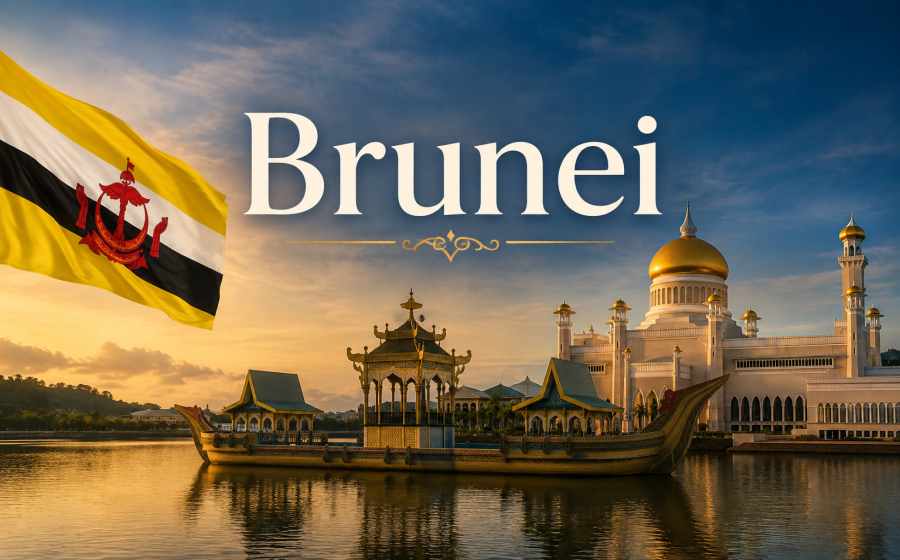
One of the best-known symbols of Brunei’s Islamic and royal heritage is the Omar Ali Saifuddien Mosque in Bandar Seri Begawan. Its impressive golden dome and setting near the Brunei River make it one of the country’s most recognizable landmarks.
Food and Lifestyle
Bruneian cuisine reflects the country’s Malay, Islamic and regional Southeast Asian influences. Rice, seafood, noodles, chicken and spices are common ingredients. Popular foods include ambuyat, a traditional dish made from sago starch, as well as various grilled, fried and noodle-based dishes.
Because Brunei is a Muslim-majority country, halal food is widely available. Traditional meals are often enjoyed during family gatherings, religious celebrations and national events.
Sports in Brunei
Sports are an important part of community life in Brunei. Football, badminton, swimming, athletics, sepak takraw, martial arts and basketball are among the sports enjoyed in the country.
Brunei participates in regional competitions such as the Southeast Asian Games and ASEAN sporting events. The country also hosted the 14th ASEAN Schools Games in 2025, which brought together more than 900 student-athletes from 10 ASEAN countries. Competitions included badminton, basketball, netball, athletics, sepak takraw, swimming, pencak silat and wushu.
Brunei’s national football team represents the country in international competitions, while individual Bruneian athletes have competed in regional and international events in sports such as swimming, athletics, shooting and martial arts.
Economy of Brunei
Brunei is particularly well known for its petroleum resources. Crude oil and natural gas have historically played a major role in the country’s economy and export earnings. The petroleum industry helped Brunei develop a high-income economy and supported extensive public services and infrastructure.
In recent years, Brunei has also focused on economic diversification. Areas such as tourism, halal industries, food production, logistics, financial services and other non-oil sectors are important to its long-term development.
Nature and Tourism
Despite its small size, Brunei contains significant areas of tropical rainforest. Temburong District is particularly famous for its natural environment and forest landscapes. The country’s protected forests provide habitats for numerous species of plants and wildlife.
Tasek Merimbun, Brunei’s largest natural lake, is another notable natural attraction. Visitors can also explore beaches, rivers, traditional water villages and cultural museums. Water taxis are a distinctive way to travel along the Brunei River and visit communities around the capital.
The country offers a combination of royal heritage, Islamic architecture, rainforest experiences and traditional culture, making it different from many other destinations in Southeast Asia.
Key Facts About Brunei
- Official Name: Brunei Darussalam
- Capital: Bandar Seri Begawan
- Location: Northern coast of Borneo, Southeast Asia
- Area: About 5,765 square kilometres
- Official Language: Malay
- Official Religion: Islam
- Currency: Brunei Dollar (BND)
- Government: Sultanate
- Independence: 1 January 1984
- ASEAN Membership: 8 January 1984
- Main Natural Resources: Crude oil and natural gas
- Major Districts: Brunei-Muara, Belait, Tutong and Temburong
- Climate: Tropical and humid
- National Carrier: Royal Brunei Airlines
Summary
Brunei Darussalam is a small but historically significant nation with a distinctive identity shaped by the Malay world, Islam and its long royal tradition. From the powerful Brunei Sultanate of earlier centuries to its period as a British protectorate and eventual independence in 1984, the country has undergone major political and economic changes.
Today, Brunei is recognized for its oil and natural gas resources, peaceful environment, Islamic culture, royal heritage, traditional crafts and extensive tropical forests.
Also Check: General Knowledge