Grenada – History, Culture, Tourist Places, Sports, Geography and Key Facts
Discover Grenada’s history, culture, sports, geography, economy, spices, tourism and key facts about the beautiful Caribbean “Spice Island.”
Grenada
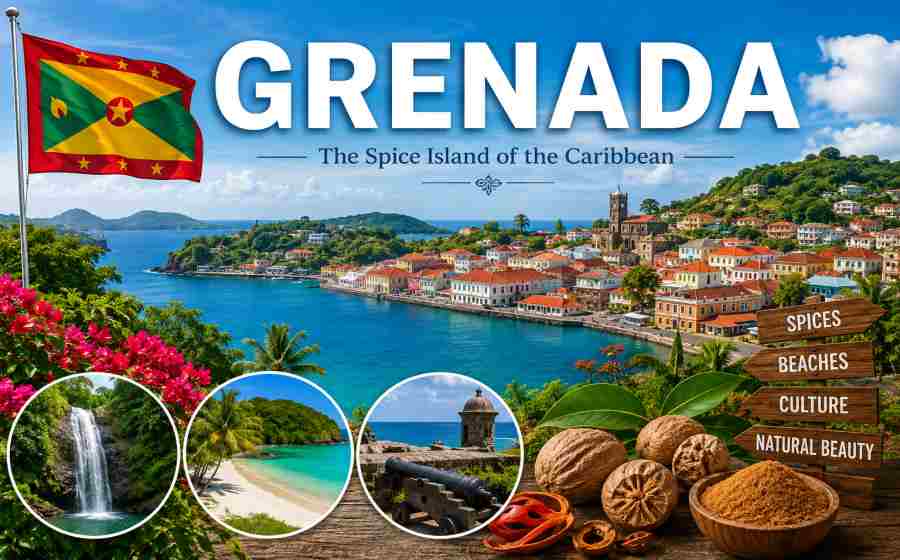
Grenada is a beautiful island country in the eastern Caribbean, famous for its lush landscapes, tropical climate, colorful culture, and production of spices. Often called the “Spice Island”, Grenada is particularly associated with nutmeg, mace, cinnamon, cloves, and other aromatic crops. The country consists of the main island of Grenada and two smaller islands, Carriacou and Petite Martinique. Together, they form a nation covering about 344 square kilometres.
The capital and largest urban centre is St. George’s, a picturesque city known for its harbor, historic buildings, and scenic surroundings. Grenada combines a fascinating colonial history with African, European, Caribbean, and East Indian influences, making it an interesting country.
Table of Contents
Geography of Grenada
Grenada is located in the southeastern part of the Caribbean Sea, north of Trinidad and Tobago and south of Saint Vincent and the Grenadines. Its territory includes three principal islands: Grenada, Carriacou, and Petite Martinique. The country’s landscape includes mountains, rainforests, beaches, valleys, waterfalls, and coastal areas.
Grenada has a tropical climate, with warm temperatures throughout much of the year. The main island is relatively mountainous and receives more rainfall than the smaller islands. Grand Etang, located in the interior of Grenada, is an important natural feature surrounded by forested highlands.
The country’s natural environment has also made it an attractive destination for tourism. According to the Government of Grenada, the country has more than 40 beaches, around 15 waterfalls, and numerous diving sites.
History of Grenada
Grenada was inhabited by Indigenous Caribbean peoples before European colonization. Christopher Columbus encountered the island during his third voyage in 1498. European powers later competed for control of Grenada, particularly France and Britain.
The French established a strong presence on the island, while Britain eventually became the dominant colonial power. Grenada remained under British rule until it achieved independence on 7 February 1974. Independence Day is now one of the country’s most important national observances.
Grenada’s colonial past left lasting influences on its language, architecture, place names, political institutions, and cultural traditions. African heritage became especially important as communities developed through the history of the plantation economy, while later East Indian influences further enriched the country’s society and cuisine.
Government and Political System
Grenada is a constitutional monarchy and parliamentary democracy. The British monarch is the head of state and is represented in Grenada by the Governor-General. The Prime Minister serves as the head of government.
The country’s Parliament consists of the Senate and the House of Representatives. The House of Representatives has elected members representing single-seat constituencies, while the Senate consists of appointed members.
As of 2026, Dickon Mitchell is the Prime Minister of Grenada, while Dame Cécile La Grenade serves as Governor-General.
Culture and Traditions of Grenada
Grenadian culture is a lively combination of Caribbean, African, European, and East Indian influences. Music, dance, food, festivals, storytelling, and traditional celebrations are important parts of national life.
One of the country’s biggest cultural celebrations is Spicemas, the annual carnival held during August. It features colorful costumes, music, dancing, street celebrations, masqueraders, and traditional characters. Other cultural events include Carriacou Carnival, the Carriacou Maroon & Stringband Music Festival, and various food, chocolate, diving, and sailing festivals.
Music is another important element of Grenadian culture. Calypso, soca, steelpan, and other Caribbean musical traditions are closely connected with festivals and community celebrations. The country’s cultural authorities also support music, theatre, dance, steelpan, and calypso through educational and artistic programmes.
Food of Grenada
Grenadian cuisine reflects the country’s tropical environment and diverse heritage. One of its best-known traditional dishes is Oil Down, widely regarded as a national dish.
Oil Down is a hearty one-pot meal generally prepared with ingredients such as breadfruit, vegetables, coconut milk, meat or salted fish, and seasonings. Spices play an important role in Grenadian cooking, giving many local dishes distinctive aromas and flavors.
Cocoa and chocolate are also important parts of Grenada’s culinary identity. The island’s agricultural traditions have supported both cocoa production and the development of locally produced chocolate.
Spice Island and Economy
Grenada’s nickname, the “Spice Island,” comes from its long association with spice production. Nutmeg is particularly important to the country’s identity and economy. Other important agricultural products include cocoa, mace, cloves, cinnamon, fruits, vegetables, and fish.
Grenada’s economy has gradually shifted from being primarily agriculture-based toward services, with tourism becoming a major source of foreign exchange. Agriculture nevertheless remains culturally and economically significant, particularly through nutmeg and cocoa production. Official statistics continue to track nutmeg, cocoa, mace, and other crops as important agricultural exports.
Sports in Grenada
Sports play an important role in Grenadian society, with athletics and cricket being particularly notable. Football, boxing, basketball, swimming, tennis, cycling, and other sports are also practiced.
Grenada achieved international sporting fame through Kirani James, one of the country’s greatest athletes. James won the men’s 400 metres gold medal at the 2012 London Olympics, giving Grenada its first-ever Olympic medal. He later won silver at the 2016 Rio Olympics and bronze at the Tokyo 2020 Olympics.
Kirani James also became a world champion in the 400 metres in 2011 and won a Commonwealth Games gold medal in 2014. His achievements have made athletics a major source of national pride in Grenada.
Grenada has participated in the Summer Olympic Games since 1984. Its Olympic athletes have competed in disciplines including athletics, boxing, swimming, and taekwondo.
Tourism in Grenada
Tourism is an increasingly important part of Grenada’s economy. Visitors are attracted by its beaches, tropical forests, waterfalls, historic forts, spice plantations, cultural festivals, and underwater attractions.
Grenada is particularly famous for marine tourism. Its waters provide opportunities for diving and snorkeling, while the country’s underwater sculpture park is one of its distinctive attractions. The combination of natural beauty and cultural experiences has helped establish Grenada as a notable Caribbean destination.
Important Facts About Grenada
- Official Name: Grenada
- Capital: St. George’s
- Region: Caribbean
- Nickname: Spice Island
- Independence Day: 7 February 1974
- Currency: Eastern Caribbean Dollar (XCD)
- Official Language: English
- Other Language: French Patois
- Area: About 344 km²
- Main Islands: Grenada, Carriacou and Petite Martinique
- Government: Constitutional monarchy
- Head of Government: Prime Minister
- Major Agricultural Products: Nutmeg, cocoa, mace, cinnamon and cloves
- Major Economic Sector: Services and tourism
- International Dialing Code: +1 473
- Internet Domain: .gd
- Major Airport: Maurice Bishop International Airport
- Famous Sportsperson: Kirani James
- First Olympic Medal: Gold in men’s 400m, won by Kirani James in 2012
Summary
Grenada is a small Caribbean nation with a remarkable combination of natural beauty, cultural diversity, historical significance, and sporting achievement. Its identity is strongly connected with spices, especially nutmeg, while its festivals, music, cuisine, and traditions demonstrate the diverse influences that have shaped the country. Its journey from Indigenous settlement and European colonial rule to independence in 1974 makes it an important example of Caribbean history and nation-building.
Also Check: General Knowledge