Cuba – History, Culture, Sports, Tourist Places and Key Facts
Discover Cuba through its rich history, culture, famous sports, traditions, geography, economy and key facts that make the island nation truly remarkable.
Cuba
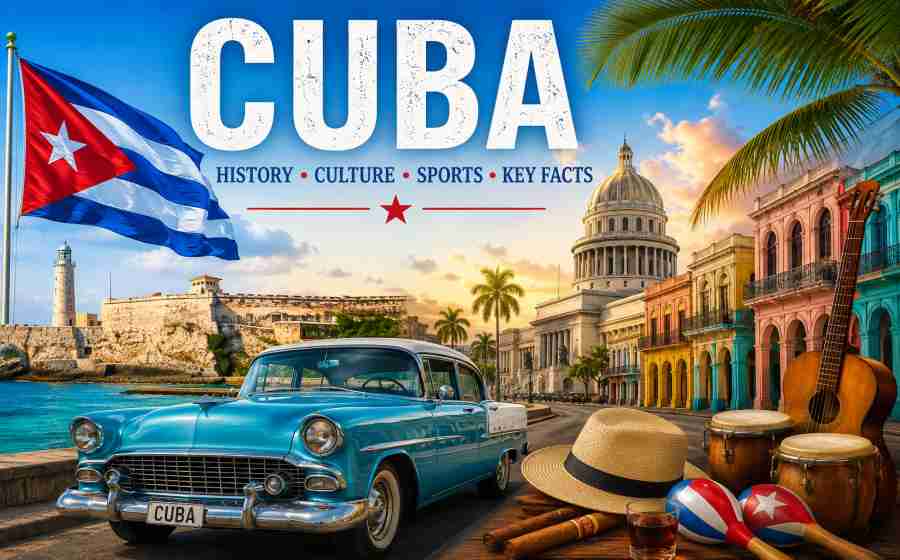
Cuba is the largest island nation in the Caribbean and is well known for its rich history, colorful culture, classic vintage cars, beautiful beaches, music, and revolutionary past. Located where the Caribbean Sea, the Gulf of Mexico, and the Atlantic Ocean meet, Cuba has played an important role in world history due to its strategic location. Today, the country is recognized for its strong cultural identity, achievements in sports and healthcare, and unique political system.
From the rhythms of salsa music to the historic streets of Havana, Cuba offers a fascinating blend of tradition and modern life. Despite facing economic challenges and international sanctions for decades, the country continues to preserve its heritage and attract millions of visitors every year.
Table of Contents
Geography of Cuba
Cuba lies in the northern Caribbean and consists of the main island of Cuba, the Isla de la Juventud (Island of Youth), and thousands of smaller islands and cays.
- Capital: Havana
- Largest City: Havana
- Official Language: Spanish
- Currency: Cuban Peso (CUP)
- Area: Approximately 109,884 square kilometers
- Population: Around 11 million people
- Time Zone: Cuba Standard Time (CST)
The island has tropical weather with warm temperatures throughout the year. Its landscape includes fertile plains, mountains, forests, rivers, and white-sand beaches, making it one of the Caribbean’s most attractive destinations.
History of Cuba
Cuba’s early inhabitants were indigenous peoples, including the Taíno and Ciboney. In 1492, Christopher Columbus arrived on the island during his first voyage to the Americas, marking the beginning of Spanish colonization.
For nearly four centuries, Cuba remained under Spanish rule. During this period, sugar plantations expanded, and enslaved Africans were brought to the island, greatly influencing Cuban culture.
The struggle for independence intensified in the 19th century. Following the Spanish-American War in 1898, Spain lost control of Cuba. Although Cuba officially became independent in 1902, the United States maintained significant influence over its affairs.
One of the most significant events in Cuban history was the Cuban Revolution of 1959. Led by Fidel Castro, Che Guevara, and their supporters, the revolution overthrew the government of Fulgencio Batista. Cuba then adopted a socialist political system, which continues today.
During the Cold War, Cuba became a close ally of the Soviet Union. The Cuban Missile Crisis of 1962 brought the world to the brink of nuclear conflict and remains one of the most important events in modern history.
Government and Economy
Cuba is a socialist republic with a single-party political system. The government plays a major role in sectors such as healthcare, education, transportation, and industry.
The country’s economy depends on:
- Tourism
- Agriculture
- Tobacco production
- Sugar
- Biotechnology
- Pharmaceutical research
- Nickel mining
- Medical services
Although Cuba has experienced economic difficulties due to trade restrictions and limited foreign investment, tourism remains one of its largest sources of income.
Culture of Cuba
Cuban culture is a vibrant combination of Spanish, African, and Caribbean influences. This cultural mix is reflected in music, dance, food, literature, religion, and festivals.
Family plays a central role in Cuban society, and communities often celebrate together through music and social gatherings.
Music and Dance
Music is one of Cuba’s greatest contributions to the world. Popular styles include:
- Salsa
- Son Cubano
- Rumba
- Mambo
- Cha-cha-cha
- Bolero
These musical traditions have influenced artists across the globe.
Festivals
Some important festivals celebrated in Cuba include:
- Havana International Jazz Festival
- Carnival of Santiago de Cuba
- International Ballet Festival
- New Year’s celebrations
- National Liberation Day
These events showcase Cuban music, dance, and artistic talent.
Traditional Food
Cuban cuisine combines Spanish, African, and Caribbean flavors.
Popular dishes include:
- Ropa Vieja (shredded beef)
- Moros y Cristianos (rice and black beans)
- Roast pork
- Fried plantains
- Yuca with garlic sauce
- Cuban sandwiches
- Flan
Coffee is also an important part of Cuban daily life, and Cuban espresso is famous worldwide.
Sports in Cuba
Sports are highly valued in Cuba, and the country has achieved remarkable success in international competitions despite its relatively small population.
Baseball
Baseball is the national sport and enjoys immense popularity. Cuba has won numerous international baseball championships and produced many talented players.
Boxing
Cuba is considered one of the world’s strongest boxing nations. Cuban boxers have won numerous Olympic and World Championship medals.
Athletics
Cuban athletes have excelled in:
- High jump
- Triple jump
- Sprinting
- Wrestling
- Judo
- Volleyball
The country consistently performs well in the Olympic Games.
Education and Healthcare
Cuba is widely recognized for its universal education and healthcare systems. Education is free from primary school through university, resulting in one of the highest literacy rates in Latin America.
Healthcare is also publicly funded, with an extensive network of hospitals and clinics. Cuban doctors have participated in medical missions across many countries.
Tourism in Cuba
Tourism is one of Cuba’s most important industries. Popular attractions include:
- Historic Havana
- Varadero Beach
- Viñales Valley
- Trinidad
- Cayo Coco
- Cienfuegos
- Santiago de Cuba
Visitors enjoy colonial architecture, beaches, classic American cars, museums, music, and vibrant nightlife.
Wildlife and Natural Beauty
Cuba has rich biodiversity with many species found nowhere else.
Its natural attractions include:
- Coral reefs
- Mangrove forests
- Tropical rainforests
- Limestone caves
- National parks
- Wetlands
The country is home to colorful birds, reptiles, marine life, and rare plant species.
Economy and Major Exports
Important exports from Cuba include:
- Tobacco
- Cigars
- Sugar
- Rum
- Nickel
- Pharmaceuticals
- Coffee
Cuban cigars are internationally famous for their quality and craftsmanship.
Interesting Facts About Cuba
- Cuba is the largest island in the Caribbean.
- Havana is one of the oldest continuously inhabited cities in the Americas.
- Cuba has one of the world’s highest literacy rates.
- Baseball is the country’s most popular sport.
- Cuban music has influenced artists worldwide.
- The island is famous for its classic vintage American cars.
- Cuba has over 5,000 kilometers of coastline.
- The country has more than 4,000 islands and small cays.
- Cuban cigars are considered among the finest in the world.
- Cuba has earned numerous Olympic medals, especially in boxing and athletics.
Summary
Cuba is a nation where history, culture, resilience, and natural beauty come together to create a unique identity. From its revolutionary past and colonial architecture to its lively music, world-class athletes, and scenic landscapes, the country continues to capture global attention. Despite economic challenges, Cuba has made remarkable achievements in education, healthcare, sports, and cultural preservation. Its rich traditions, welcoming people, and historical significance make it one of the most fascinating countries in the Caribbean and an important topic in world general knowledge.
Also Check: General Knowledge