
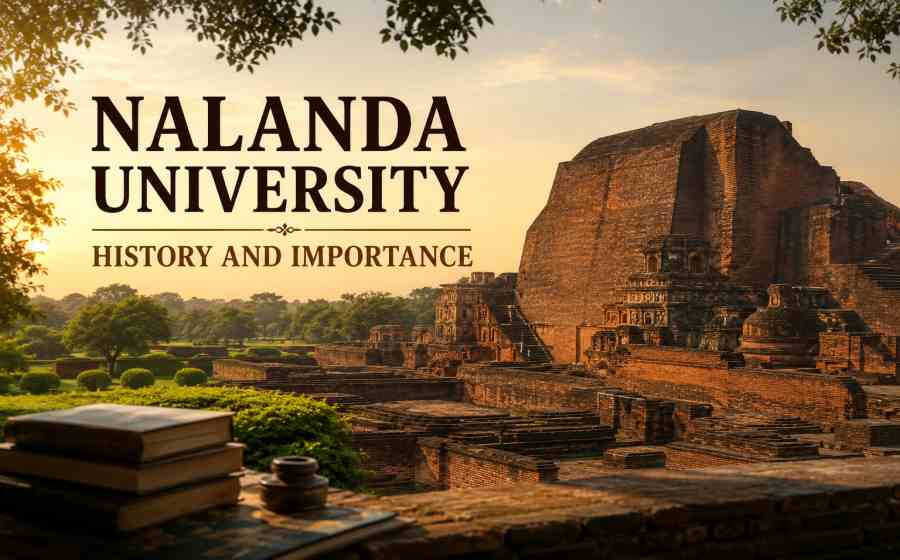
Nalanda University History and Importance – Bihar’s Ancient Center of Global Learning
Explore the Nalanda University History and Importance, the world-famous ancient center of learning in Bihar that shaped education, culture and knowledge.
Nalanda University History and Importance
Nalanda University is one of the most remarkable educational institutions in world history. Located in present-day Bihar, India, it was among the earliest residential universities and attracted students and scholars from various parts of Asia. Known for its vast library, highly qualified teachers, and advanced learning system, Nalanda became a symbol of intellectual excellence. The university played a crucial role in spreading knowledge, culture, and Buddhist philosophy across different regions of the world.
The history of Nalanda University reflects India’s rich educational heritage and its contribution to global learning. Even centuries after its decline, Nalanda continues to inspire educators, historians, and students worldwide.
Table of Contents
Origin and Establishment of Nalanda University
Nalanda University was established during the Gupta Empire in the 5th century CE. It is widely believed that Kumaragupta I, one of the prominent Gupta rulers, founded the university. The Gupta period is often referred to as the Golden Age of India because of significant achievements in science, literature, mathematics, art, and education.
The location of Nalanda was strategically important. Situated near Rajgir and not far from Patna, it was connected to important trade and cultural routes. The region was also closely associated with Buddhism, making it an ideal place for a major center of learning.
Initially established as a Buddhist educational institution, Nalanda gradually expanded its curriculum and welcomed students from various backgrounds and faiths.
Growth into a World-Famous University
Nalanda University quickly gained international recognition. Scholars and students traveled from China, Korea, Tibet, Japan, Mongolia, Sri Lanka, and Southeast Asia to study there. Historical records suggest that thousands of students and teachers lived and studied on the campus at the same time.
The university maintained very high academic standards. Admission was not easy, and prospective students had to pass challenging entrance examinations. This ensured that only dedicated and capable learners became part of the institution.
The reputation of Nalanda spread far beyond India, making it one of the earliest examples of an international university.
Subjects Taught at Nalanda
Although Nalanda is primarily known for Buddhist studies, its academic offerings were much broader. Students received education in a wide range of subjects, including:
- Buddhist philosophy
- Logic and reasoning
- Grammar and linguistics
- Mathematics
- Astronomy
- Medicine
- Literature
- Fine arts
- Political science
- Theology
This diverse curriculum demonstrates that Nalanda was not merely a religious center but a comprehensive institution dedicated to intellectual development.
Famous Scholars Associated with Nalanda
Many renowned scholars contributed to the university’s prestige. Among them was Acharya Shilabhadra, who served as a respected head of the institution. He was known for his deep knowledge of Buddhist philosophy and attracted students from distant countries.
One of the most famous visitors was the Chinese monk Xuanzang (Hiuen Tsang), who studied at Nalanda during the 7th century CE. He spent several years there and later documented his experiences in detailed writings. His accounts provide valuable information about the university’s structure, educational methods, and daily life.
Another important Chinese scholar, Yijing, also visited Nalanda and praised its academic excellence and disciplined environment.
The Magnificent Library of Nalanda
Nalanda University possessed one of the largest libraries of the ancient world. The library complex was known as “Dharmaganja,” meaning “Treasury of Truth.”
It consisted of multiple buildings that housed thousands of manuscripts on various subjects. These manuscripts contained valuable knowledge related to religion, science, medicine, mathematics, philosophy, and literature.
The library became a major source of learning for scholars from different countries. Its vast collection reflected the university’s commitment to preserving and expanding human knowledge.
Architectural Excellence
The Nalanda campus was carefully planned and featured impressive architecture. Excavations have revealed monasteries, temples, lecture halls, courtyards, and residential buildings.
The structures were built primarily using red bricks and displayed advanced engineering skills. Wide pathways connected different sections of the campus, creating an organized academic environment.
The architectural remains discovered by archaeologists continue to attract historians and tourists interested in ancient Indian civilization.
Role in the Spread of Knowledge
Nalanda University played a major role in the transmission of knowledge across Asia. Students who completed their studies often returned to their homelands and shared what they had learned.
As a result, Buddhist teachings, philosophical ideas, scientific concepts, and literary traditions spread to many regions. Nalanda became a bridge connecting different cultures and civilizations.
The institution encouraged intellectual discussions and scholarly exchanges, helping create a vibrant international academic community centuries before the modern concept of global universities emerged.
Decline and Destruction
Despite its success, Nalanda eventually faced decline. Political instability and changing religious dynamics affected the university’s support system.
The most significant blow came during the late 12th century when the forces of Bakhtiyar Khilji invaded the region. Historical accounts indicate that the university suffered extensive destruction. Many buildings were damaged, and countless manuscripts were lost.
The decline of Nalanda marked the end of one of the world’s greatest centers of learning. However, its legacy survived through historical records and the influence it had already spread across Asia.
Archaeological Discoveries
Modern archaeological excavations have uncovered significant remains of the ancient university. These discoveries include monasteries, temples, sculptures, inscriptions, and educational structures.
The ruins provide valuable insights into the organization and functioning of one of the world’s earliest universities. Today, the site is recognized as an important heritage location and attracts visitors from around the globe.
The archaeological findings have helped historians reconstruct the story of Nalanda and understand its contributions to education and culture.
Importance of Nalanda University Today
Nalanda University remains an enduring symbol of India’s educational heritage. Its importance can be understood through several key contributions:
- It demonstrated the value of organized higher education.
- It promoted international academic exchange.
- It encouraged research and intellectual inquiry.
- It preserved and expanded knowledge in multiple disciplines.
- It contributed significantly to the spread of Indian culture and Buddhist philosophy.
- It showcased Bihar’s historic role as a center of learning.
- It continues to inspire modern educational institutions worldwide.
The revival of Nalanda University in modern times reflects the continued relevance of its vision of global education and cultural cooperation.
Summary
Nalanda University was far more than an ancient educational institution. It represented a tradition of learning, research, and international collaboration that was centuries ahead of its time. Established in Bihar during the Gupta period, it attracted scholars from across Asia and became one of the greatest centers of knowledge in human history.
Its achievements in education, philosophy, science, and cultural exchange continue to be celebrated today. The history and importance of Nalanda University remind us of India’s rich intellectual heritage and the enduring power of education to connect people, ideas, and civilizations across the world.
Also Check: Bihar GK