Gupta Empire The Golden Age of India in Bihar and Its Lasting Legacy
Explore Gupta Empire The Golden Age of India in Bihar, its rulers, achievements, culture, science, education and lasting influence on Indian history.
Gupta Empire The Golden Age of India in Bihar
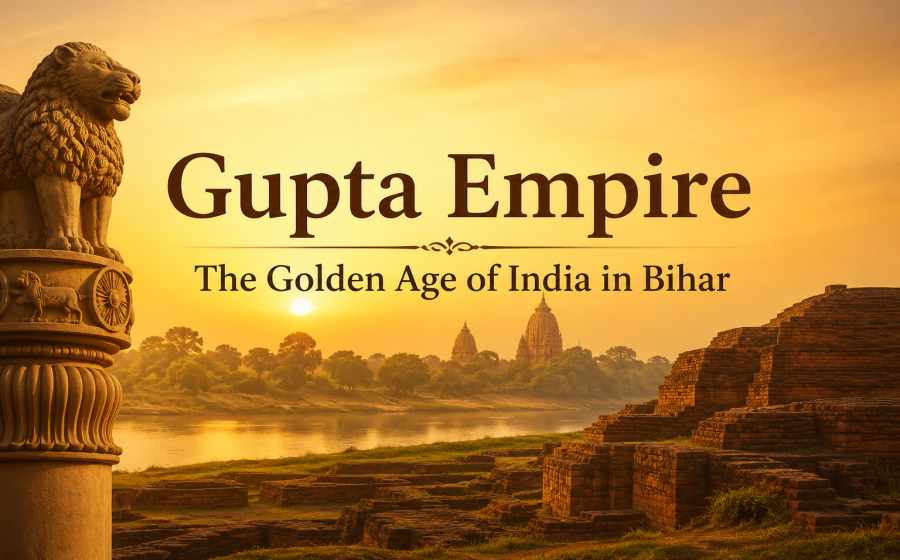
The Gupta Empire is widely regarded as the Golden Age of Ancient India, a period marked by remarkable achievements in politics, literature, science, mathematics, art, and education. Lasting from approximately 320 CE to 550 CE, the Gupta Empire brought peace, prosperity, and cultural development across much of the Indian subcontinent. Bihar played a significant role during this era, serving as an important center of learning, religion, administration, and trade.
The Gupta rulers established one of the most influential dynasties in Indian history. Their reign witnessed rapid advancements in knowledge and culture that shaped India’s identity for centuries. The contributions of the Gupta Empire continue to inspire scholars, historians, and students around the world.
Table of Contents
Rise of the Gupta Empire
The Gupta Empire was founded by Sri Gupta, who established a small kingdom in northern India around the late 3rd century CE. His successor Ghatotkacha strengthened the kingdom, but the empire truly began expanding under Chandragupta I, who came to power around 320 CE.
Chandragupta I formed strategic alliances through marriage, especially with the powerful Licchavi dynasty. This alliance increased the empire’s influence in regions including present-day Bihar. He adopted the title Maharajadhiraja, meaning “King of Kings,” signifying his growing authority.
Bihar’s Importance During the Gupta Period
Bihar occupied a central position within the Gupta Empire. Ancient cities such as Pataliputra (modern Patna), Nalanda, Rajgir, and Vaishali remained important political, educational, and religious centers.
Pataliputra, which had earlier served as the capital of the Mauryan Empire, continued to be an important administrative city under the Guptas. Its strategic location along the Ganga River supported trade, governance, and communication throughout northern India.
Nalanda gradually developed into one of the world’s greatest centers of higher education during the Gupta period. Although the university reached its peak later, its foundations were laid during Gupta rule, attracting scholars from different parts of Asia.
Great Gupta Rulers
Chandragupta I (320–335 CE)
Chandragupta I transformed the Gupta kingdom into a rising empire. His diplomatic alliances and efficient administration laid the groundwork for future expansion.
Samudragupta (335–375 CE)
Samudragupta is often called the “Napoleon of India” because of his remarkable military campaigns. He expanded the empire across much of northern India and into parts of central and southern India.
Despite being a great conqueror, Samudragupta respected defeated rulers and often allowed them to govern their territories under Gupta authority. His achievements are recorded in the famous Allahabad Pillar Inscription, composed by his court poet Harisena.
He was also a patron of music and is depicted on coins playing the veena, demonstrating his interest in the arts.
Chandragupta II (Vikramaditya) (375–415 CE)
Under Chandragupta II, the Gupta Empire reached its greatest extent and prosperity. Trade flourished, cities expanded, and Indian culture reached new heights.
His court became famous for hosting the legendary Navaratnas (Nine Gems), a group of distinguished scholars and intellectuals. Among them was the renowned poet and playwright Kalidasa, whose literary works remain classics of Sanskrit literature.
Administration and Governance
The Gupta rulers established an efficient administrative system. The empire was divided into provinces, districts, and villages, each managed by appointed officials.
Local self-government was encouraged, and village councils played an important role in resolving disputes and managing local affairs. This decentralized administration helped maintain peace and stability across the empire. The Gupta kings also maintained a strong military while promoting law, order, and economic development.
Economic Prosperity
The Gupta period witnessed significant economic growth. Agriculture remained the backbone of the economy, supported by fertile river valleys, especially in Bihar.
Trade expanded both within India and with foreign regions including Southeast Asia and parts of the Roman world. Merchants traded textiles, spices, precious stones, ivory, and metal goods.
The Gupta rulers issued high-quality gold coins, reflecting the empire’s economic strength and commercial prosperity.
Achievements in Science and Mathematics
One of the greatest contributions of the Gupta period was the advancement of science and mathematics. The famous mathematician and astronomer Aryabhata, who was associated with Kusumapura (identified with Pataliputra in Bihar), made groundbreaking discoveries.
His achievements include:
- Explaining that the Earth rotates on its axis.
- Calculating the approximate value of pi.
- Advancing algebra and trigonometry.
- Making significant contributions to astronomy.
The concept of zero and the decimal number system also gained prominence during this period, later influencing mathematics across the world.
Literature and Language
Sanskrit flourished under Gupta patronage and became the dominant language of scholarship and literature.
The greatest literary figure of the period was Kalidasa, whose works include:
- Abhijnanashakuntalam
- Meghaduta
- Raghuvamsha
These masterpieces are still admired for their poetic beauty and philosophical depth. Many religious texts, scientific works, and legal treatises were also composed during the Gupta era.
Art and Architecture
The Gupta period is considered a golden age of Indian art. Artists created elegant sculptures of Hindu, Buddhist, and Jain deities with refined craftsmanship and balanced proportions.
Temple architecture also evolved significantly during this time. Stone temples with beautifully carved pillars and decorative sculptures became more common. Gupta-style art influenced artistic traditions across South and Southeast Asia for centuries.
Religion and Culture
The Gupta rulers primarily followed Hinduism, particularly Vaishnavism, but they practiced religious tolerance.
Buddhism and Jainism continued to flourish, especially in Bihar, where important pilgrimage centers attracted monks and scholars from distant countries. Religious harmony and cultural diversity became defining characteristics of Gupta society.
Education and Nalanda
Education reached exceptional heights during the Gupta period. Nalanda in Bihar emerged as an important center of learning, where students studied philosophy, medicine, astronomy, mathematics, grammar, and Buddhist scriptures.
Scholars from China, Korea, Tibet, and Southeast Asia later traveled to Nalanda, making Bihar a globally respected educational destination.
Decline of the Gupta Empire
After the reign of Skandagupta, the empire gradually weakened. Several factors contributed to its decline:
- Repeated invasions by the Hunas (White Huns)
- Internal political conflicts
- Weak successors
- Economic challenges
- Loss of provincial control
By the middle of the 6th century CE, the Gupta Empire had fragmented into smaller kingdoms.
Legacy of the Gupta Empire
Although the Gupta Empire eventually declined, its influence remained profound. Its achievements in mathematics, astronomy, literature, education, governance, and art laid the foundation for many later Indian kingdoms. The decimal system, Sanskrit literature, scientific discoveries, and architectural styles developed during this era continue to be celebrated worldwide.
For Bihar, the Gupta period strengthened its reputation as one of India’s greatest centers of learning and culture. Cities like Pataliputra and Nalanda became symbols of intellectual excellence and historical significance.
Summary
The Gupta Empire truly deserves its title as the Golden Age of India. Under visionary rulers, India experienced extraordinary progress in governance, science, literature, education, and culture. Bihar stood at the heart of this transformation, contributing significantly to the empire’s political strength and intellectual achievements.
Even today, the legacy of the Gupta Empire reminds us of an era when knowledge, creativity, and cultural harmony flourished. Its remarkable accomplishments continue to inspire generations and remain an essential chapter in the history of Bihar and India.
Also Check: Bihar GK