
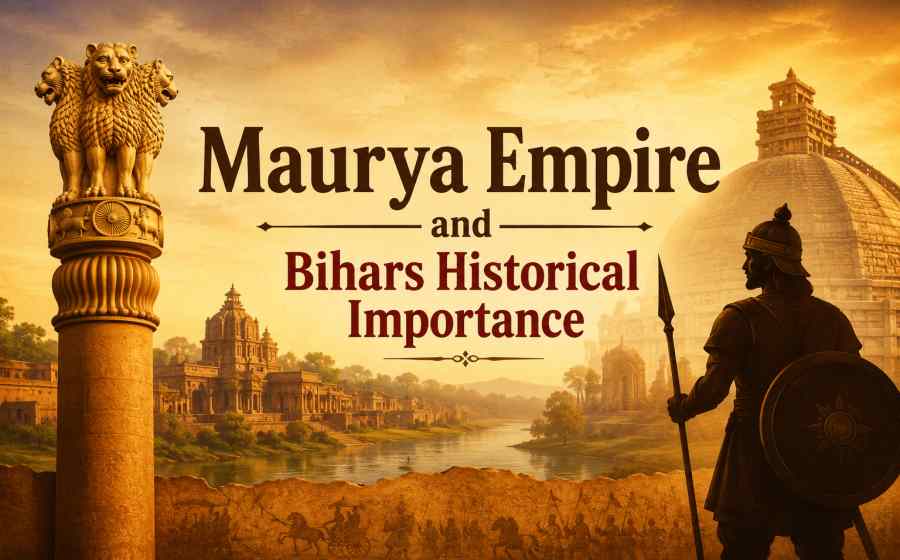
Maurya Empire and Bihars Historical Importance – The Cradle of India’s First Great Empire
Explore Maurya Empire and Bihars Historical Importance, from Chandragupta Maurya to Ashoka and discover Bihar’s role in shaping ancient India.
Maurya Empire and Bihars Historical Importance
The Maurya Empire was one of the greatest and most influential empires in the history of ancient India. Established in the 4th century BCE, it became the first empire to unite a large part of the Indian subcontinent under a single administration. The empire laid the foundation for political unity, efficient governance, economic prosperity, and the spread of Buddhism. At the heart of this remarkable civilization was Bihar, a region that served as the political, cultural, and intellectual center of the Mauryan rulers.
Bihar’s historical importance extends far beyond being the capital region of the Maurya Empire. It was home to famous universities, major trade routes, religious movements, and influential rulers whose contributions shaped Indian history for centuries. Even today, the ruins, monuments, and historical sites of Bihar remind us of its glorious past.
Table of Contents
Origin of the Maurya Empire
The Maurya Empire was founded by Chandragupta Maurya around 322 BCE after defeating the Nanda Dynasty. With the guidance of his brilliant teacher and strategist Chanakya (Kautilya), Chandragupta successfully established a powerful kingdom centered in Pataliputra, present-day Patna in Bihar.
The empire soon expanded across northern India and gradually became one of the largest empires in the ancient world. Chandragupta’s strong military organization, administrative reforms, and diplomatic policies helped secure his rule and establish lasting stability.
Pataliputra: The Capital of the Empire
One of the strongest reasons behind Bihar’s historical importance was Pataliputra, the magnificent capital of the Maurya Empire.
Situated near the confluence of the Ganga, Son, Gandak, and Punpun rivers, Pataliputra enjoyed several advantages:
- Excellent transportation through river networks
- Fertile agricultural land
- Easy communication with different regions
- Strong natural defenses
- Flourishing trade and commerce
Greek ambassador Megasthenes, who visited the Mauryan court, described Pataliputra as one of the largest and most prosperous cities of its time. Wide roads, fortified walls, administrative buildings, gardens, and organized marketplaces reflected the empire’s advanced urban planning.
Chandragupta Maurya: The Founder
Chandragupta Maurya transformed a small kingdom into a vast empire extending across much of the Indian subcontinent.
His achievements include:
- Defeating the Nanda rulers
- Expanding territory through military campaigns
- Establishing a centralized administration
- Maintaining a disciplined standing army
- Encouraging agriculture and trade
- Building diplomatic relations with neighboring kingdoms
His reign marked the beginning of political unity in ancient India.
Chanakya and the Arthashastra
No discussion of the Maurya Empire is complete without mentioning Chanakya, also known as Kautilya. He served as Chandragupta’s chief advisor and authored the famous Arthashastra, one of the world’s earliest works on governance, economics, military strategy, taxation, and diplomacy.
The Arthashastra explains:
- Efficient administration
- Revenue collection
- Law and justice
- Intelligence networks
- Foreign policy
- Economic management
- Public welfare
Many principles described in this ancient text continue to be studied by scholars of political science and management today.
Emperor Ashoka: The Greatest Mauryan Ruler
The Maurya Empire reached its greatest height under Emperor Ashoka, grandson of Chandragupta Maurya. Initially known for his military campaigns, Ashoka’s life changed dramatically after the Kalinga War around 261 BCE. Witnessing the immense suffering caused by the conflict, he embraced Buddhism and adopted a policy of peace and non-violence.
Ashoka’s major contributions include:
- Promotion of Buddhism
- Construction of stupas and monasteries
- Welfare measures for citizens
- Road construction
- Tree plantation along highways
- Hospitals for humans and animals
- Spread of moral values through inscriptions
His famous rock and pillar edicts remain valuable historical sources for understanding the administration and philosophy of the Maurya Empire.
Bihar as the Center of Buddhism
Bihar became one of the world’s most important centers of Buddhism during the Mauryan period. After adopting Buddhism, Ashoka actively supported Buddhist institutions and sponsored the construction of monasteries, stupas, and pilgrimage sites throughout Bihar.
Important Buddhist locations in Bihar include:
- Bodh Gaya
- Rajgir
- Nalanda
- Vaishali
These places attracted monks, scholars, and pilgrims from across Asia and helped spread Buddhist teachings internationally.
Administration of the Maurya Empire
The Mauryan administrative system was highly organized and efficient.
Key features included:
- Centralized government
- Provincial governors
- District administrators
- Village officials
- Efficient taxation
- Standing army
- Spy network
- Judicial system
The king supervised all major affairs with assistance from ministers and advisors. Different departments handled agriculture, trade, mining, forests, roads, irrigation, and defense. This administrative structure inspired several later Indian kingdoms.
Economy and Trade
The Maurya Empire enjoyed a prosperous economy supported by agriculture, industry, and commerce.
Major economic activities included:
- Farming
- Animal husbandry
- Textile production
- Metalwork
- Pottery
- Trade
- Forestry
- Mining
Bihar’s fertile plains contributed significantly to agricultural production. Well-developed roads and river transport connected Pataliputra with various parts of India, encouraging domestic and international trade. Merchants traded goods such as spices, cotton, ivory, precious stones, silk, and handicrafts.
Art and Architecture
Mauryan art reached remarkable heights during Ashoka’s reign. Famous architectural achievements include:
- Ashokan pillars
- Stone sculptures
- Rock-cut caves
- Buddhist stupas
- Palaces
- Monasteries
The polished sandstone pillars topped with beautifully carved animal figures became symbols of Mauryan craftsmanship.
The Lion Capital of Ashoka, originally erected at Sarnath, later became the National Emblem of India, while the Ashoka Chakra appears at the center of the Indian National Flag.
Education and Knowledge
Bihar has long been recognized as a center of learning. Although Nalanda University flourished after the Mauryan period, the educational traditions established in Bihar during ancient times laid the foundation for later institutions.
Scholars studied subjects such as:
- Philosophy
- Grammar
- Mathematics
- Astronomy
- Medicine
- Politics
- Literature
- Religion
The intellectual environment of Bihar attracted students from various regions of Asia.
Historical Importance of Bihar
Bihar occupies a unique place in Indian history because of its contributions to politics, religion, education, and culture.
Its historical importance includes:
- Capital region of the Maurya Empire
- Birthplace of powerful rulers
- Center of Buddhist activities
- Home of Chanakya’s political philosophy
- Major center of trade
- Early urban development
- Growth of ancient education
- Cultural exchange across Asia
The region influenced the development of governance, administration, and religious thought throughout South Asia.
Legacy of the Maurya Empire
The Maurya Empire left an enduring legacy that continues to shape India’s historical identity.
Its contributions include:
- Political unification of much of the Indian subcontinent
- Strong administrative institutions
- Promotion of ethical governance
- Expansion of Buddhism across Asia
- Development of trade networks
- Cultural and architectural achievements
- Lasting influence on later kingdoms
The empire demonstrated that effective governance, public welfare, and cultural harmony could coexist within a vast and diverse state.
Summary
The Maurya Empire and Bihar’s historical importance are inseparable chapters of India’s ancient heritage. From the rise of Chandragupta Maurya and the wisdom of Chanakya to the compassionate rule of Emperor Ashoka, Bihar served as the political and cultural heart of one of the world’s greatest empires. Pataliputra became a symbol of administrative excellence, while Bihar emerged as a center of learning, trade, and Buddhism that influenced civilizations across Asia. Even today, the legacy of the Maurya Empire continues to inspire historians, students, and citizens, reminding us of Bihar’s pivotal role in shaping India’s glorious past.
Also Check: Bihar GK