
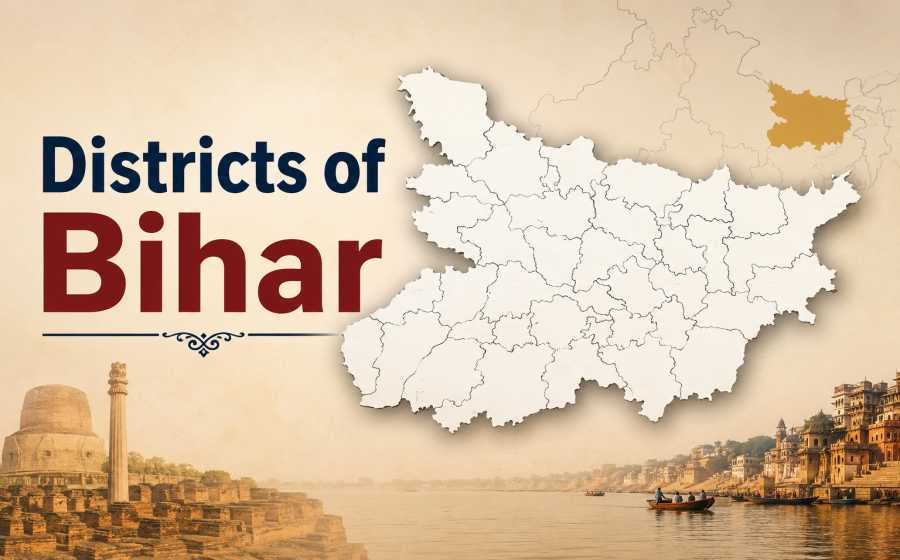
Districts of Bihar – Historical, Cultural and Administrative Overview
Explore the Districts of Bihar with complete details on all the districts, their history, geography, administrative importance and key facts.
Districts of Bihar
Bihar is one of India’s most historically significant states, known for its ancient civilization, rich cultural heritage, and important contribution to education and politics. Located in eastern India, Bihar covers an area of approximately 94,163 square kilometers and is home to a population of over 12 crore people. The state is divided into several administrative units called districts, which help in governance, development, and public administration.
Understanding the districts of Bihar is important for students preparing for competitive examinations, general knowledge enthusiasts, and anyone interested in learning about the state’s geography and administration. This article provides comprehensive information about Bihar’s districts, their significance, and key facts.
Table of Contents
Administrative Structure of Bihar
Bihar is currently divided into 38 districts, which are grouped under 9 divisions. Each district is administered by a District Magistrate (DM) or Deputy Commissioner appointed by the state government. Districts are further divided into subdivisions, blocks, and panchayats to ensure efficient governance.
The nine divisions of Bihar are:
- Patna Division
- Tirhut Division
- Saran Division
- Darbhanga Division
- Kosi Division
- Purnia Division
- Bhagalpur Division
- Munger Division
- Magadh Division
List of Districts of Bihar
The 38 districts of Bihar are:
- Araria
- Arwal
- Aurangabad
- Banka
- Begusarai
- Bhagalpur
- Bhojpur
- Buxar
- Darbhanga
- East Champaran (Motihari)
- Gaya
- Gopalganj
- Jamui
- Jehanabad
- Kaimur (Bhabua)
- Katihar
- Khagaria
- Kishanganj
- Lakhisarai
- Madhepura
- Madhubani
- Munger
- Muzaffarpur
- Nalanda
- Nawada
- Patna
- Purnia
- Rohtas
- Saharsa
- Samastipur
- Saran (Chhapra)
- Sheikhpura
- Sheohar
- Sitamarhi
- Siwan
- Supaul
- Vaishali
- West Champaran (Bettiah)
Major Districts and Their Importance
Patna
Patna is the capital and largest urban center of Bihar. It is one of the oldest continuously inhabited cities in the world. Historically known as Pataliputra, Patna served as the capital of ancient empires such as the Mauryas and Guptas. Today, it is the administrative, educational, and economic hub of the state.
Gaya
Gaya is famous worldwide for its religious significance. It is closely associated with Buddhism because Bodh Gaya, where Gautama Buddha attained enlightenment, is located in this district. It attracts thousands of pilgrims and tourists every year.
Nalanda
Nalanda is renowned for the ancient Nalanda University, one of the world’s earliest residential universities. The district represents Bihar’s glorious educational heritage and remains an important center for historical tourism.
Muzaffarpur
Often called the “Litchi Capital of India,” Muzaffarpur is famous for producing high-quality litchis. Agriculture and trade contribute significantly to the district’s economy.
Bhagalpur
Bhagalpur is known as the “Silk City of Bihar” due to its famous silk industry. The district is also located near the Vikramshila ruins, an important center of ancient learning.
East and West Champaran
These districts hold great importance in India’s freedom movement. Mahatma Gandhi launched the historic Champaran Satyagraha here in 1917, which became a turning point in India’s struggle for independence.
Smallest and Largest Districts
Largest District by Area
West Champaran is the largest district in Bihar in terms of geographical area. It is located near the Nepal border and contains rich forest resources, including the Valmiki Tiger Reserve.
Smallest District by Area
Sheohar is the smallest district in Bihar. Despite its small size, it plays an important role in the state’s administrative framework.
Most Populous District
Patna is among the most populous districts and serves as the political and economic center of Bihar.
Economic Activities Across Districts
The economy of Bihar’s districts is largely based on agriculture. Major crops include:
- Rice
- Wheat
- Maize
- Sugarcane
- Pulses
- Oilseeds
Different districts are known for specific products:
- Muzaffarpur – Litchi
- Bhagalpur – Silk
- Nalanda – Vegetables
- Begusarai – Industrial activities
- Patna – Trade and services
Several districts are also witnessing growth in infrastructure, education, healthcare, and manufacturing sectors.
Historical Significance of Bihar’s Districts
Many districts of Bihar have deep historical roots dating back thousands of years.
- Nalanda was home to the ancient Nalanda University.
- Vaishali is considered one of the world’s earliest republics.
- Gaya is a major Buddhist pilgrimage center.
- Patna was the capital of the Mauryan Empire.
- Rajgir in Nalanda district served as the capital of Magadha.
- Champaran played a crucial role in India’s independence movement.
These districts collectively preserve the rich cultural and historical heritage of Bihar.
Districts and Tourism
Tourism is an important source of revenue for several districts. Popular tourist destinations include:
- Bodh Gaya (Gaya)
- Nalanda Ruins (Nalanda)
- Rajgir (Nalanda)
- Golghar (Patna)
- Takht Sri Patna Sahib (Patna)
- Vikramshila Ruins (Bhagalpur)
- Valmiki Tiger Reserve (West Champaran)
- Vaishali Archaeological Sites (Vaishali)
These locations attract domestic as well as international visitors throughout the year.
Summary
The districts of Bihar form the backbone of the state’s administrative and developmental structure. Each district has its own unique identity, history, culture, and economic significance. From the ancient educational centers of Nalanda and Vikramshila to the religious importance of Gaya and the historical legacy of Champaran, Bihar’s districts reflect the state’s rich heritage and diversity. A good understanding of these districts is essential for general knowledge, academic studies, and competitive examination preparation. Bihar’s 38 districts together contribute to making the state one of the most culturally and historically important regions of India.
Also Check: Bihar GK