
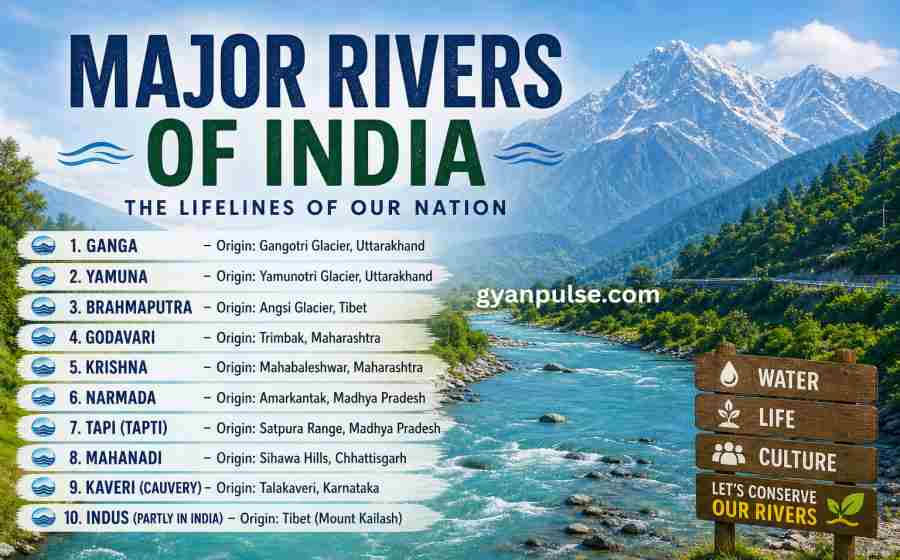
Major Rivers of India and their origin, List with Statewise
Explore Major Rivers of India with their origins, lengths and statewise details. Learn key facts about Ganga, Yamuna, Brahmaputra and more.
Major Rivers of India and Their Origin
India is a land of rivers. These rivers not only provide water for drinking and irrigation but also support agriculture, industries, transportation, and hydroelectricity. Let’s explore the major rivers of India, their points of origin, and their significance.
Table of Contents
1. Ganga (Ganges)
- Origin: Gangotri Glacier, Uttarakhand
- Length: Approx. 2,525 km
- States Covered: Uttarakhand, Uttar Pradesh, Bihar, Jharkhand, West Bengal
- Important Tributaries: Yamuna, Ghaghara, Gandak, Kosi
- Fact: Considered the holiest river by Hindus, it flows into the Bay of Bengal.
2. Yamuna
- Origin: Yamunotri Glacier, Uttarakhand
- Length: Approx. 1,376 km
- States Covered: States where the Yamuna River flows are Uttarakhand, Himachal Pradesh, Haryana, Delhi, and Uttar Pradesh.
- Joins: Ganga at Prayagraj (Sangam)
- Fact: Delhi, the capital of India, is situated along the banks of the Yamuna River.
3. Brahmaputra
- Origin: Angsi Glacier, Tibet (as Yarlung Tsangpo)
- Length: Approx. 2,900 km (916 km in India)
- States Covered: Arunachal Pradesh, Assam
- Fact: Known for one of the highest silt deposits and flooding during monsoon.
4. Godavari
- Origin: Trimbak Plateau, Nashik, Maharashtra
- Length: Approx. 1,465 km
- States Covered: Maharashtra, Telangana, Andhra Pradesh, Chhattisgarh, Odisha
- Fact: It is often called the ‘Dakshin Ganga’ or ‘Ganga of the South’.
5. Krishna
- Origin: Mahabaleshwar, Maharashtra
- Length: Approx. 1,400 km
- States Covered: Maharashtra, Karnataka, Telangana, Andhra Pradesh
- Important Tributaries: Bhima, Tungabhadra
- Fact: It plays a key role in irrigation in southern India.
6. Narmada
- Origin: Amarkantak Plateau, Madhya Pradesh
- Length: Approx. 1,312 km
- States Covered: Madhya Pradesh, Maharashtra, Gujarat
- Fact: One of the few rivers that flows westward into the Arabian Sea.
7. Tapi (Tapti)
- Origin: Satpura Range, Madhya Pradesh
- Length: Approx. 724 km
- States Covered: Madhya Pradesh, Maharashtra, Gujarat
- Fact: Like the Narmada, it flows westward and drains into the Arabian Sea.
8. Mahanadi
- Origin: Sihawa Hills, Chhattisgarh
- Length: Approx. 851 km
- States Covered: Chhattisgarh, Odisha
- Fact: Known for the Hirakud Dam – one of the longest dams in the world.
9. Kaveri (Cauvery)
- Origin: Talakaveri, Brahmagiri Hills, Karnataka
- Length: Approx. 800 km
- States Covered: Karnataka, Tamil Nadu, Kerala
- Fact: Highly sacred in South India and supports dense agriculture.
10. Indus (Partly in India)
- Origin: Tibet (Mount Kailash)
- Length: Approx. 3,180 km (only ~1,114 km in India)
- Indian States: Ladakh, Himachal Pradesh, Punjab
- Fact: It’s one of the longest rivers in the world, and the Indus Valley Civilization thrived along its banks
Summary Table – Rivers and Their Origins
| River | Origin Location | Major States Covered |
|---|---|---|
| Ganga | Gangotri Glacier, Uttarakhand | UP, Bihar, WB |
| Yamuna | Yamunotri Glacier, Uttarakhand | Delhi, UP |
| Brahmaputra | Angsi Glacier, Tibet | Arunachal, Assam |
| Godavari | Trimbak, Maharashtra | Maharashtra, Telangana |
| Krishna | Mahabaleshwar, Maharashtra | Karnataka, Andhra Pradesh |
| Narmada | Amarkantak, Madhya Pradesh | MP, Gujarat |
| Tapi | Satpura, Madhya Pradesh | MP, Maharashtra |
| Mahanadi | Chhattisgarh Hills | Chhattisgarh, Odisha |
| Kaveri | Talakaveri, Karnataka | Karnataka, Tamil Nadu |
| Indus | Tibet (Mount Kailash) | Ladakh, Punjab |
Importance of River Origins and Statewise Distribution
Understanding the origins and statewise distribution of India’s major rivers provides valuable insight into the country’s geographical structure and resource management. Rivers like the Ganga, Brahmaputra, and Godavari originate from distinct terrains such as glaciers, plateaus, and hills, influencing their flow patterns and the regions they nourish.
Their journey across multiple states supports agriculture, drinking water supply, and economic activities. Studying these details not only enhances general knowledge but also helps in environmental awareness, disaster management, and sustainable development planning across different regions of India.
Summary
India’s rivers play a key role in its economy, culture, and rich biodiversity. Understanding their origins helps in better water management, environmental planning, and appreciating their historical and spiritual value.
Also Check: General Knowledge