Romania – History, Culture, Sports, Tourist Attractions and Key Facts
Discover Romania’s rich history, vibrant culture, famous sports, landscapes, traditions, economy and key facts that make this European nation truly unique.
Romania
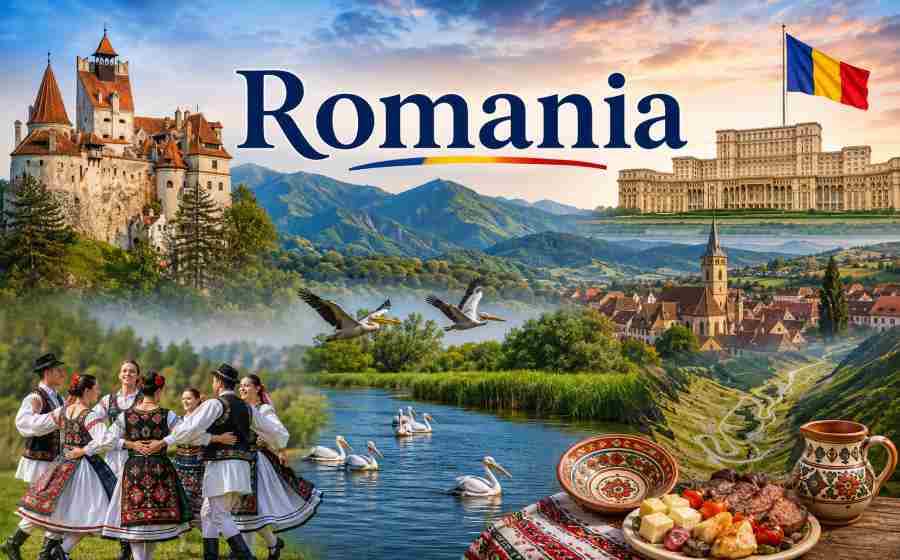
Romania is a beautiful country located in Southeastern Europe, known for its medieval castles, breathtaking mountains, ancient traditions, and rich cultural heritage. It is home to the famous Transylvania region, often associated with the legend of Dracula, but Romania offers much more than myths and legends. From its diverse landscapes and historic cities to its remarkable contributions in sports, literature, and science, Romania has played an important role in European history.
Today, Romania is a member of the European Union and continues to grow as a modern nation while preserving its unique traditions and customs. Its welcoming people, colorful festivals, and delicious cuisine make it a fascinating destination for travelers and learners alike.
Table of Contents
Location and Geography
Romania is situated in Southeastern Europe and shares borders with Ukraine, Moldova, Hungary, Serbia, and Bulgaria. It also has a coastline along the Black Sea, making it strategically important for trade and tourism.
The country’s geography is highly diverse. The Carpathian Mountains stretch across central Romania, providing stunning scenery, forests, and wildlife. The Danube River, one of Europe’s longest rivers, flows along the southern border before forming the Danube Delta, one of the world’s most important wetlands and a UNESCO World Heritage Site.
Romania experiences a temperate continental climate with four distinct seasons—warm summers, colorful autumns, cold snowy winters, and pleasant springs.
Brief History of Romania
Romania’s history dates back thousands of years. The region was originally inhabited by the Dacians, an ancient civilization known for its bravery. In the second century AD, the Roman Empire conquered Dacia under Emperor Trajan, leaving a lasting influence on the language and culture.
During the Middle Ages, Romania was divided into three principal regions—Wallachia, Moldavia, and Transylvania. These regions often defended themselves against powerful neighboring empires, including the Ottoman Empire.
In 1859, Wallachia and Moldavia united to form the foundation of modern Romania. The country gained full independence from the Ottoman Empire in 1877 and later became a kingdom.
Following World War II, Romania became a communist state under Soviet influence. After the Romanian Revolution of 1989, communism ended, and Romania transitioned into a democratic republic. It joined NATO in 2004 and the European Union in 2007.
Capital and Major Cities
The capital city of Romania is Bucharest, often called the “Little Paris of the East” because of its elegant architecture and vibrant cultural life.
Other major cities include:
- Cluj-Napoca
- Timișoara
- Iași
- Constanța
- Brașov
- Sibiu
These cities are known for their universities, historical monuments, technology industries, and tourism.
Culture and Traditions
Romanian culture reflects influences from Roman, Slavic, Ottoman, Hungarian, and Balkan civilizations. Despite these influences, Romania has preserved its own distinct traditions.
Folk music, traditional dances, colorful embroidered clothing, and handcrafted wooden art remain important parts of Romanian life. Villages continue to celebrate ancient customs during weddings, harvest festivals, and religious holidays.
Christmas and Easter are celebrated with great enthusiasm. Families prepare traditional meals, decorate their homes, and attend church services. Carol singing and painted Easter eggs are cherished customs throughout the country.
Romanians are known for their hospitality, respect for family values, and pride in preserving their cultural heritage.
Language and Religion
Romanian is the official language and is one of the few Romance languages spoken in Eastern Europe. It evolved directly from Latin, making it closely related to Italian, French, Spanish, and Portuguese.
The majority of the population follows Eastern Orthodox Christianity, while Roman Catholicism, Protestantism, Islam, and Judaism are also practiced by smaller communities.
Economy
Romania has one of the fastest-growing economies in Europe. Important sectors include:
- Information technology
- Automobile manufacturing
- Agriculture
- Energy production
- Tourism
- Construction
- Services
Romania is also one of Europe’s major producers of wheat, corn, sunflower seeds, and wine. The country’s IT industry has become internationally recognized, attracting global technology companies.
Famous Tourist Attractions
Romania offers numerous attractions for visitors. Some of the most famous include:
- Bran Castle, often connected to the Dracula legend
- Peleș Castle
- The Carpathian Mountains
- Danube Delta
- Painted Monasteries of Bucovina
- Historic center of Sibiu
- Medieval city of Brașov
- Black Sea beaches
Nature lovers enjoy hiking, skiing, wildlife observation, and river cruises across Romania’s beautiful landscapes.
Sports in Romania
Sports play an important role in Romanian society. Football is the most popular sport, followed by gymnastics, tennis, handball, rowing, fencing, and athletics. Romania has earned worldwide recognition through outstanding athletes. Romanian gymnasts have won numerous Olympic medals, while tennis players have achieved international success.
The country has also performed well in rowing competitions and has consistently produced talented athletes who represent Romania in global sporting events.
Education and Science
Romania places strong emphasis on education. Its universities attract students from many countries, especially in medicine, engineering, and information technology.
Romanian scientists, mathematicians, engineers, and inventors have contributed significantly to fields such as aviation, medicine, and computer science. The nation continues investing in research, innovation, and higher education.
Wildlife and Natural Beauty
Romania possesses some of Europe’s richest biodiversity. Its forests are home to:
- Brown bears
- Wolves
- Lynxes
- Deer
- Wild boars
- Eagles
The Carpathian Mountains contain one of Europe’s largest populations of wild animals, while the Danube Delta supports hundreds of bird species and aquatic life. Many national parks protect Romania’s forests, rivers, and mountain ecosystems.
Interesting Facts About Romania
- Romania’s official currency is the Romanian Leu (RON).
- Bucharest is the country’s largest city.
- The Romanian language has Latin roots.
- The Danube Delta is among Europe’s largest wetlands.
- Romania has numerous UNESCO World Heritage Sites.
- The Palace of the Parliament in Bucharest is one of the world’s largest administrative buildings.
- Romania is famous for its medieval castles and fortified churches.
- The country experiences four distinct seasons.
- Traditional folk costumes differ from one region to another.
- Romania is well known for producing world-class gymnasts and tennis players.
Summary
Romania is a nation where ancient history blends harmoniously with modern development. Its remarkable landscapes, rich traditions, historic castles, vibrant cities, and sporting achievements make it one of Europe’s most fascinating countries. From the majestic Carpathian Mountains and the peaceful Danube Delta to colorful festivals and warm hospitality, Romania offers something unique for everyone. As it continues to grow economically and culturally, Romania remains proud of its heritage while embracing the future, making it an inspiring country to study and explore.
Also Check: General Knowledge