
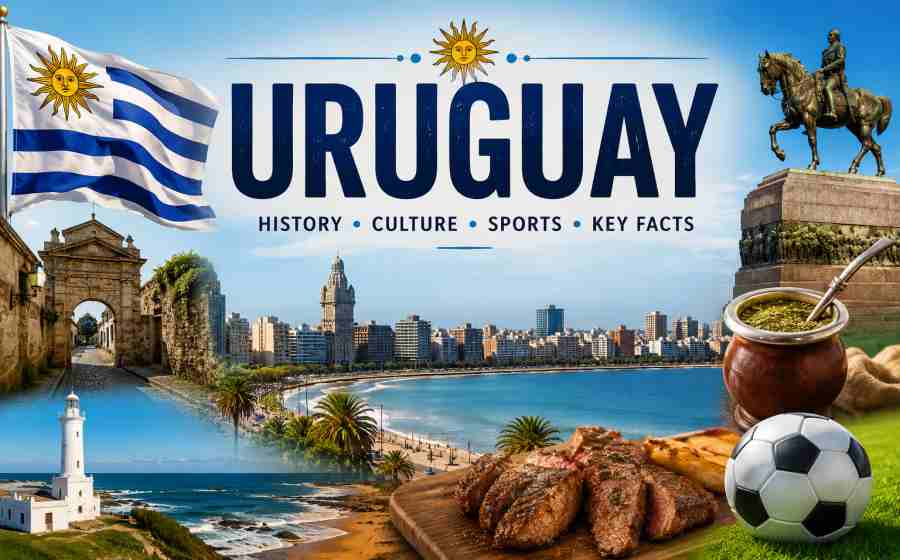
Uruguay – History, Culture, Tourist Places, Sports and Fascinating Facts
Discover Uruguay through its rich history, vibrant culture, football legacy, stunning landscapes, economy, traditions and fascinating national facts.
Uruguay
Uruguay is one of South America’s most peaceful and progressive nations. Though it is the second-smallest country on the continent after Suriname, Uruguay has earned worldwide recognition for its stable democracy, high quality of life, rich cultural traditions, and remarkable football history. Located between Brazil and Argentina along the Atlantic Ocean, the country combines beautiful beaches, rolling grasslands, colonial cities, and a modern lifestyle.
Known for its friendly people, strong education system, and commitment to social equality, Uruguay has become a model nation in Latin America. Whether it is its historical journey, colorful festivals, famous cuisine, or sporting achievements, Uruguay offers countless interesting facts worth exploring.
Table of Contents
Location and Geography
Uruguay is situated in southeastern South America. It shares borders with Brazil to the north and Argentina to the west, while the Atlantic Ocean forms its southeastern coastline. The country covers an area of approximately 176,215 square kilometers, making it relatively small but geographically diverse.
The landscape mainly consists of fertile plains, rolling hills, rivers, and grasslands that support agriculture and livestock farming. Uruguay also features beautiful coastal resorts and sandy beaches that attract visitors throughout the year.
Capital City
The capital of Uruguay is Montevideo, which is also the country’s largest city. Montevideo serves as the nation’s political, economic, cultural, and educational center. Nearly half of Uruguay’s population lives in or around the capital.
Brief History of Uruguay
Uruguay was originally inhabited by indigenous groups, particularly the Charrúa people. During the early 16th century, Spanish explorers arrived in the region, although permanent settlements were established much later due to resistance from indigenous communities.
Throughout the colonial period, Uruguay became an area of conflict between the Spanish and Portuguese empires because of its strategic location. Montevideo was founded by Spain in 1726 to strengthen its control over the region.
In the early 19th century, Uruguay fought for independence. National hero José Gervasio Artigas played a significant role in the struggle against Spanish rule and is regarded as the “Father of Uruguay.”
After years of political conflict involving neighboring Brazil and Argentina, Uruguay officially gained independence in 1828. Since then, the country has experienced periods of political instability but eventually developed into one of Latin America’s strongest democracies. Today, Uruguay is recognized for its peaceful government, respect for human rights, and political stability.
People and Language
Uruguay has a population of around 3.5 million people. Most citizens are of European descent, particularly Spanish and Italian ancestry.
The official language is Spanish, although Portuguese is spoken in some northern border regions. English is increasingly taught in schools and is commonly understood in tourist areas.
Uruguay has one of the highest literacy rates in Latin America, reflecting its strong educational system.
Culture of Uruguay
Uruguayan culture reflects a blend of European traditions and South American influences.
Music and Dance
One of the country’s most famous cultural expressions is the Tango, which developed alongside neighboring Argentina. Uruguay also has its own musical tradition called Candombe, featuring energetic drum performances with African roots. Candombe has been recognized by UNESCO as an important element of world cultural heritage.
Festivals
Uruguay hosts numerous colorful festivals throughout the year. One of the biggest celebrations is the Montevideo Carnival, considered the longest carnival in the world, lasting over a month. It includes parades, costumes, music, dancing, and theatrical performances.
Food
Uruguayan cuisine is famous for its high-quality beef.
Popular traditional dishes include:
- Asado (barbecue)
- Chivito (steak sandwich)
- Empanadas
- Milanesa
- Dulce de leche desserts
A traditional herbal drink called Mate is widely consumed across the country and forms an important part of daily social life.
Economy of Uruguay
Uruguay enjoys one of the strongest and most stable economies in South America.
Major sectors include:
- Agriculture
- Livestock farming
- Forestry
- Tourism
- Information technology
- Financial services
- Renewable energy
The country is one of the world’s largest exporters of high-quality beef, wool, dairy products, and soybeans.
Uruguay has also invested heavily in wind and solar energy, making renewable energy a major contributor to its electricity production.
Education and Healthcare
Uruguay places significant importance on education. Public education is free and compulsory for children.
The country was among the first in Latin America to provide free laptops to school students through educational initiatives aimed at improving digital literacy.
Healthcare services are generally well-developed, contributing to one of the highest life expectancies in South America.
Sports in Uruguay
Football (soccer) is by far the most popular sport in Uruguay. Despite its relatively small population, Uruguay has achieved extraordinary success in international football.
Some of its greatest accomplishments include:
- Winning the 1930 FIFA World Cup, the first-ever World Cup hosted by Uruguay.
- Winning the 1950 FIFA World Cup after defeating Brazil in the legendary “Maracanazo.”
- Winning numerous Copa América championships.
Many world-famous footballers have represented Uruguay, including:
- Luis Suárez
- Edinson Cavani
- Diego Forlán
- Diego Godín
Besides football, sports such as rugby, basketball, cycling, athletics, and tennis are also growing in popularity.
Wildlife and Nature
Uruguay’s natural environment includes wetlands, grasslands, forests, and coastal ecosystems.
Common wildlife includes:
- Capybaras
- Armadillos
- Foxes
- Flamingos
- Sea lions
- Numerous migratory birds
Protected national parks help preserve biodiversity while promoting eco-tourism.
Government and Politics
Uruguay is a democratic republic with a presidential system. The President serves as both the head of state and head of government. Elections are held regularly, and the country consistently ranks among the least corrupt and most democratic nations in Latin America. Uruguay is also known for progressive social policies and strong civil liberties.
Tourism in Uruguay
Tourism plays a major role in Uruguay’s economy.
Popular tourist destinations include:
- Montevideo
- Punta del Este
- Colonia del Sacramento
- Cabo Polonio
- Piriápolis
Visitors enjoy historic architecture, beautiful beaches, coastal resorts, museums, vineyards, and nature reserves.
Interesting Facts About Uruguay
- Uruguay is often called the “Switzerland of South America” because of its political stability and banking system.
- The country has one of the highest literacy rates in Latin America.
- It was the first country to host the FIFA World Cup in 1930.
- Uruguay legalized same-sex marriage before many developed countries.
- Renewable energy provides most of the country’s electricity.
- The national drink, Mate, is deeply rooted in everyday life.
- Uruguay has one of the lowest corruption levels in Latin America.
- Beef production is among the highest per person in the world.
- Montevideo consistently ranks as one of South America’s best cities for quality of life.
- Uruguay has more cattle than people.
Summary
Uruguay may be small in size, but it stands out as one of South America’s most remarkable countries. Its fascinating history, democratic values, rich cultural traditions, sporting excellence, and strong economy make it a unique nation on the global stage. From the vibrant streets of Montevideo to the scenic Atlantic coastline and world-famous football achievements, Uruguay offers an inspiring blend of heritage and modern development. Whether you are interested in history, geography, sports, or culture, Uruguay provides countless reasons to learn more about this peaceful and progressive nation.
Also Check: General Knowledge