
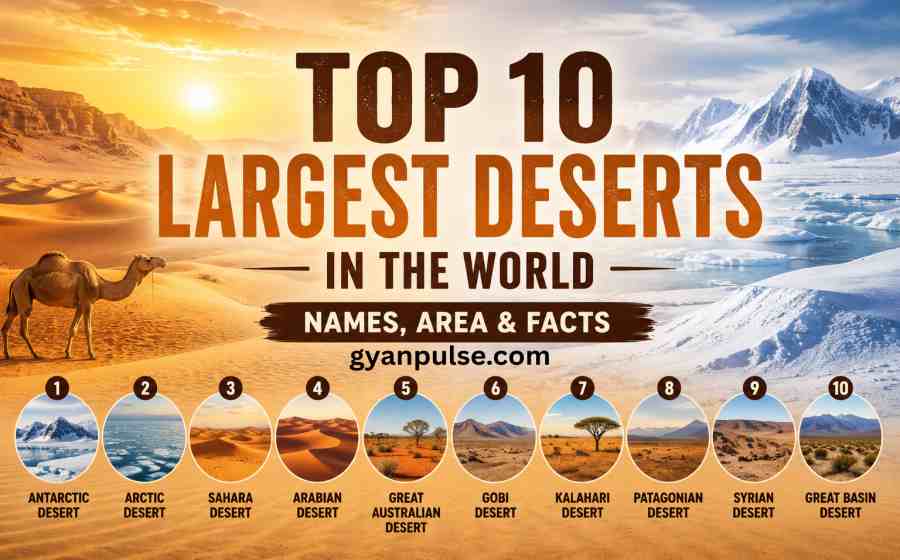
Top 10 Largest Deserts in the World – Names, Area and Facts
Explore the Top 10 Largest Deserts in the World with names, area, climate types and amazing facts about hot and cold deserts worldwide.
Top 10 Largest Deserts in the World
When we hear the word desert, the first image that comes to mind is endless sand dunes, scorching heat, and camels. But not all deserts are hot, some of the largest ones are icy cold! A desert is a place that gets very little rain, usually less than 250 mm in a year. Depending on the climate, some deserts are scorching hot like the Sahara, while others are freezing cold like Antarctica. Let’s explore the Top 10 Largest Deserts in the World.
Table of Contents
List of Largest Deserts in the World
1. Antarctic Desert
- Area: ~14 million sq. km
- Type: Cold Desert
- Location: Antarctica (Southern Hemisphere)
- Fact: This is the world’s biggest desert, and almost the entire region is covered with thick ice. Despite being icy, it qualifies as a desert due to extremely low rainfall.
2. Arctic Desert
- Area: ~13.9 million sq. km
- Type: Cold Desert
- Location: Arctic region (North Pole)
- Fact: The Arctic is the second-largest desert and consists of ice-covered seas and frozen landscapes.
3. Sahara Desert
- Area: ~9.2 million sq. km
- Type: Hot Desert
- Location: North Africa (11 countries)
- Fact: The Sahara is the largest hot desert in the world, with daytime temperatures reaching up to 50°C.
4. Arabian Desert
- Area: ~2.3 million sq. km
- Type: Hot Desert
- Location: Middle East (Saudi Arabia, Oman, UAE, Yemen, Jordan, Iraq)
- Fact: The Arabian Desert contains the Rub’ al Khali, also called the Empty Quarter, which is the largest sand desert in the world.
5. Great Australian Desert
- Area: ~1.3 million sq. km
- Type: Hot Desert
- Location: Australia
- Fact: Known as the Great Australian Desert, it is the country’s largest arid zone, featuring red sand dunes, dry grasslands, and very sparse rainfall.
6. Gobi Desert
- Area: ~1.3 million sq. km
- Type: Cold Desert
- Location: China and Mongolia
- Fact: Unlike sandy deserts, the Gobi is mostly rocky and bare soil, with extreme temperature variations.
7. Kalahari Desert
- Area: ~900,000 sq. km
- Type: Semi-Arid Desert
- Location: Southern Africa (Botswana, Namibia, South Africa)
- Fact: The Kalahari is home to the San Bushmen and a variety of wildlife, including lions and meerkats.
8. Patagonian Desert (Patagonia)
- Area: ~620,000 sq. km
- Type: Cold Desert
- Location: Argentina (South America)
- Fact: It is the largest desert in South America, known for strong winds and dry climate.
9. Syrian Desert
- Area: ~500,000 sq. km
- Type: Hot Desert
- Location: Middle East (Syria, Iraq, Jordan, Saudi Arabia)
- Fact: Historically, it served as a trade route for ancient caravans and nomadic tribes.
10. Great Basin Desert
- Area: ~492,000 sq. km
- Type: Cold Desert
- Location: USA (Nevada, Utah, Oregon, California)
- Fact: It is the largest desert in North America, characterized by cold winters and sagebrush vegetation.
Importance of Deserts in Nature and Human Life
Deserts may appear lifeless at first glance, but they are among the most unique ecosystems on Earth. These dry regions are home to specially adapted plants, animals, and even human communities that survive in extreme conditions. Many deserts also contain valuable natural resources such as minerals, oil, and solar energy potential. From the freezing Antarctic Desert to the burning sands of the Sahara, deserts help scientists study climate change, weather patterns, and the remarkable ability of life to adapt in harsh environments.
Fascinating Facts About the World’s Largest Deserts
The largest deserts in the world are spread across different continents and climates, showing that deserts are not always filled with sand. While Antarctica and the Arctic are covered in ice, they still qualify as deserts because they receive very little precipitation each year.
Some deserts, like the Gobi and Great Basin, experience freezing winters, whereas others such as the Arabian and Sahara deserts face intense heat during the day. These vast landscapes have influenced trade, exploration, wildlife, and human civilization for thousands of years.
Summary
The world’s deserts may look barren, but they play a major role in Earth’s ecosystem. From icy Antarctica to scorching Sahara, these vast lands remind us of the planet’s extreme diversity.
Knowing about the largest deserts in the world is not just GK trivia, it also helps us understand geography, climate, and how humans adapt to challenging environments.
Also Check: General Knowledge