
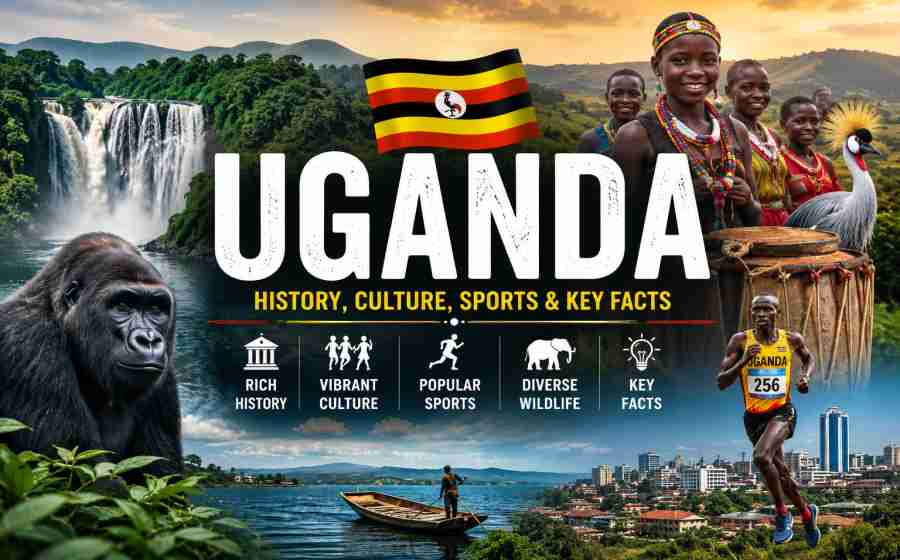
Uganda – History, Culture, Sports, Wildlife, Natural Beauty and Fascinating Key Facts
Discover Uganda with its rich history, vibrant culture, popular sports, stunning wildlife, diverse geography, economy and fascinating key facts.
Uganda
Uganda is a beautiful landlocked country located in East Africa. Known as the “Pearl of Africa,” Uganda is famous for its breathtaking landscapes, rich cultural traditions, abundant wildlife, and warm hospitality. The country is home to snow-capped mountains, vast lakes, dense forests, and diverse ethnic communities. Uganda has played an important role in African history and continues to grow as a developing nation with a strong focus on education, tourism, and agriculture.
From mountain gorillas and the mighty River Nile to colorful festivals and talented athletes, Uganda offers countless fascinating facts that make it one of Africa’s most unique countries.
Table of Contents
Location and Geography
Uganda is situated in East Africa and shares borders with Kenya to the east, South Sudan to the north, the Democratic Republic of the Congo to the west, Rwanda to the southwest, and Tanzania to the south. Although it has no coastline, Uganda has several large freshwater lakes, including Lake Victoria, Africa’s largest lake.
The country’s landscape includes fertile plains, rolling hills, mountains, forests, wetlands, and rivers. The equator passes through southern Uganda, giving it a tropical climate with moderate temperatures due to its high elevation.
Quick Facts about Uganda
- Capital: Kampala
- Continent: Africa
- Official Languages: English and Swahili
- National Language: Luganda (widely spoken)
- Currency: Ugandan Shilling (UGX)
- Population: Over 50 million (estimated)
- Government: Presidential Republic
- Time Zone: East Africa Time (EAT)
A Brief History of Uganda
Human settlement in Uganda dates back thousands of years. Ancient communities practiced farming, hunting, and cattle rearing long before written history. Powerful kingdoms such as Buganda, Bunyoro, Toro, and Ankole emerged and became influential political and cultural centers.
During the late 19th century, Uganda became a British protectorate. British administration introduced railways, formal education, Christianity, and new administrative systems. However, colonial rule also changed traditional governance and social structures.
Uganda gained independence from Britain on 9 October 1962. The country later experienced political instability, military coups, and economic challenges. Since the late 20th century, Uganda has made significant progress in infrastructure, healthcare, tourism, and economic development while continuing to face various social and political challenges.
Culture and Traditions
Uganda is one of Africa’s most culturally diverse nations. It has more than 50 ethnic groups, each with its own language, customs, music, and traditional dress.
Respect for elders, family values, and community cooperation remain central to Ugandan society. Traditional ceremonies, storytelling, and dance continue to be important parts of daily life.
Music and dance are deeply connected to celebrations such as weddings, harvest festivals, and cultural events. Every ethnic group has its own distinctive musical instruments and dance styles.
Ugandans are widely known for their friendliness and hospitality, making visitors feel welcome throughout the country.
Languages Spoken in Uganda
English serves as the official language and is used in education, government, and business. Swahili is also an official language and is commonly used in trade and security services.
Besides these, Uganda has dozens of indigenous languages. Luganda is the most widely spoken local language, especially around Kampala and central Uganda.
Traditional Food
Ugandan cuisine is simple, nutritious, and based mainly on locally grown crops.
Popular foods include:
- Matoke (steamed green bananas)
- Posho (maize flour porridge)
- Rice
- Cassava
- Sweet potatoes
- Millet bread
- Groundnut sauce
- Beans
- Fish from Lake Victoria
- Goat and chicken dishes
Fresh tropical fruits such as bananas, pineapples, mangoes, passion fruits, and jackfruit are also widely enjoyed.
Wildlife and Natural Beauty
Uganda is internationally famous for its incredible biodiversity. It is one of the few countries where visitors can see endangered mountain gorillas in their natural habitat.
The country has numerous national parks and wildlife reserves that protect elephants, lions, giraffes, chimpanzees, leopards, buffaloes, hippos, crocodiles, and hundreds of bird species.
The River Nile begins its journey from Lake Victoria in Uganda, making the country an important destination for adventure tourism, including rafting and kayaking. Tourism remains one of Uganda’s most important industries because of its remarkable natural attractions.
Education System
Uganda has steadily expanded access to education through government initiatives. Primary education is widely available, while secondary schools, vocational institutes, and universities continue to grow.
Major universities offer programs in science, medicine, engineering, business, agriculture, and technology. Improving literacy and educational quality remains an important national goal.
Economy
Agriculture is the backbone of Uganda’s economy. A large portion of the population depends on farming for income and employment.
Major agricultural products include:
- Coffee
- Tea
- Cotton
- Sugarcane
- Maize
- Bananas
- Beans
- Tobacco
Coffee is Uganda’s leading export product and contributes significantly to foreign exchange earnings. In addition to agriculture, tourism, manufacturing, telecommunications, and construction are becoming increasingly important sectors.
Sports in Uganda
Sports are extremely popular in Uganda and play a major role in national pride.
Football
Football is the country’s most loved sport. Thousands of fans passionately support local clubs and the national football team. Young players dream of representing Uganda in international competitions.
Athletics
Uganda has produced world-class long-distance runners who have achieved success in Olympic Games, World Championships, and international marathons. Distance running continues to inspire young athletes across the country.
Boxing
Uganda has a proud boxing tradition and has produced several successful boxers who have represented the country internationally.
Rugby and Cricket
Both rugby and cricket have gained popularity in recent years, with improved domestic competitions and growing youth participation.
Tourism Highlights
Uganda offers unforgettable travel experiences for nature lovers and adventure seekers.
Popular attractions include:
- Bwindi Impenetrable National Park
- Murchison Falls National Park
- Queen Elizabeth National Park
- Lake Victoria
- Source of the River Nile
- Rwenzori Mountains
- Kibale National Park
- Kampala City
Visitors enjoy gorilla trekking, chimpanzee tracking, birdwatching, wildlife safaris, hiking, boating, and cultural tours.
Interesting Facts About Uganda
- Uganda is called the Pearl of Africa due to its natural beauty.
- The equator passes through the country.
- Uganda is home to half of the world’s remaining mountain gorillas.
- Lake Victoria is Africa’s largest freshwater lake.
- The River Nile begins its journey from Uganda.
- More than 1,000 bird species have been recorded in Uganda.
- Uganda has over 50 ethnic groups.
- Agriculture provides employment for a large share of the population.
- Coffee is Uganda’s most important export crop.
- Kampala is one of East Africa’s fastest-growing cities.
Summary
Uganda is a nation blessed with extraordinary natural beauty, rich cultural diversity, and remarkable wildlife. Its long history, welcoming people, vibrant traditions, and growing economy make it one of Africa’s most fascinating countries. Whether learning about ancient kingdoms, exploring mountain gorillas, following successful athletes, or understanding its agricultural strength, Uganda offers valuable knowledge for students and general readers alike. As the country continues to develop, it remains a symbol of resilience, cultural pride, and natural heritage in East Africa.
Also Check: General Knowledge