
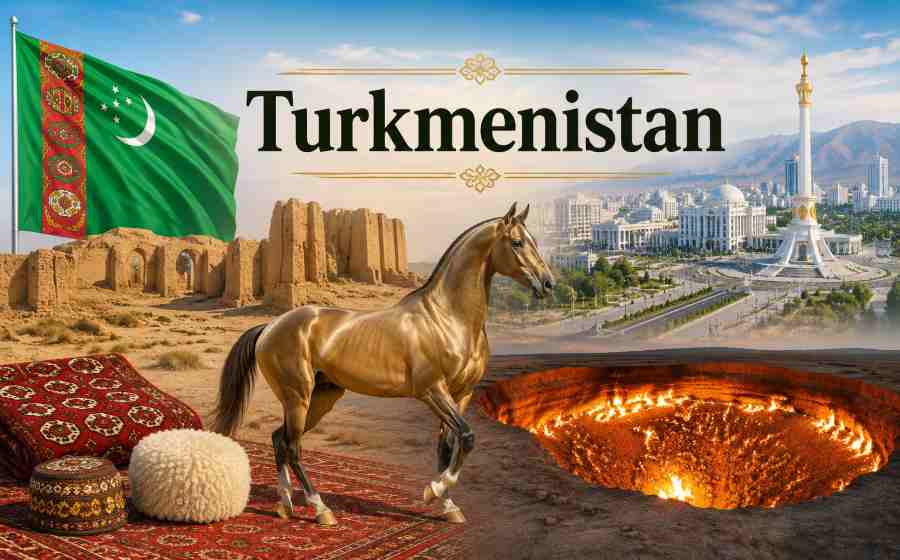
Turkmenistan – History, Culture, Sports, Tourist Attractions and Key Facts
Explore Turkmenistan’s rich history, culture, traditional sports, unique heritage, geography and fascinating facts about this remarkable Central Asian nation.
Turkmenistan
Turkmenistan is a fascinating country located in Central Asia. Known for its vast deserts, rich cultural heritage, ancient Silk Road history, and unique traditions, Turkmenistan remains one of the lesser-explored nations of the world. Despite its modern development, the country proudly preserves its historical roots and cultural identity. From magnificent archaeological sites to colorful carpets and traditional horse breeding, Turkmenistan offers a blend of history, culture, and national pride.
Table of Contents
Location and Geography
Turkmenistan is situated in Central Asia and shares borders with Kazakhstan, Uzbekistan, Afghanistan, Iran, and the Caspian Sea. The country covers an area of approximately 488,100 square kilometers, making it one of the largest nations in the region.
A major part of this Country is covered by the Karakum Desert, which occupies nearly 70% of the country’s territory. Despite its arid climate, the nation has valuable natural resources, especially natural gas reserves, which play a significant role in its economy.
Brief History of Turkmenistan
The territory of modern Turkmenistan has been inhabited since ancient times. It was an important part of the Silk Road, the historic trade route connecting Asia and Europe. Ancient civilizations flourished here, leaving behind remarkable archaeological sites.
Over the centuries, the region was influenced by several empires, including the Persian Empire, Alexander the Great’s empire, Arab Caliphates, and the Mongol Empire. During the medieval period, cities such as Merv became major centers of trade, learning, and culture.
In the 19th century, This Country gradually came under Russian control and later became part of the Soviet Union as the Turkmen Soviet Socialist Republic. After the dissolution of the Soviet Union in 1991, Turkmenistan gained independence and emerged as a sovereign nation.
Capital and Major Cities
The capital city of Turkmenistan is Ashgabat, known for its impressive white-marble buildings, wide avenues, and modern architecture. The city serves as the political, cultural, and economic center of the country.
Other important cities include:
- Turkmenabat
- Dashoguz
- Mary
- Balkanabat
- Türkmenbaşy
These cities contribute significantly to the nation’s commerce, industry, and cultural life.
Culture and Traditions
Turkmen culture is deeply rooted in nomadic traditions and tribal heritage. Hospitality is one of the most respected values in Turkmen society. Guests are welcomed warmly and treated with great respect.
Traditional clothing remains an important symbol of cultural identity. Men often wear embroidered garments and distinctive hats, while women wear colorful dresses decorated with intricate patterns.
Music and dance are also significant aspects of Turkmen culture. Traditional instruments such as the dutar are commonly used in folk performances. Storytelling, poetry, and folk songs have been passed down through generations.
The Famous Turkmen Carpets
Turkmen carpets are among the most celebrated handicrafts in the world. These handwoven carpets feature unique geometric designs and vibrant colors. Carpet weaving has been a central part of Turkmen culture for centuries and is considered a source of national pride.
The importance of carpets is reflected in the country’s symbols, as carpet motifs even appear on the national flag of Turkmenistan.
Religion and Language
The majority of Turkmenistan’s population follows Islam, primarily Sunni Islam. Religious traditions influence many cultural practices and celebrations.
The official language is Turkmen, which belongs to the Turkic language family. Russian is also understood and spoken by some sections of the population, especially in urban areas.
Economy of Turkmenistan
Turkmenistan possesses some of the world’s largest natural gas reserves. The energy sector forms the backbone of the national economy. Natural gas exports contribute significantly to government revenue and economic development.
Apart from energy resources, agriculture remains important. Cotton is one of the country’s major agricultural products. Wheat cultivation and livestock farming also support the economy.
The government has invested in infrastructure, transportation, and urban development projects to strengthen economic growth and modernization.
Sports in Turkmenistan
Sports play an important role in promoting national unity and physical fitness. Football is the most popular sport in this Country and enjoys widespread support across the country.
Other popular sports include:
- Wrestling
- Weightlifting
- Boxing
- Basketball
- Volleyball
- Athletics
Traditional equestrian sports also hold special significance. The country is famous for the Akhal-Teke horse, one of the oldest and most beautiful horse breeds in the world. These horses are admired for their speed, endurance, and distinctive metallic sheen.
Turkmen athletes have participated in various international competitions, including the Olympic Games and Asian Games. The country has invested heavily in sports facilities and has hosted several international sporting events.
Tourist Attractions
Although tourism remains limited compared to many countries, Turkmenistan has several remarkable attractions:
1. Darvaza Gas Crater
Often called the “Door to Hell,” this burning natural gas crater has been continuously aflame for decades and attracts visitors from around the world.
2. Ancient Merv
A UNESCO World Heritage Site, Merv was once one of the most important cities along the Silk Road.
3. Ashgabat
The capital city is famous for its grand monuments, marble architecture, and impressive public buildings.
4. Yangykala Canyon
Known for its colorful rock formations, the canyon offers breathtaking landscapes and photographic opportunities.
National Symbols
Several symbols represent Turkmenistan’s national identity:
- National Flag featuring traditional carpet designs
- Akhal-Teke horse as a symbol of pride
- Traditional carpets reflecting cultural heritage
- White marble architecture in Ashgabat
These symbols showcase the country’s unique blend of tradition and modernity.
Interesting Facts About Turkmenistan
- Turkmenistan is one of the most sparsely populated countries in Central Asia.
- The Karakum Desert covers most of the nation’s land area.
- Ashgabat is famous for having numerous white-marble buildings.
- The Akhal-Teke horse is considered a national treasure.
- Ancient Merv was once among the world’s largest cities.
- Turkmen carpets are recognized internationally for their craftsmanship.
- Natural gas reserves are among the country’s greatest economic assets.
- The country gained independence from the Soviet Union in 1991.
- Hospitality is a highly valued cultural tradition.
- Turkmenistan occupies a strategic location along historic Silk Road routes.
Summary
Turkmenistan is a unique Central Asian nation with a rich history, vibrant culture, and valuable natural resources. From the ancient Silk Road city of Merv to the modern marble structures of Ashgabat, the country offers a fascinating blend of tradition and progress. Its world-famous carpets, legendary Akhal-Teke horses, growing sports culture, and vast desert landscapes make Turkmenistan an intriguing subject for students, travelers, and general knowledge enthusiasts alike.
Also Check: General Knowledge