Greece – History, Culture, Tourist Places, Sports and Fascinating Facts
Discover Greece through its rich history, unique culture, famous sports traditions, iconic landmarks, delicious cuisine and fascinating facts in one place.
Greece
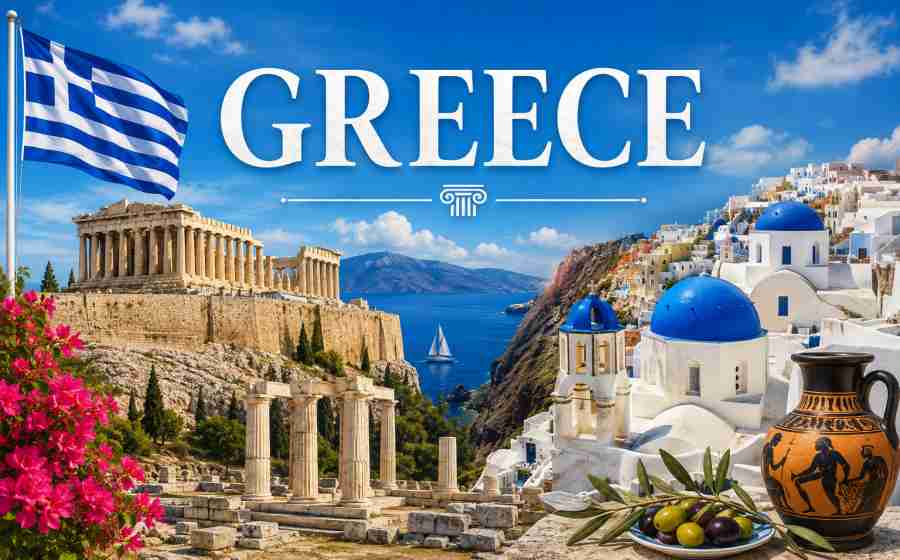
Greece is one of the world’s oldest civilizations and is often referred to as the birthplace of democracy, philosophy, and the Olympic Games. Located in southeastern Europe, Greece has played a remarkable role in shaping Western civilization through its contributions to politics, science, literature, mathematics, and the arts. With its beautiful islands, ancient ruins, Mediterranean climate, and rich traditions, Greece attracts millions of visitors every year.
Today, Greece is a modern European nation while preserving thousands of years of history. From the legendary tales of ancient gods to modern cultural festivals, Greece offers a fascinating blend of the past and present.
Table of Contents
Basic Information About Greece
- Official Name: Hellenic Republic
- Capital: Athens
- Continent: Europe
- Population: Around 10 million
- Official Language: Greek
- Currency: Euro (EUR)
- Government: Parliamentary Republic
- National Animal: Dolphin (commonly associated)
- National Bird: Little Owl
- National Flower: Bear’s Breech (Acanthus)
- Time Zone: Eastern European Time (EET)
History of Greece
The history of Greece dates back more than 5,000 years. It is home to some of the earliest advanced civilizations in Europe.
Ancient Greece
Ancient Greece flourished between the 8th and 4th centuries BCE. During this period, powerful city-states such as Athens, Sparta, Corinth, and Thebes emerged. Each city-state had its own government and military.
Athens became famous for introducing democracy, while Sparta was known for its disciplined military culture. Ancient Greeks also excelled in philosophy, mathematics, astronomy, medicine, architecture, and literature. Great thinkers such as Socrates, Plato, and Aristotle influenced education and philosophy across the world.
Alexander the Great
One of Greece’s greatest historical figures was Alexander the Great, who created one of the largest empires in history during the 4th century BCE. His conquests spread Greek culture throughout Asia, Egypt, and parts of Europe, creating the Hellenistic Age.
Roman and Byzantine Period
Later, Greece became part of the Roman Empire. After the Roman Empire split, Greece remained under the Byzantine Empire for nearly a thousand years, preserving Greek language and Orthodox Christianity.
Ottoman Rule and Independence
The Ottoman Empire ruled Greece for almost 400 years. After a long struggle, Greece gained independence in 1830.
Modern Greece
Today, Greece is a democratic country and a member of the European Union (EU), NATO, and many international organizations.
Geography of Greece
Greece lies in southeastern Europe and shares borders with Albania, North Macedonia, Bulgaria, and Turkey.
The country is famous for its:
- More than 6,000 islands
- Long Mediterranean coastline
- Beautiful mountains
- Crystal-clear beaches
- Mild Mediterranean climate
Some famous islands include Santorini, Mykonos, Crete, Rhodes, and Corfu.
Culture of Greece
Greek culture is among the oldest in the world and has greatly influenced global civilization.
Family Values
Family plays a central role in Greek society. Respect for elders, hospitality, and close family relationships remain important traditions.
Festivals
Greeks celebrate many religious and cultural festivals, including:
- Greek Orthodox Easter
- Christmas
- Independence Day (25 March)
- Ohi Day (28 October)
Music, dancing, and traditional food are major parts of celebrations.
Traditional Clothing
Traditional Greek costumes vary by region but often include embroidered dresses, colorful vests, skirts, and decorative hats worn during festivals.
Greek Cuisine
Greek food is famous for being healthy and flavorful.
Popular Greek dishes include:
- Moussaka
- Souvlaki
- Greek Salad
- Tzatziki
- Spanakopita
- Baklava
- Dolmades
- Gyros
Olive oil, cheese, seafood, vegetables, herbs, and fresh fruits are essential ingredients in Greek cooking.
Language and Religion
Greek is one of the world’s oldest recorded languages and has influenced many modern languages.
The majority of Greeks follow the Greek Orthodox Church, making Christianity the country’s dominant religion.
Sports in Greece
Sports have always held a special place in Greek history.
Birthplace of the Olympic Games
The first Olympic Games were held in Olympia around 776 BCE. Athletes from different Greek city-states competed in events such as running, wrestling, boxing, and chariot racing. The modern Olympic Games were revived in Athens in 1896.
Popular Sports Today
Modern Greece enjoys various sports including:
- Football (Soccer)
- Basketball
- Volleyball
- Water Polo
- Athletics
- Sailing
- Tennis
Greek athletes have achieved international success in both Olympic and world competitions.
Economy of Greece
Greece has a mixed economy largely supported by:
- Tourism
- Shipping
- Agriculture
- Food processing
- Manufacturing
- Renewable energy
Tourism is one of the country’s biggest industries, with millions visiting its islands, historical monuments, and beaches annually.
Education in Greece
Education is compulsory for children and includes:
- Primary Education
- Secondary Education
- Higher Education
Greek universities are known for research in archaeology, engineering, medicine, and humanities.
Famous Tourist Attractions
Some of Greece’s most famous attractions include:
- Acropolis of Athens
- Parthenon
- Delphi
- Meteora Monasteries
- Santorini
- Mykonos
- Mount Olympus
- Crete
- Olympia
- Rhodes Old Town
These sites showcase Greece’s rich historical and natural heritage.
Famous Greeks
Many influential personalities originated from Greece, including:
- Socrates
- Plato
- Aristotle
- Hippocrates
- Alexander the Great
- Pythagoras
- Archimedes (Greek mathematician from Syracuse)
- Nikos Kazantzakis
Their ideas continue to influence education, science, medicine, and philosophy worldwide.
Interesting Facts About Greece
- Greece is considered the birthplace of democracy.
- The Olympic Games began in ancient Greece.
- Around 80% of Greece consists of mountains.
- Greece has over 6,000 islands, though only about 200 are inhabited.
- Olive trees have been cultivated in Greece for thousands of years.
- Athens is one of the oldest continuously inhabited cities in the world.
- Greece has one of the longest coastlines in Europe.
- Greek mythology remains popular worldwide.
- The Greek alphabet influenced many modern alphabets.
- Tourism contributes significantly to the national economy.
Importance of Greece in World History
Greece has shaped modern civilization in countless ways. Democratic governance, philosophical thinking, scientific inquiry, theatre, architecture, and the Olympic tradition all trace important roots back to ancient Greece. Its cultural achievements continue to inspire societies across the globe.
Summary
Greece is far more than a beautiful Mediterranean destination. It is a nation where ancient history meets modern life, offering remarkable contributions to politics, philosophy, sports, science, and the arts. Its stunning landscapes, rich traditions, world-famous cuisine, and historical landmarks make it one of the most fascinating countries in the world. Understanding Greece helps us appreciate the foundations of many ideas and institutions that continue to influence global society today.
Also Check: General Knowledge