
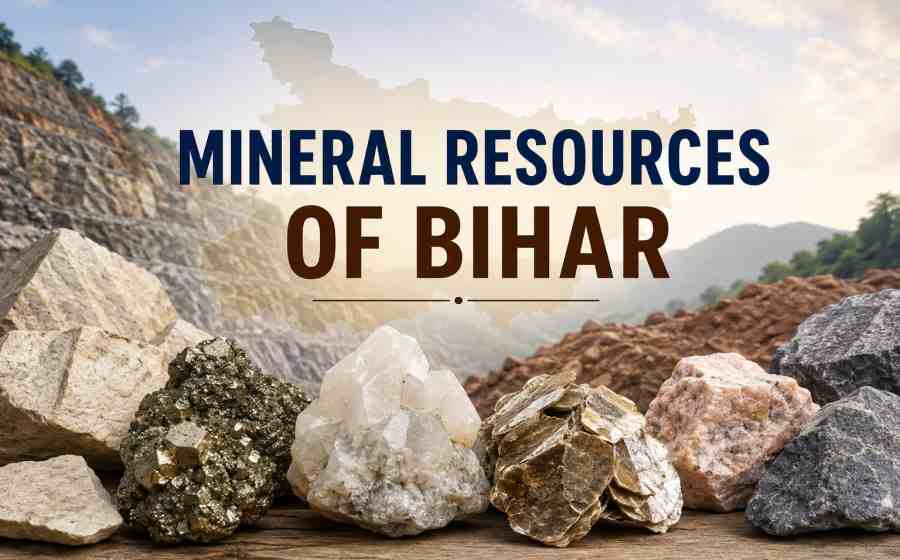
Mineral Resources of Bihar – Major Minerals, Distribution and Economic Importance
Explore the mineral resources of Bihar, including limestone, pyrite, quartz, mica and other minerals, their distribution, uses and economic importance.
Mineral Resources of Bihar
Bihar is primarily known for its fertile plains, rivers, agriculture, and rich historical heritage. However, the state also possesses a variety of mineral resources that contribute to its industrial and economic activities. Although Bihar’s present-day mineral wealth is more limited than that of some mineral-rich neighboring states, minerals such as limestone, pyrite, quartz, mica, and other minor minerals have played an important role in the state’s economic development.
The distribution of minerals in Bihar is closely connected with its geological structure. The southern part of the state, particularly the Kaimur, Rohtas, Aurangabad, Gaya, Jamui and Nawada regions, contains several important mineral deposits. The northern plains, on the other hand, are dominated by alluvial deposits and are better known for agriculture than for metallic mineral resources.
Table of Contents
Major Mineral Resources of Bihar
1. Limestone
Limestone is one of the most important mineral resources found in Bihar. It is widely used as a raw material in cement manufacturing, construction, lime production, and several other industries.
Important limestone-bearing areas are mainly located in Rohtas and Kaimur districts. The Rohtas region has historically been associated with limestone deposits and cement-related industrial activity. The availability of limestone has supported industries that depend on this mineral as a basic raw material.
Because limestone is essential for cement production, its presence has considerable economic significance for the state.
2. Pyrite
Bihar is particularly notable for its deposits of pyrite, a mineral composed mainly of iron and sulfur. Pyrite is often called “fool’s gold” because of its metallic appearance and yellowish color.
The most important pyrite deposits in Bihar are associated with the Amjhor area of Rohtas district. These deposits have attracted attention because pyrite can be used as a source of sulfur and has industrial applications.
The Amjhor pyrite deposit is one of the distinctive mineral resources associated with Bihar and is therefore important from an examination perspective.
3. Quartz
Quartz is another mineral found in Bihar, particularly in parts of the southern districts. It is an important industrial mineral and is used in glass manufacturing, ceramics, construction materials, and various industrial applications.
Quartz-bearing areas occur in districts such as Jamui, Nawada and Gaya. The quality and quantity of deposits can vary from one location to another, but the mineral contributes to Bihar’s overall non-metallic mineral resource base.
4. Mica
Mica has historically been associated with the mineral-bearing regions of southern Bihar. It is a naturally occurring mineral valued for its heat resistance, electrical insulation properties, and ability to split into thin sheets.
Areas around Nawada and nearby parts of southern Bihar have been associated with mica occurrences. Although Bihar is not currently among India’s leading mica-producing regions, mica remains relevant when studying the state’s traditional mineral resources.
5. Feldspar
Feldspar occurs in several mineral-bearing areas of southern Bihar. It is an important industrial mineral and is widely used in the manufacture of ceramics, glass, tiles, and other products.
Its occurrence alongside quartz and other minerals reflects the geological diversity of the southern plateau region of Bihar.
6. Stone and Building Materials
Bihar has substantial resources of stone and other materials used in construction. Kaimur, Rohtas, Gaya, Jamui and nearby areas have various types of stone resources.
Stone is used for roads, buildings, flooring, walls, aggregates, and other construction activities. With increasing infrastructure development, construction minerals have considerable local economic importance.
District-wise Distribution of Mineral Resources
The mineral resources of Bihar are not evenly distributed across the state. Southern Bihar contains a larger share of the state’s important rock and mineral deposits.
Rohtas: Rohtas is one of the most important mineral-bearing districts of Bihar. It is particularly known for limestone and pyrite deposits. Limestone has supported cement-related activities, while the Amjhor area is associated with pyrite.
Kaimur: Kaimur contains limestone and other stone resources. The district’s geological formations make it significant in Bihar’s mineral map.
Gaya: Gaya has occurrences of quartz, feldspar, stone, and other minor minerals. These resources are useful for local construction and industrial purposes.
Nawada: Nawada is associated with quartz, mica, feldspar, and other mineral occurrences. Its location in the southern mineral belt makes it important for Bihar’s geological studies.
Jamui: Jamui is known for various mineral occurrences, including quartz and stone resources. The district has attracted attention because of its geological potential.
Importance of Minerals to Bihar’s Economy
Mineral resources contribute to Bihar’s economy in several ways. Mining and quarrying create employment opportunities, particularly in areas where agriculture is less dominant. Mineral-based industries also generate demand for transportation, construction, equipment, and other supporting services.
Limestone is particularly important because it provides raw material for cement and construction-related industries. Stone and other minor minerals are essential for roads, bridges, houses, and public infrastructure.
Mineral development can also contribute to government revenue through royalties, permits, and other forms of taxation. However, responsible management is necessary to ensure that economic benefits do not come at the expense of environmental sustainability.
Mineral Resources and Environmental Concerns
Mining can provide economic benefits, but uncontrolled extraction may create environmental challenges. Quarrying and mining activities can lead to land degradation, dust pollution, changes in drainage patterns, loss of vegetation, and damage to local ecosystems.
Therefore, mineral extraction in Bihar needs to follow environmental regulations and scientific mining practices. Reclamation of mined land, plantation, proper waste management, water conservation, and monitoring of mining activities can help reduce negative environmental impacts.
Sustainable mining is especially important because Bihar also depends heavily on agriculture, forests, rivers, and groundwater resources. Development should therefore maintain a balance between mineral extraction and environmental protection.
Role of Mineral Resources in Industrial Development
Minerals serve as basic raw materials for many industries. Limestone supports cement manufacturing, while quartz and feldspar have applications in glass and ceramic industries. Stone resources support the rapidly expanding construction sector.
The development of transportation networks and industrial infrastructure can improve the economic value of Bihar’s mineral resources. Better roads, rail connectivity, processing facilities, and modern mining technology can help increase the efficiency of mineral utilization while reducing unnecessary environmental damage.
Summary
Bihar may not be one of India’s largest mineral-producing states today, but its mineral resources remain an important part of its natural wealth and geographical identity. Limestone, pyrite, quartz, mica, feldspar, stone and other minor minerals are among the significant resources associated with the state.
The southern districts, especially Rohtas, Kaimur, Gaya, Nawada and Jamui, form an important part of Bihar’s mineral landscape. These resources support construction, industry, employment, and government revenue.
Also Check: Bihar GK