Slovenia – History, Culture, Sports, Geography, Tourism and Key Facts
Slovenia – Learn about its history, culture, geography, sports, famous places, traditions, economy, national symbols and other important facts.
Slovenia
Slovenia is a small but remarkably diverse country in Central Europe, known for its beautiful Alpine landscapes, historic towns, forests, lakes and rich cultural traditions. Officially called the Republic of Slovenia, the country lies at the crossroads of the Alps, the Mediterranean, the Pannonian Plain and the Dinaric Alps. Despite its relatively small size, Slovenia offers an interesting combination of European history, natural beauty, traditional culture and modern development.
The capital and largest city of Slovenia is Ljubljana. The country is bordered by Austria to the north, Hungary to the northeast, Croatia to the south and southeast, and Italy to the west. Slovenia also has a short Adriatic Sea coastline. Its geographical position has played an important role in shaping its history, culture and economy.
Table of Contents
Historical Background of Slovenia
The history of Slovenia stretches back to ancient times. The region was inhabited by various prehistoric communities before becoming part of the Roman world. Roman influence can still be seen in archaeological remains and historic settlements found across the country.
During the early medieval period, Slavic peoples settled in the region. The territory later became connected with several powerful European political entities, including the Duchy of Carantania, the Habsburg lands and the Austro-Hungarian Empire. For centuries, much of present-day Slovenia was influenced by the Habsburg monarchy.
The development of the Slovenian national identity became especially important during the 19th century. Slovenian language, literature and cultural movements helped strengthen a sense of national unity. Important writers and intellectuals contributed to the preservation and development of Slovenian culture.
After the First World War, Slovenian territories became part of the Kingdom of Serbs, Croats and Slovenes, which was later renamed the Kingdom of Yugoslavia. During the Second World War, Slovenia was occupied and divided among several Axis powers.
After the war, Slovenia became one of the constituent republics of socialist Yugoslavia. The country declared independence from Yugoslavia on 25 June 1991. The subsequent Ten-Day War ended with the withdrawal of Yugoslav forces, and Slovenia began its development as an independent state.
Slovenia joined the European Union and NATO in 2004 and later adopted the euro as its currency in 2007. These developments strengthened its integration into European political and economic institutions.
Geography of Slovenia
Slovenia is geographically diverse for its size. Much of the country is covered by hills, mountains and forests. The Julian Alps are among its most famous natural features, and the country’s highest mountain is Mount Triglav, which rises to 2,864 metres.
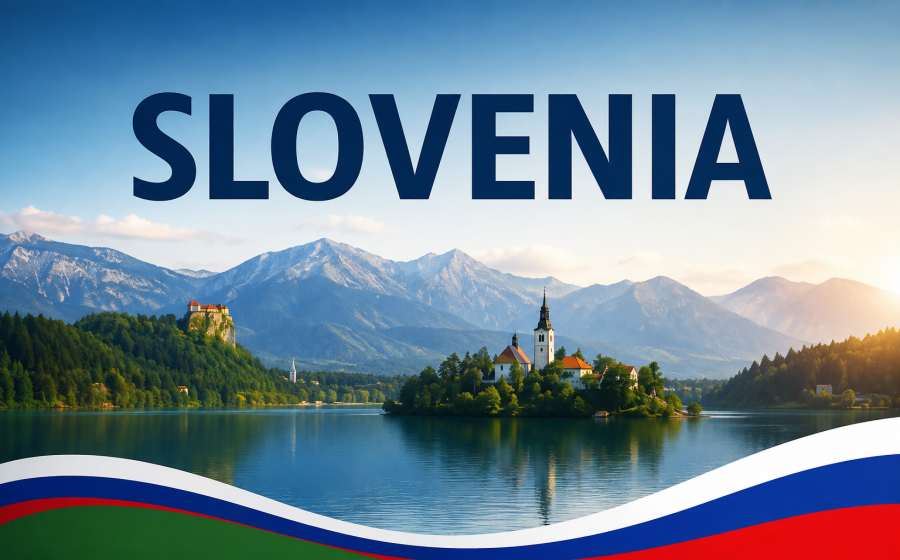
One of Slovenia’s most recognizable natural landmarks is Lake Bled, famous for its picturesque island, church and medieval castle. Another important natural area is Lake Bohinj, located within Triglav National Park.
Slovenia is also famous for its extensive cave systems. The Postojna Cave is one of the country’s best-known tourist attractions, while the Škocjan Caves are internationally recognized for their exceptional underground landscape.
The country has a relatively short coastline along the Adriatic Sea, with coastal towns such as Koper, Piran and Izola contributing to Slovenia’s Mediterranean character.
Culture and Traditions
Slovenian culture reflects influences from Central Europe, the Alps, the Mediterranean and the Balkans. The Slovenian language is the country’s official language and is an important part of national identity.
Traditional Slovenian cuisine includes a wide variety of regional dishes. Popular foods include potica, a traditional rolled pastry, štruklji, a type of filled dumpling, and kranjska klobasa, a well-known Slovenian sausage.
Music and folk traditions are also important. Traditional dances and costumes vary between regions. Slovenia has a strong literary tradition, and the poet France Prešeren is regarded as one of the country’s most important cultural figures. Slovenia celebrates Prešeren Day on 8 February as a national cultural holiday.
Slovenian architecture also reflects the country’s diverse history. Ljubljana combines medieval, Baroque, Art Nouveau and modern architectural styles. The work of architect Jože Plečnik has had a particularly strong influence on the appearance of Ljubljana.
Sports in Slovenia
Sports play an important role in Slovenian society, and the country has produced internationally successful athletes despite its small population.
Ski jumping is one of Slovenia’s most popular winter sports. The country has a strong tradition in the sport and hosts major competitions. Slovenia is also highly respected in alpine skiing, snowboarding and other winter disciplines.
Cycling has become particularly prominent in recent years. Slovenian cyclists such as Tadej Pogačar and Primož Roglič have achieved major success in international road racing. Their performances have helped make cycling one of the country’s most popular sports.
Basketball is another important sport. Slovenia won the EuroBasket championship in 2017, marking one of the greatest achievements in the country’s basketball history. Football, handball, volleyball, rowing and athletics are also widely followed.
Slovenia has participated successfully in the Olympic Games and has won medals in several different sports.
Economy of Slovenia
Slovenia has a developed and export-oriented economy. Important sectors include manufacturing, pharmaceuticals, automotive-related industries, information technology, tourism, logistics and services.
Its location between Central and Southeastern Europe gives Slovenia an important position for trade and transportation. The Port of Koper provides access to the Adriatic Sea and serves as an important gateway for Central European markets.
Tourism is another major contributor to the economy. Visitors are attracted by Slovenia’s mountains, lakes, caves, historic cities, thermal spas and coastline.
Famous Places in Slovenia
Slovenia has numerous attractions worth knowing for general knowledge and travel-related awareness. Some of the most notable include:
- Ljubljana Castle – A historic landmark overlooking the capital.
- Lake Bled – One of Slovenia’s most recognizable natural attractions.
- Lake Bohinj – A scenic Alpine lake surrounded by mountains.
- Triglav National Park – Slovenia’s only national park.
- Postojna Cave – A spectacular cave system and major tourist attraction.
- Škocjan Caves – Famous for their enormous underground canyon.
- Piran – A historic coastal town with Venetian architectural influences.
- Predjama Castle – A dramatic castle built into a cave-covered cliff.
National Symbols and Key Facts
Slovenia’s national flag consists of white, blue and red horizontal bands with the country’s coat of arms near the hoist. The coat of arms contains Mount Triglav, the Adriatic Sea and stars associated with Slovenia’s historical heritage.
The country’s currency is the euro (€). Slovenia is a member of the European Union, NATO, the United Nations and several other international organizations.
Capital: Ljubljana
Official Name: Republic of Slovenia
Official Language: Slovenian
Currency: Euro (€)
Independence: 25 June 1991
Highest Mountain: Mount Triglav
Largest City: Ljubljana
Continent: Europe
Coastline: Adriatic Sea
National Anthem: Zdravljica
National Park: Triglav National Park
Summary
Slovenia is a fascinating European country where natural beauty, historical heritage and modern development come together. From the Alpine peaks of Mount Triglav and the peaceful waters of Lake Bled to the historic streets of Ljubljana and the country’s strong sporting tradition, Slovenia offers many important facts for general knowledge. Its journey from the Habsburg era through Yugoslavia to independence in 1991 has shaped a distinctive national identity. Today, Slovenia stands as a modern European nation recognized for its culture, environmental landscapes, tourism, successful athletes and high quality of life.
Also Check: General Knowledge