
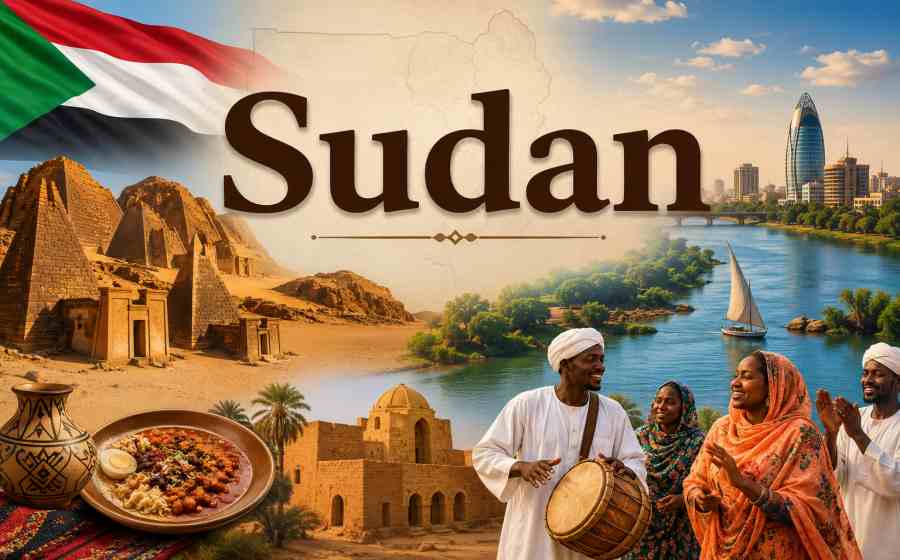
Sudan – History, Culture, Sports, Geography and Fascinating Facts
Explore Sudan’s history, culture, sports, geography, economy and key facts. Learn about one of Africa’s largest and most historically significant nations.
Sudan
Sudan is a fascinating country located in northeastern Africa. Known for its ancient civilizations, rich cultural heritage, vast deserts, and the mighty Nile River, Sudan has played an important role in African history for thousands of years. Despite facing political and economic challenges in recent decades, Sudan remains a nation with a unique identity and remarkable historical significance.
Table of Contents
Introduction to Sudan
Sudan is situated in northeastern Africa and shares borders with Egypt, Libya, Chad, the Central African Republic, South Sudan, Ethiopia, and Eritrea. It also has a coastline along the Red Sea. The country’s strategic location has made it an important center for trade and cultural exchange throughout history.
The capital city of Sudan is Khartoum, which lies at the meeting point of the Blue Nile and White Nile rivers. Arabic is the official language, and Islam is the dominant religion. The Sudanese pound is the national currency.
History of Sudan
Sudan has one of the oldest histories in Africa. The region was home to the ancient Kingdom of Kush, which flourished along the Nile River. The Kushite civilization was known for its pyramids, powerful rulers, and advanced culture. At one point, Kushite kings even ruled ancient Egypt during the 25th Dynasty.
Throughout the centuries, Sudan became a crossroads for trade routes connecting Africa, the Middle East, and the Mediterranean world. Arab influence increased after the spread of Islam in the region during the medieval period.
In the nineteenth century, Sudan came under Egyptian and later British control. The country eventually gained independence on January 1, 1956. Since independence, Sudan has experienced periods of political instability, civil conflict, and economic challenges. In 2011, South Sudan became an independent nation after a referendum, significantly changing Sudan’s geographical and political landscape.
Geography and Climate
Sudan is one of the largest countries in Africa by land area. Its geography is diverse and includes deserts, savannas, mountains, and fertile river valleys.
The Sahara Desert covers much of northern Sudan, while central and southern regions feature grasslands and agricultural areas. The Nile River, one of the world’s longest rivers, is the country’s most important natural feature. It provides water for farming, transportation, and daily life.
Sudan experiences a predominantly hot and dry climate. Northern regions are extremely arid, while southern areas receive more rainfall and support agriculture.
Culture of Sudan
Sudanese culture reflects a blend of African, Arab, and Islamic traditions. The country is home to numerous ethnic groups, each contributing to its rich cultural diversity.
Traditional music often features drums, string instruments, and rhythmic dances. Music plays an important role during weddings, festivals, and social gatherings. Sudanese folk songs frequently celebrate family, community, and historical events.
Traditional clothing is also an important aspect of Sudanese culture. Men often wear a long white robe called a “jalabiya,” while women commonly wear colorful garments known as “tobes.”
Hospitality is highly valued in Sudanese society. Guests are often welcomed warmly and offered food, tea, or coffee as a sign of respect and friendship.
Sudanese Cuisine
Sudanese cuisine is influenced by African and Middle Eastern culinary traditions. Meals are often simple, nutritious, and prepared using locally available ingredients.
Some popular Sudanese foods include:
- Kisra – A thin fermented bread made from sorghum.
- Ful Medames – Cooked fava beans seasoned with spices.
- Asida – A porridge-like dish served with sauces.
- Tamia – Sudanese-style falafel.
- Grilled meats – Commonly enjoyed during celebrations and family gatherings.
Tea and coffee are popular beverages, and sharing them is an important social tradition.
Sports in Sudan
Sports play an important role in Sudanese society, with football (soccer) being the most popular sport. Football matches attract large crowds and passionate supporters across the country.
The Sudan national football team has participated in numerous international competitions and was one of the founding members of African football organizations. Sudan also hosted and won the African Cup of Nations in 1970, marking one of the greatest achievements in the country’s sporting history.
Apart from football, athletics, basketball, wrestling, and martial arts are gaining popularity among young people. Schools and community organizations often encourage sports participation to promote fitness and teamwork.
Economy of Sudan
Sudan’s economy is based primarily on agriculture, livestock, mining, and natural resources. Agriculture employs a large portion of the population and contributes significantly to national income.
Major agricultural products include:
- Sorghum
- Millet
- Wheat
- Cotton
- Sesame
- Groundnuts
Sudan also possesses significant mineral resources, including gold, which has become an important export commodity. Livestock farming remains another major sector of the economy.
Economic development has faced challenges due to political instability, infrastructure limitations, and regional conflicts. However, agriculture and natural resources continue to offer opportunities for future growth.
Education and Society
Education is highly valued in Sudan, and the government has worked to expand educational opportunities across the country. Universities in Khartoum and other cities attract students from different regions.
Family and community relationships are central to Sudanese society. Respect for elders, strong family bonds, and religious values play important roles in everyday life.
Interesting Facts About Sudan
- Sudan is home to more pyramids than Egypt, thanks to the ancient Kingdom of Kush.
- The Blue Nile and White Nile meet in Khartoum.
- Sudan has a coastline along the Red Sea.
- The country contains vast desert landscapes as well as fertile agricultural regions.
- Gold mining is one of Sudan’s major industries.
- Sudan won the African Cup of Nations in 1970.
- The country has hundreds of ethnic groups and diverse cultural traditions.
- Ancient Nubian civilizations flourished in Sudan thousands of years ago.
- Hospitality is considered a key cultural value.
- The Nile River remains essential to Sudan’s agriculture and daily life.
Summary
Sudan is a nation with a rich historical legacy, diverse cultural traditions, and remarkable geographical features. From the ancient Kingdom of Kush and its pyramids to the life-giving waters of the Nile River, Sudan offers a unique blend of history and heritage. Despite modern challenges, the country continues to preserve its cultural identity while striving for progress and development. Understanding Sudan provides valuable insight into one of Africa’s most historically important and culturally diverse nations.
Also Check: General Knowledge