Bihar – History, Geography, Culture and Important Facts
Discover Bihar’s history, geography, culture, economy and important facts. Learn how Bihar shaped India’s civilization and heritage.
Bihar
Bihar is one of the most historically significant states in India. Located in the eastern part of the country, Bihar is known for its rich cultural heritage, ancient universities, religious importance, and contribution to Indian civilization. The state has played a vital role in shaping the history, politics, and intellectual traditions of India for thousands of years.
From the rise of powerful empires to the spread of Buddhism and Jainism, Bihar has been at the center of many important events in Indian history. Today, it is a rapidly developing state with a large population, fertile agricultural land, and a unique cultural identity.
Table of Contents
Historical Background of Bihar
The history of Bihar dates back to ancient times. The name “Bihar” is believed to have originated from the Sanskrit word “Vihara,” meaning monastery, as the region was home to numerous Buddhist monasteries.
In ancient India, Bihar was part of the powerful kingdom of Magadha, which became one of the most influential kingdoms in the country. Several great dynasties, including the Maurya Empire and the Gupta Empire, ruled from this region.
The famous ruler Chandragupta Maurya established the Mauryan Empire in the 4th century BCE, while Emperor Ashoka later expanded it and promoted Buddhism across Asia. Bihar also witnessed the golden age of Indian culture and learning during the Gupta period.
The state is closely associated with two major religions:
- Buddhism: Gautama Buddha attained enlightenment at Bodh Gaya.
- Jainism: Lord Mahavira, the 24th Tirthankara, was born and attained enlightenment in Bihar.
During the medieval period, Bihar came under the rule of various dynasties and later became part of the Mughal Empire. Under British rule, Bihar was part of the Bengal Presidency before becoming a separate province in 1912. On 15 November 2000, the southern part of Bihar was carved out to form the state of Jharkhand.
Geography of Bihar
Bihar is situated in eastern India and covers an area of approximately 94,163 square kilometers. It shares borders with:
- Nepal in the north
- Uttar Pradesh in the west
- West Bengal in the east
- Jharkhand in the south
The state is primarily located in the fertile Indo-Gangetic Plain, making it one of India’s major agricultural regions.
Major Rivers
Bihar is blessed with several important rivers, including:
- Ganga
- Kosi
- Gandak
- Son
- Bagmati
- Punpun
The Ganga River flows through the center of the state and plays a crucial role in agriculture, transportation, and daily life.
Climate
Bihar experiences a subtropical climate with three main seasons:
- Summer (March to June)
- Monsoon (June to September)
- Winter (November to February)
The monsoon season brings significant rainfall, which supports agriculture but sometimes causes floods, especially in northern districts.
Capital and Administrative Structure
The capital city of Bihar is Patna, one of the oldest continuously inhabited cities in the world. Patna serves as the political, educational, and economic center of the state.
Bihar is divided into multiple districts and administrative divisions for efficient governance. The state follows a parliamentary system with a Governor as the constitutional head and a Chief Minister as the executive head.
Culture and Traditions
Bihar has a vibrant cultural heritage that reflects centuries of historical influence.
Languages
The official language of Bihar is Hindi. Other widely spoken languages include:
- Bhojpuri
- Maithili
- Magahi
- Angika
- Urdu
Maithili is recognized in the Eighth Schedule of the Indian Constitution.
Festivals
People in Bihar celebrate many festivals with great enthusiasm. Some important festivals are:
- Chhath Puja
- Diwali
- Holi
- Durga Puja
- Eid
- Makar Sankranti
Among these, Chhath Puja is the most famous and is considered the cultural identity of Bihar.
Folk Art and Music
Bihar is known for its traditional art forms such as:
- Madhubani Painting
- Manjusha Art
- Tikuli Art
Folk music and dance remain an important part of rural life and cultural celebrations.
Economy of Bihar
Agriculture is the backbone of Bihar’s economy. The fertile plains and river systems support the cultivation of various crops.
Major Crops
- Rice
- Wheat
- Maize
- Sugarcane
- Pulses
- Vegetables
In recent years, Bihar has also focused on industrial development, infrastructure projects, education, and tourism to strengthen its economy.
Education and Learning Heritage
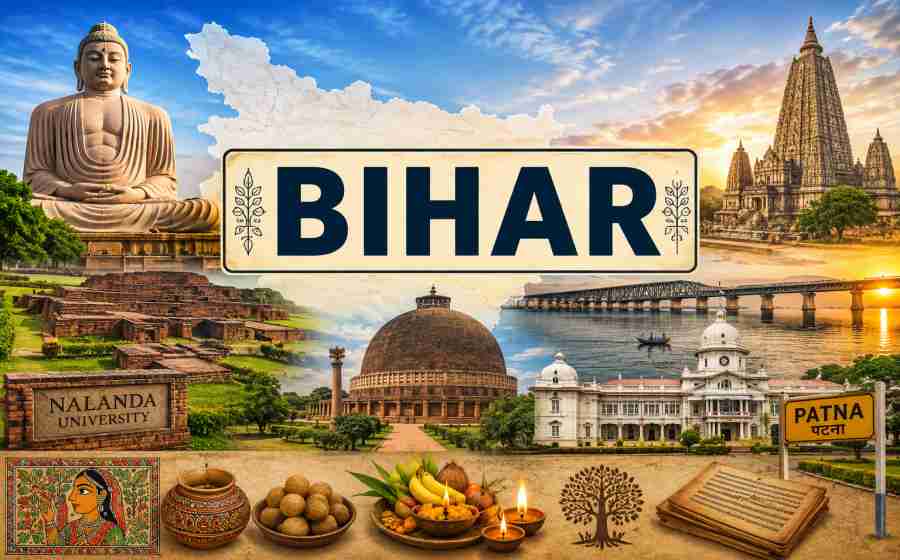
Bihar has a glorious educational history. The ancient universities of Nalanda and Vikramshila attracted students from different parts of Asia.
Nalanda University
Nalanda was one of the world’s earliest residential universities and a major center of learning between the 5th and 12th centuries. Scholars studied subjects such as philosophy, astronomy, medicine, mathematics, and literature.
Today, Bihar continues to expand educational opportunities through universities, colleges, and technical institutions.
Tourism in Bihar
Bihar is a major destination for religious, historical, and cultural tourism.
Some famous tourist attractions include:
- Bodh Gaya
- Nalanda Ruins
- Rajgir
- Vaishali
- Patna Sahib
- Vikramshila Ruins
- Kesaria Stupa
Pilgrims and tourists from around the world visit these sites every year.
Important Facts About Bihar
- Bihar was the center of the ancient Magadha Empire.
- Gautama Buddha attained enlightenment at Bodh Gaya.
- Lord Mahavira was closely associated with Bihar.
- Nalanda University was one of the world’s first universities.
- Patna is among the oldest continuously inhabited cities in the world.
- Chhath Puja is the most significant festival of Bihar.
- The Ganga River flows through the heart of the state.
- Bihar is one of India’s leading agricultural states.
- Maithili is one of the constitutionally recognized languages of India.
- The state shares an international border with Nepal.
Summary
Bihar is a land of ancient wisdom, cultural richness, and historical significance. From the mighty Magadha Empire and the teachings of Buddha and Mahavira to the world-famous Nalanda University, Bihar has contributed immensely to India’s heritage. Its fertile plains, vibrant traditions, religious landmarks, and growing economy make it an important state in modern India. Understanding Bihar’s history, geography, and key facts helps us appreciate its unique role in shaping the nation’s past and future.
Also Check: Bihar GK